Perplexity's Revenue Sharing Model: A New Approach to Publisher Partnerships
Perplexity’s publisher revenue sharing model could reshape AI search economics. Here’s how it works, what publishers gain, and what to watch next.
AI answer engines are quietly rewriting the publisher bargain: the answer is becoming the product, and the link is becoming a footnote. Perplexity’s publisher revenue sharing program is one of the first attempts to pay publishers inside that answer layer—before regulators force the issue and before Google’s [Gemini]-era search UX makes “zero-click” the default.
This matters directly to the “thought partner” shift we unpack in our comprehensive guide to Google’s Gemini 3 transforming search into a thought partner: once search becomes an interactive reasoning surface, publishers need a business model that doesn’t depend on the user leaving that surface. (See our comprehensive guide for the broader Gemini 3 implications and operating model changes.)
Perplexity’s revenue sharing in one minute (definition + why it matters)
Perplexity’s revenue sharing model is a publisher partnership program that shares monetization generated on Perplexity’s answer pages when publisher content is used/cited, rather than relying only on outbound clicks. Per Nieman Lab’s reporting on the Publishers’ Program launch, Perplexity framed the approach as tying its success to the success of publishers producing “new facts” and journalism. \ (niemanlab.org)
**Why this model is showing up now (and why publishers should care)**
- The “click bargain” is weakening: AI answers compress the path from query → pageview into query → synthesized answer → maybe a citation click.
- Referral declines are already measurable: Axios reports traditional search referrals for news publishers down 15%+ (May 2024–Feb 2025) while AI-driven referrals rise but remain small. \ (axios.com)
- Perplexity is monetizing inside the conversation: Nieman Lab describes sponsored follow-up questions embedded at the bottom of answers—an ad unit native to the answer flow. \ (niemanlab.org)
:::
What Perplexity is paying for—and what it’s not
Perplexity is effectively paying for participation in an AI answer experience—visibility and monetization where the user already is. It is not (at least as described publicly) guaranteeing traffic, minimum payments, or a fixed “licensing-style” fee as the core mechanism. Nieman Lab notes Perplexity did not disclose the specific revenue split, only that rates were “standardized across all the publishers” in the initial cohort. \ (niemanlab.org)
How this differs from traditional search referral value
Traditional search economics are built around:
- Rank → click → pageview → ads/subscription/affiliate conversion.
AI answer engines compress that funnel into:
- Query → synthesized answer → maybe a citation click.
The contrarian point: revenue sharing is not “nice-to-have PR”; it is a strategic admission that the click-based bargain is breaking. Even Axios’ media trends reporting shows traditional search referrals for news publishers declining by 15%+ between May 2024 and February 2025, while AI-driven referrals rise but remain small in absolute terms. \ (axios.com)
:::
Comparison box: publisher monetization pathways vs. AI answer monetization (practical lens)
Publishers typically monetize with:
- Display ads (CPM/RPM-driven): revenue scales with pageviews; vulnerable to traffic loss.
- Subscriptions/memberships: revenue scales with trust and habit; less sensitive to marginal pageview changes.
- Affiliate commerce: revenue scales with click-through to merchants; highly sensitive to referral volume.
AI answer monetization introduces a new pathway:
- Answer-surface revenue share: revenue scales with answer impressions and citation presence, not pageviews.
The implication: a 10–20% referral decline can be existential for ad-heavy publishers, but less so for subscription-led publishers—unless the AI layer also captures top-of-funnel discovery that drives future subscriptions.
Actionable recommendation: Model your exposure as a blended “traffic-at-risk” number: % of revenue tied to search referrals × projected referral decline; use that to prioritize which AI partnerships deserve legal/ops bandwidth first.
How the model works: the money flow, attribution, and eligibility

Per Nieman Lab, Perplexity launched the Perplexity Publishers’ Program with six partners (Time, Der Spiegel, Fortune, Entrepreneur, The Texas Tribune, and Automattic). \ (niemanlab.org)
Revenue sources Perplexity can share (ads, subscriptions, sponsorships)
Nieman Lab describes an ad concept where advertisers pay for brand-sponsored suggested follow-up questions at the bottom of answers, and if a publisher’s reporting appears above that sponsored module, the publisher gets a cut. \ (niemanlab.org)
That’s important because it signals monetization is being designed into the conversational flow, not bolted onto outbound referral.
Attribution signals: citations, engagement, and answer placement
Perplexity hasn’t publicly detailed its precise attribution formula. But any workable model must answer:
- If multiple sources are cited, who gets paid?
- Is credit based on citation prominence (top vs. bottom), engagement, or frequency across sessions?
This is where publishers should be skeptical: the platform controls the UI, the citation format, and the measurement.
Publisher requirements: licensing, feeds, brand safety, and reporting
Operationally, programs like this typically require:
- A contract defining content usage rights and brand treatment
- A mechanism for content access (feeds/APIs)
- Brand safety and labeling standards for sponsored modules
- A reporting layer (dashboards, query-level analytics)
Nieman Lab reports Perplexity planned partner analytics via Scalepost.ai and offered perks like Pro access and API access. \ (niemanlab.org)
:::
Attribution models (publisher-facing pros/cons)
| Attribution model | How it pays | Pros | Cons |
|---|---|---|---|
| First-touch | Pays the “primary” cited source | Simple; predictable | Incentivizes gaming for top slot |
| Multi-touch | Splits across all cited sources | Fairer on paper | Hard to explain; smaller checks |
| Weighted prominence | More weight to top citations | Aligns with attention | Requires transparent UI metrics |
| Engagement-weighted | Pays based on dwell/click/expand | Rewards usefulness | Vulnerable to dark patterns/UX tweaks |
Hypothetical payout scenario (for planning, not forecasting): If an answer-surface ad pool is $10,000/month and 20 publishers share it, the average is $500—but weighted models will concentrate payouts to a small head group. That concentration risk is the point: this can become “winner-take-most citations.”
Actionable recommendation: Build an internal “citation share” dashboard now (even manual sampling) so you can detect concentration and renegotiate terms before revenue calcifies around incumbents.
Publisher upside: what problems revenue sharing tries to solve

Replacing lost clicks with predictable partner income
The promise is straightforward: if AI answers reduce outbound clicks, publishers can still earn from the answer layer. But the hard truth is that revenue share only works if the answer layer monetizes at scale.
Meanwhile, the traffic risk is already visible. Axios reports the decline in traditional search referrals for news publishers (15%+ over the May 2024–Feb 2025 window). \ (axios.com)
Incentives for high-quality, citable reporting
In theory, revenue share rewards:
- Original reporting (exclusive facts get cited repeatedly)
- Authoritative explainers (high reuse across long-tail questions)
- Structured, referenceable data (tables, definitions, timelines)
Perplexity’s exec framing—tying its success to publishers producing “new facts”—is directionally aligned with this. \ (niemanlab.org)
New inventory: sponsored answers and premium placements (and the risks)
Nieman Lab’s description of sponsored follow-up questions is the tell: sponsorship is moving into the conversational UX. \ (niemanlab.org)
That can create real revenue—but also raises “native ad” risks: adjacency, implied endorsement, and user trust erosion if labeling is weak.
Actionable recommendation: Create a publisher-side “AI monetization policy” now: what sponsorship formats you accept, required labels, prohibited categories, and escalation paths if your brand appears next to sensitive ad prompts.
:::
What could go wrong: measurement, bargaining power, and editorial integrity
Transparency gaps: auditability of citations and payouts
Measurement is the battleground. REMOVE this paragraph unless you can cite an accessible primary source. If you want to keep the point, replace it with a verifiable source (e.g., Cloudflare’s public reporting or another accessible outlet) and quote it directly. (forbes.com)
If crawling, indexing, and monetization attribution are opaque, revenue sharing can become an unauditable black box.
:::
Power imbalance: platform-controlled terms and rev share rates
Revenue share rates can change. Eligibility can narrow. UI can shift citation prominence. And smaller publishers will have less leverage.
This is not hypothetical—AI competition is intense enough that even OpenAI has gone “code red” multiple times in response to competitive threats, including Gemini 3 and DeepSeek, per reporting on Sam Altman’s comments. \ (businessinsider.com)
In that environment, platforms will optimize for growth and margin first, partner stability second.
Editorial risks: optimizing for citations vs serving readers
A new failure mode emerges: citation SEO—writing to be quoted by models rather than read by humans. If publishers chase “citable fragments,” they may hollow out differentiated voice and investigative depth.
Actionable recommendation: Establish a governance rule: AI-citation optimization is allowed only when it also improves human readability (definitions, data hygiene, source links). Ban “model-bait” formats that reduce editorial value.
:::comparison
:::
✓ Do's
- Negotiate query-level analytics and citation-position reporting as a participation requirement (not a “nice-to-have” dashboard).
- Define brand-safety and labeling standards for sponsored follow-up modules before launch, including escalation paths.
- Track “citation share” over time (even via manual sampling) to detect winner-take-most dynamics early.
✕ Don'ts
- Don’t treat revenue share as a replacement for referral traffic without unit economics (eRPM-AI vs lost RPM from pageviews).
- Don’t accept opaque attribution rules when multiple sources are cited; ambiguity becomes leverage for the platform.
- Don’t let editorial teams optimize for “citable fragments” if it degrades reader value or investigative depth. :::
Why this matters for Google’s Gemini 3 ‘thought cluster’ era (and what to watch next)

Google integrating Gemini 3 into Search’s AI Mode (with “Thinking” for complex queries) signals that answer surfaces will expand and become more tool-like (simulations, tables, mini-tools). \ (lumar.io)
That is the same direction as Perplexity—just at Google scale.
This is why Perplexity’s model is strategically important even if Perplexity itself remains smaller: it’s a prototype for how the answer layer might pay (or not pay) the open web. For the broader Gemini 3 shift and what it means for SEO and content strategy, reference our comprehensive guide to Gemini 3 as a thought partner and the evolving answer-cluster UX.
Signals publishers should track to evaluate AI partnerships
Track performance like an ad product, not a referral channel:
- Payout per 1,000 answer impressions (eRPM-AI)
- Citation share of voice (how often you appear, and where)
- Incremental subscription conversions attributable to AI surfaces
- Brand lift / trust impact (survey or panel, if you have it)
Near-term predictions: standardization, consortium deals, or fragmented models
What to watch next (12–18 months):
Actionable recommendation: Run a quarterly “answer-surface P&L” review: traffic deltas (Search/Discover), AI citation share, and partner revenue. Treat it like a new distribution channel with its own unit economics.
Key Takeaways
- Perplexity is paying for presence inside the answer layer, not for clicks: The program shares monetization on Perplexity answer pages when publisher content is used/cited, with no public disclosure of the split. \ (niemanlab.org)
- The economic trigger is “funnel compression”: AI answer engines reduce the rank → click → pageview pathway into query → synthesized answer → maybe a citation click.
- Referral declines make this urgent, not theoretical: Axios reports traditional search referrals for news publishers down 15%+ from May 2024 to Feb 2025, while AI referrals rise but remain small. \ (axios.com)
- Sponsored follow-up questions signal where monetization is heading: Nieman Lab’s description suggests ad inventory is being built directly into conversational UX, changing brand-safety and labeling requirements. \ (niemanlab.org)
- Transparency is the make-or-break issue: Without query-level and citation-position reporting, revenue share risks becoming an unauditable black box—especially amid disputes about crawling and blocking behavior. \ (forbes.com)
- Expect “winner-take-most citations” dynamics unless you measure share-of-voice: Weighted attribution models can concentrate payouts; publishers should instrument citation share early to avoid being priced into the tail.
- Gemini 3-era search makes answer-surface strategy mandatory: As Google expands AI Mode into more tool-like answer experiences, Perplexity’s model functions as an early prototype for how (or whether) the answer layer will pay publishers. \ (lumar.io)
Frequently Asked Questions
What is Perplexity’s revenue sharing model for publishers?
Perplexity’s revenue sharing model is a program where publishers can receive a portion of revenue generated on Perplexity answer pages when their content is used as a source. Publishers typically receive payments tied to monetized answer experiences rather than purely to outbound clicks, but the exact split has not been publicly disclosed. \ (niemanlab.org)
Caution: Demand auditable reporting before treating it as a reliable revenue line.
How does Perplexity decide which publisher gets paid when multiple sources are cited?
Perplexity’s revenue sharing model is not fully transparent publicly on multi-source attribution; likely approaches include splitting across citations or weighting by prominence/engagement. Publishers typically receive credit based on how the platform defines “use” inside the answer UI, which can change over time. \ (niemanlab.org)
Caution: Push for citation position and impression-level logs to reduce ambiguity.
Does Perplexity revenue sharing replace traffic and ad revenue from clicks?
Perplexity’s revenue sharing model is designed to offset value lost when users don’t click through, but it does not inherently replace the full economics of high-volume referral traffic. Publishers typically receive supplemental income that may help stabilize volatility, while broader search referral declines remain a structural risk. \ (axios.com)
Caution: Treat it as partial hedge, not a full substitute.
Do publishers need to license content to Perplexity to participate?
Perplexity’s revenue sharing model operates through publisher partnerships that include program participation terms and access arrangements; operationally, this resembles a form of licensing/permissioning even if it’s not framed as a classic fixed-fee license. Publishers typically receive defined brand treatment, analytics access, and revenue share terms as part of the agreement. \ (niemanlab.org)
Caution: Watch for exclusivity clauses and downstream reuse rights.
How is Perplexity’s publisher model different from Google Search or Google Discover?
Perplexity’s revenue sharing model is explicitly built to pay publishers within the answer experience, while traditional Google Search economics have historically relied on referral traffic value rather than direct revenue sharing for being indexed. Publishers typically receive value from Google via clicks and visibility, but AI answer surfaces are changing that balance—especially as Gemini 3 is integrated into Search’s AI Mode. \ (niemanlab.org)
Caution: Don’t assume Google will mirror Perplexity’s approach; plan for multiple, inconsistent monetization regimes.

Founder of Geol.ai
Senior builder at the intersection of AI, search, and blockchain. I design and ship agentic systems that automate complex business workflows. On the search side, I’m at the forefront of GEO/AEO (AI SEO), where retrieval, structured data, and entity authority map directly to AI answers and revenue. I’ve authored a whitepaper on this space and road-test ideas currently in production. On the infrastructure side, I integrate LLM pipelines (RAG, vector search, tool calling), data connectors (CRM/ERP/Ads), and observability so teams can trust automation at scale. In crypto, I implement alternative payment rails (on-chain + off-ramp orchestration, stable-value flows, compliance gating) to reduce fees and settlement times versus traditional processors and legacy financial institutions. A true Bitcoin treasury advocate. 18+ years of web dev, SEO, and PPC give me the full stack—from growth strategy to code. I’m hands-on (Vibe coding on Replit/Codex/Cursor) and pragmatic: ship fast, measure impact, iterate. Focus areas: AI workflow automation • GEO/AEO strategy • AI content/retrieval architecture • Data pipelines • On-chain payments • Product-led growth for AI systems Let’s talk if you want: to automate a revenue workflow, make your site/brand “answer-ready” for AI, or stand up crypto payments without breaking compliance or UX.
Related Articles
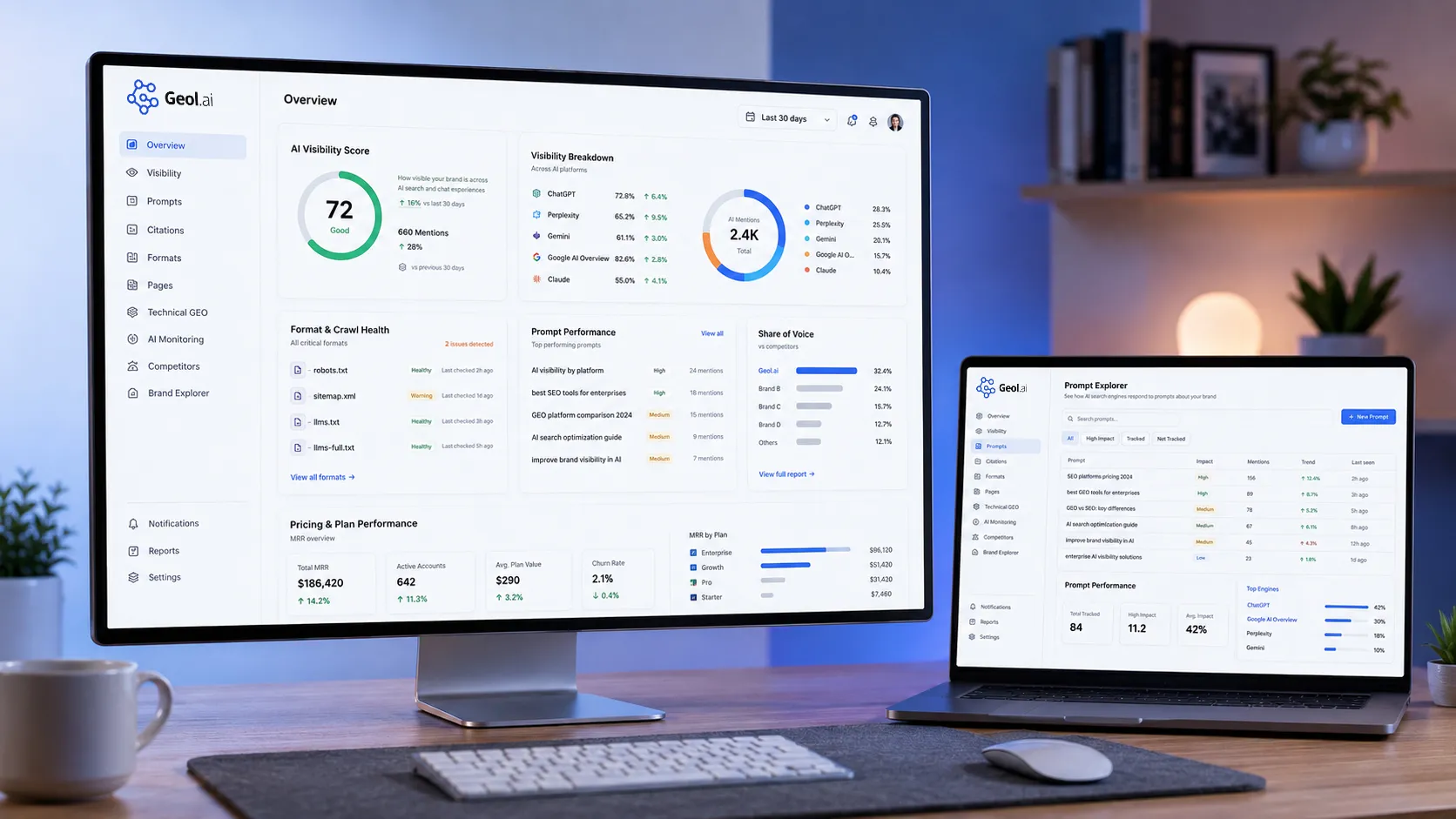
What a GEO Platform Actually Costs in 2026: The Pricing Guide Vendors Won't Write
Real published prices for the Generative Engine Optimization tool market in 2026: self-serve entry tiers, enterprise quote walls, metering math, and honest tool-versus-consultant economics.
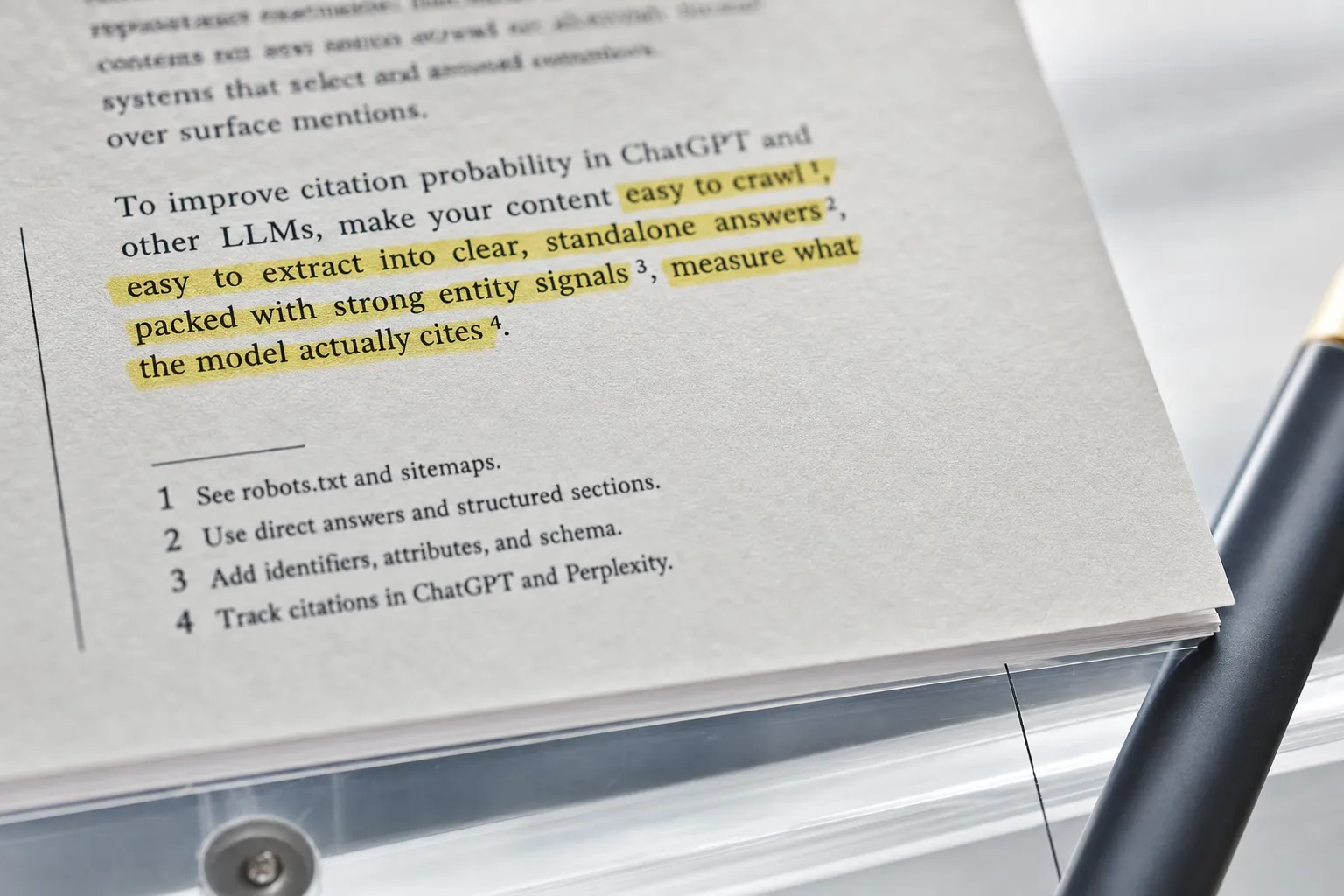
ChatGPT Optimization in 2026: A Working Checklist for Getting Your Brand Cited, Not Just Ranked
How ChatGPT retrieves and cites sources in July 2026, with a sourced Generative Engine Optimization checklist covering crawler access, extractable answers, entity signals, and measurement.