The Battle for AI Search Supremacy: OpenAI's SearchGPT vs. Google's AI Overviews (Through the Lens of Citation Confidence)
Compare SearchGPT vs Google AI Overviews for Citation Confidence: how often they cite sources, why it matters for AI training content, and what to optimize.
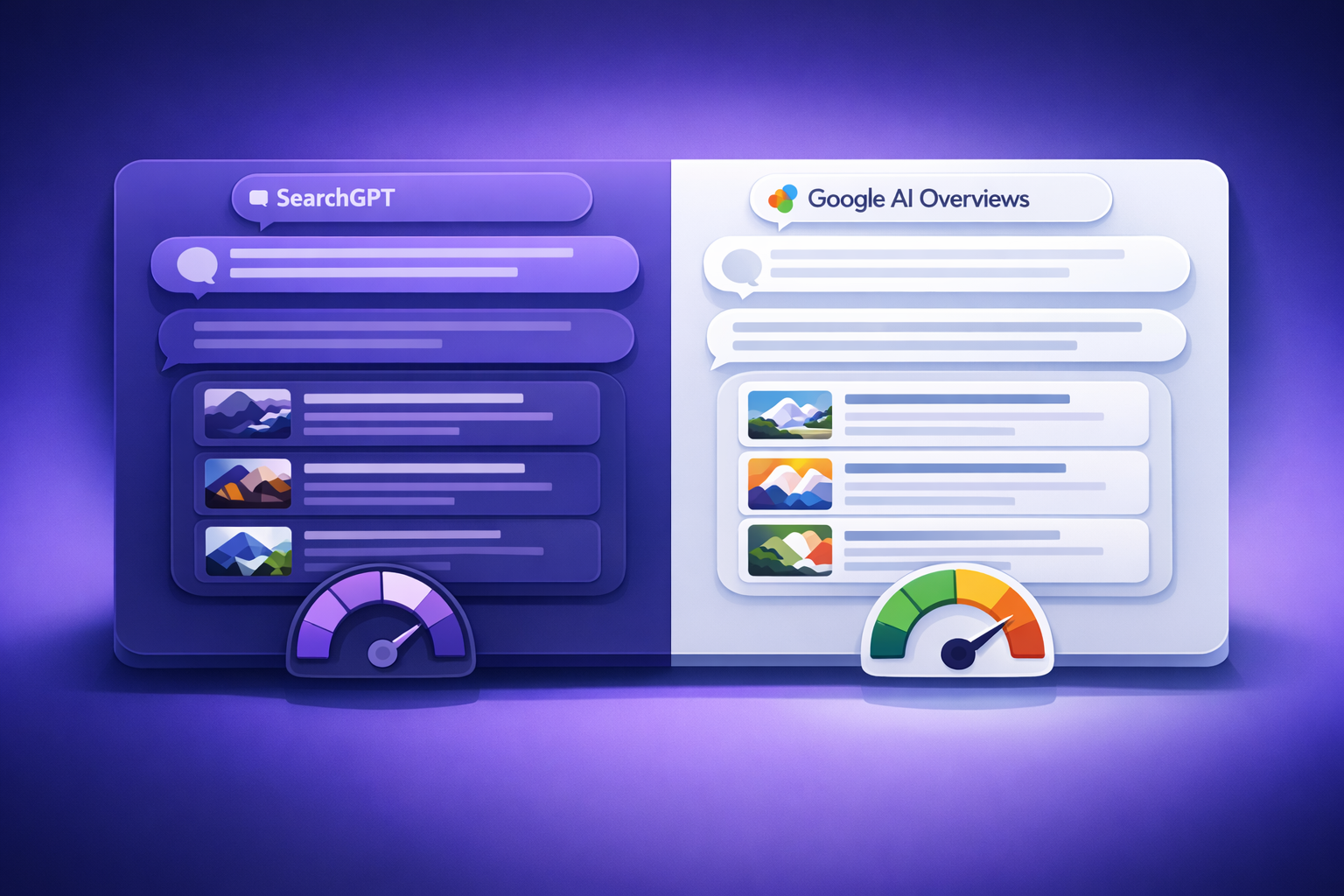
The Battle for AI Search Supremacy: OpenAI's SearchGPT vs. Google's AI Overviews (Through the Lens of Citation Confidence)
AI search is quickly shifting from “ten blue links” to answer-first experiences. For content teams publishing AI training topics (methods, benchmarks, safety, compliance, implementation guides), the question is no longer only “Do we rank?”—it’s “Will the answer engine cite us?” This article compares OpenAI’s SearchGPT and Google’s AI Overviews using one decision metric: Citation Confidence—the measurable likelihood that an AI answer engine will cite a specific page for relevant queries. We’ll define the metric, show how to measure it, and translate the differences between the two systems into an actionable optimization checklist.
SearchGPT and AI Overviews are evolving quickly and can behave differently by geography, query class, and UI experiment. The goal here is a repeatable measurement lens—Citation Confidence—so you can track changes over time and tie content improvements to observed citation outcomes.
Citation Confidence: The Metric That Decides Who Wins AI Search Visibility
Featured snippet definition: What is Citation Confidence?
Definition
Citation Confidence is the measurable probability that an AI answer engine (e.g., SearchGPT or Google AI Overviews) will cite a specific URL as a source when responding to a defined set of queries.
You may also hear similar terms like AI Citation Score or Citation Likelihood, but we’ll use “Citation Confidence” as the canonical term. Practically, it answers: for the queries you care about, how often does the engine visibly attribute your page—and how precisely does it attribute it (deep link vs. general domain)?
Why Citation Confidence matters specifically for AI training content (E-E-A-T context)
AI training topics often include high-stakes claims: evaluation methodology, dataset provenance, safety mitigations, and compliance boundaries. In these areas, engines are incentivized to anchor answers to sources that look trustworthy and verifiable. That’s where E-E-A-T (Experience, Expertise, Authoritativeness, Trustworthiness) becomes operational: not as a vague quality concept, but as a set of signals that increase the odds your content is chosen as a citable reference.
- For safety/compliance claims, engines tend to prefer sources with explicit policies, standards references, and clear accountability (authors, reviewers, dates).
- For methodology claims, engines reward reproducibility: step-by-step procedures, definitions, and primary citations (papers, standards, official docs).
- For benchmarks and performance, engines prefer precise numbers paired with context (setup, versioning, caveats) rather than unqualified superlatives.
This aligns with how AI-driven search is changing SEO strategy: visibility increasingly depends on how well your claims can be traced back to a reliable source, not just how well a page ranks. See Ranktracker’s overview of LLM-driven search changes for a broader industry view.
How to measure Citation Confidence in practice (queries, prompts, and logging)
Treat Citation Confidence like a testable KPI. You’re not trying to “win one query”; you’re trying to increase the probability of being cited across a representative query set for a topic cluster (e.g., “RLHF evaluation,” “dataset documentation,” “model card template,” “safety red-teaming checklist”).
Build a query set by intent and topic cluster
Create 30–100 queries that reflect real user intents: definitions (“what is a model card”), how-to (“how to evaluate a fine-tuned model”), compliance (“SOC 2 considerations for AI training data”), and troubleshooting (“why my eval benchmark is unstable”). Keep them stable over time so month-over-month comparisons are meaningful.
Run the same set on both systems with consistent settings
For SearchGPT, standardize prompts (same wording, same follow-ups). For Google AI Overviews, standardize location/device where possible and capture whether an overview appears at all (it won’t for every query).
Log outputs and classify citation types
For each response, record: (a) whether any citations/links appear, (b) which URLs/domains are cited, (c) whether the citation is claim-adjacent, and (d) whether it’s a deep link to the relevant section vs. a generic homepage. Classify each answer as: Direct citation (your URL cited), Indirect citation (your domain cited but wrong page / aggregator cites you), or None.
Compute Citation Confidence and track variance
Compute per-URL Citation Confidence = (# responses that cite the URL) / (total responses). For volatility, run 3 trials per query and track variance—especially important for systems where citations can change between runs.
Start with three numbers per engine and per topic cluster: % answers with any citation, average citations per answer, and per-URL Citation Confidence. These are enough to spot whether improvements are real or noise.
Citation Confidence measurement framework (what you track per query set)
A simple framework: appearance of citations, specificity, claim adjacency, and stability across runs.
Criteria for High Citation Confidence in AI Answer Engines (E-E-A-T Signals That Transfer)
Source selection signals: retrievability, clarity, and claim traceability
Across answer engines, Citation Confidence tends to rise when a page is easy to retrieve, easy to parse, and easy to “prove.” That usually means the engine can map your page to the query intent and then map specific claims to specific passages.
- Retrievability: indexable HTML, minimal render blockers, fast load, no paywall/noindex, stable URLs.
- Clarity: descriptive H2/H3s, definitions near the top, consistent terminology, scannable lists/tables.
- Claim traceability: citations to primary sources, methodology sections, explicit assumptions, and versioning for benchmarks.
E-E-A-T for AI training topics: what engines can verify vs. what they ignore
E-E-A-T is most useful when translated into machine-detectable proxies. Engines can’t “feel” expertise, but they can detect signals that correlate with it—like named authors, credentials, editorial policies, and references to primary documentation.
| E-E-A-T element | Machine-detectable proxy | What to publish on AI training pages |
|---|---|---|
| Experience | First-hand steps, screenshots, reproducible workflow | Implementation guide with prerequisites, commands, expected outputs, and failure cases |
| Expertise | Author byline, credentials, reviewer notes | Named SME author + technical reviewer + last-reviewed date |
| Authoritativeness | Entity consistency, citations from other sources, topical depth | Topic cluster with internal links + glossary + canonical definitions |
| Trustworthiness | Editorial policy, corrections, transparent sourcing | Methodology section + primary references + limitations + change log |
Failure modes that reduce Citation Confidence (hallucination buffers, redundancy, thin pages)
Even strong content can lose citations if it’s hard to retrieve or hard to attribute. Common failure modes show up repeatedly in citation audits.
- Indexability blockers: noindex, robots.txt disallow, paywalls, unstable canonical tags.
- JavaScript-only rendering: critical content not present in initial HTML.
- Thin or redundant pages: rephrased definitions with no unique examples, data, or methodology.
- Ambiguous claims: “best,” “state-of-the-art,” or “safe” without measurable criteria and sources.
Generative Engine Optimization (GEO) is best treated as making content easier to retrieve and verify, not “tricking” systems. In practice, structured sections, explicit definitions, and primary citations increase Citation Confidence without relying on manipulative tactics.
Individual Review: OpenAI SearchGPT’s Citation Confidence Profile
How SearchGPT tends to cite sources (patterns to look for)
SearchGPT is positioned as a search experience that can browse and cite sources (depending on product state and user context). In practice, citation behavior often depends on how the system retrieves evidence and how the UI chooses to display it. When citations appear, look for (1) whether they’re attached to specific claims, and (2) whether they deep-link to the most relevant section.
- Claim adjacency: citations shown near a sentence or bullet tend to be more useful than a generic list at the end.
- Specificity: deep links to a subsection (e.g., “Methodology”) usually correlate with higher traceability.
- Diversity: multiple sources can increase trust, but can also dilute any single publisher’s Citation Confidence.
For background on SearchGPT’s positioning versus Google’s approach, see TechTarget’s coverage of the prototype and competitive context. OpenAI takes on Google with new SearchGPT prototype
Strengths for AI training content (methods, benchmarks, implementation guides)
For AI training content, SearchGPT-style systems often perform best when your page provides “evidence-shaped” material: clear definitions, step-by-step procedures, and references to primary sources. Pages that include reproducible evaluation steps (inputs, outputs, metrics, and caveats) are easier to cite because the engine can map the answer to a specific passage.
- Methods: explicit methodology sections and assumptions reduce ambiguity.
- Benchmarks: versioned results + setup details are more citable than headline numbers.
- Implementation guides: prerequisites, commands, and expected outputs create strong citation anchors.
Risks and limitations (citation volatility, prompt sensitivity, coverage gaps)
The biggest practical challenge for Citation Confidence in LLM-style experiences is repeatability. The same query can yield different citations across runs due to retrieval variation, prompt interpretation, or ongoing system updates. That’s why a single screenshot is not a metric—run multiple trials and report variance.
Example volatility tracking for SearchGPT (illustrative)
Track citation rate across repeated runs per query to estimate stability. Replace with your measured data.
If citations fluctuate heavily, treat Citation Confidence as a distribution (mean + variance), not a single score. This prevents overreacting to one-off changes.
Individual Review: Google AI Overviews’ Citation Confidence Profile
How AI Overviews surfaces citations and links (UI/placement effects)
Google AI Overviews live inside the SERP, so citations compete with many other attention magnets: ads, featured snippets, organic results, and “people also ask.” Even when sources are present, placement matters—links that are visually de-emphasized can reduce click-through even if Citation Confidence is high.
For product context on Google’s conversational search direction, see PYMNTS’ reporting on Google’s AI Mode and conversational answers in Search. Google's AI Mode: Revolutionizing Search with Conversational AI
Strengths for AI training content (authority bias, freshness, breadth)
Google’s ecosystem historically rewards authority and trust signals at web scale. For AI training topics, that can translate into higher citation rates for established domains, official documentation, and well-linked reference pages. It can also help with breadth: for broad queries, AI Overviews may pull from multiple sources that already rank well.
- Authority bias: well-known publishers and official docs may be cited more often, especially for definitional queries.
- Freshness: timely updates can surface quickly when Google recrawls and re-ranks content.
- Breadth: overviews can cite multiple sources, which is helpful for comparison-style questions.
Risks and limitations (SERP competition, link dilution, inconsistent attribution)
Because AI Overviews are embedded in the SERP, Citation Confidence is entangled with classic SEO realities: indexability, ranking, and SERP feature competition. Even when you’re cited, the presence of many competing links can dilute attention. And for some queries, AI Overviews may not appear at all—so your “citation opportunity” is conditional.
What to measure for Google AI Overviews (same query set)
Track overview appearance rate, citations per overview, and concentration of cited domains. Replace with your measured data.
Side-by-Side Comparison + Recommendation: Maximizing Citation Confidence for AI Training Topics
Comparison table: Citation Confidence criteria scorecard (SearchGPT vs AI Overviews)
Citation Confidence scorecard (use as a rubric)
| Criterion | SearchGPT (typical) | Google AI Overviews (typical) |
|---|---|---|
| Citation presence | Often present, but varies by query and product state | Conditional on overview appearing; when present, multiple sources |
| Citation specificity | Can deep-link; depends on retrieval and UI | Often cites domains/pages that already rank; deep links vary |
| Claim-level attribution | Can be claim-adjacent in some experiences | UI may group sources; claim adjacency can be less explicit |
| Stability across repeated runs | Can be volatile; measure variance | More stable within SERP patterns, but changes with ranking/experiments |
| Freshness handling | Good when retrieval finds recent sources; depends on crawl/access | Strong recrawl + ranking signals; freshness often visible |
| Discoverability barriers | Depends on whether your content is retrievable and clearly attributable | Indexability + ranking + SERP competition all matter |
Recommendation by use case: publishers, SaaS docs, research labs, and educators
- Publishers: prioritize Google AI Overviews + organic rankings for broad discovery, but build “citable modules” (definitions, stats, methodology) to win citations when overviews appear.
- SaaS documentation teams: prioritize SearchGPT-style citations by publishing step-by-step, task-complete docs with clear prerequisites and deep-linkable headings.
- Research labs: publish primary artifacts (papers, datasets, model cards) plus plain-language summaries; engines cite primary sources more reliably when they’re clearly labeled and easy to parse.
- Educators: create glossary-first learning paths and link out to primary references; this improves both retrievability and claim traceability.
Action checklist: E-E-A-T upgrades that measurably lift Citation Confidence
Add explicit authorship and review signals
Use a named author with credentials, a technical reviewer, and a “last reviewed” date—especially on safety, evaluation, and compliance pages.
Cite primary sources and make claims traceable
Prefer standards, official documentation, and original papers. For each key claim, include a nearby citation and define the measurement method or assumption.
Publish methodology sections (even for “blog” content)
For benchmarks and evals, include dataset version, model version, hardware, prompts, and limitations. This turns a narrative into a citable reference.
Improve retrievability with consistent headings and deep links
Use stable H2/H3s that match query language (“What is X?”, “How to do Y”, “Limitations”). Add anchor links so engines can cite the exact section.
Measure, iterate, and report deltas monthly
Re-run the same query set monthly. Track Citation Confidence per URL and per topic cluster, and annotate content changes so you can attribute lifts to specific edits.
Build a tight internal ecosystem so engines can understand your topical authority. Link to: E-E-A-T for AI Training Content: Practical Signals and Implementation Checklist; Generative Engine Optimization (GEO) Fundamentals: How AI Answer Engines Retrieve and Cite Sources; Content Measurement Frameworks: Building Query Sets, Logging SERP/LLM Outputs, and Reporting Metrics; and Technical SEO for AI Retrieval: Indexability, Rendering, and Structured Content for Citation Likelihood.
Key takeaways
Citation Confidence is a measurable KPI: the probability an answer engine will cite your specific URL across a defined query set.
For AI training topics, E-E-A-T becomes operational through machine-detectable proxies: authorship, review, primary sourcing, and reproducible methods.
SearchGPT-style experiences can be citation-strong but volatile—measure variance with repeated trials.
Google AI Overviews’ citation opportunity is conditional (overview appearance) and intertwined with ranking and SERP competition.
The most reliable way to lift Citation Confidence is to make claims easier to retrieve and verify: clear headings, deep links, methodology, and primary citations.
FAQ
Further reading (context sources referenced): Ranktracker on AI search and SEO shifts; TechTarget on SearchGPT vs AI Overviews; PYMNTS on Google’s conversational AI in Search.

Founder of Geol.ai
Senior builder at the intersection of AI, search, and blockchain. I design and ship agentic systems that automate complex business workflows. On the search side, I’m at the forefront of GEO/AEO (AI SEO), where retrieval, structured data, and entity authority map directly to AI answers and revenue. I’ve authored a whitepaper on this space and road-test ideas currently in production. On the infrastructure side, I integrate LLM pipelines (RAG, vector search, tool calling), data connectors (CRM/ERP/Ads), and observability so teams can trust automation at scale. In crypto, I implement alternative payment rails (on-chain + off-ramp orchestration, stable-value flows, compliance gating) to reduce fees and settlement times versus traditional processors and legacy financial institutions. A true Bitcoin treasury advocate. 18+ years of web dev, SEO, and PPC give me the full stack—from growth strategy to code. I’m hands-on (Vibe coding on Replit/Codex/Cursor) and pragmatic: ship fast, measure impact, iterate. Focus areas: AI workflow automation • GEO/AEO strategy • AI content/retrieval architecture • Data pipelines • On-chain payments • Product-led growth for AI systems Let’s talk if you want: to automate a revenue workflow, make your site/brand “answer-ready” for AI, or stand up crypto payments without breaking compliance or UX.
Related Articles
Claude AI Sonnet 4.5: 30-Hour Autonomy, Stronger Safety, and What It Changes for Enterprise AI Governance + GEO
Deep dive on Claude Sonnet 4.5’s 30-hour autonomy and safety upgrades—what changes for enterprise AI governance, controls, audits, and GEO readiness.

Anthropic's Claude Conversations Exposed: Privacy Implications in AI Chatbots
Deep dive on Claude conversation exposure risks, what data may leak, and how to assess AI chatbot privacy with E-E-A-T-aligned controls.