AI Visibility Overview Tool by Wix: Why Monitoring AI Search Mentions Is Becoming the New SEO Baseline
Opinionated analysis of Wix’s AI Visibility Overview tool—what it measures, where it helps, and why AI mention tracking is the next SEO baseline.
Organic rankings still matter. But they no longer describe the full competitive reality of search.
As AI-generated answers expand across Google and chat-based interfaces, the “winner” is increasingly the brand that gets summarized and cited—not the page that holds position #1. Semrush’s 2025 analysis of 10M+ keywords shows AI Overviews triggering for ~15.69% of queries in November 2025, after peaking at 24.61% in July 2025. That’s not an edge case; it’s a new baseline surface area where ranking reports alone can’t tell you whether you’re present.
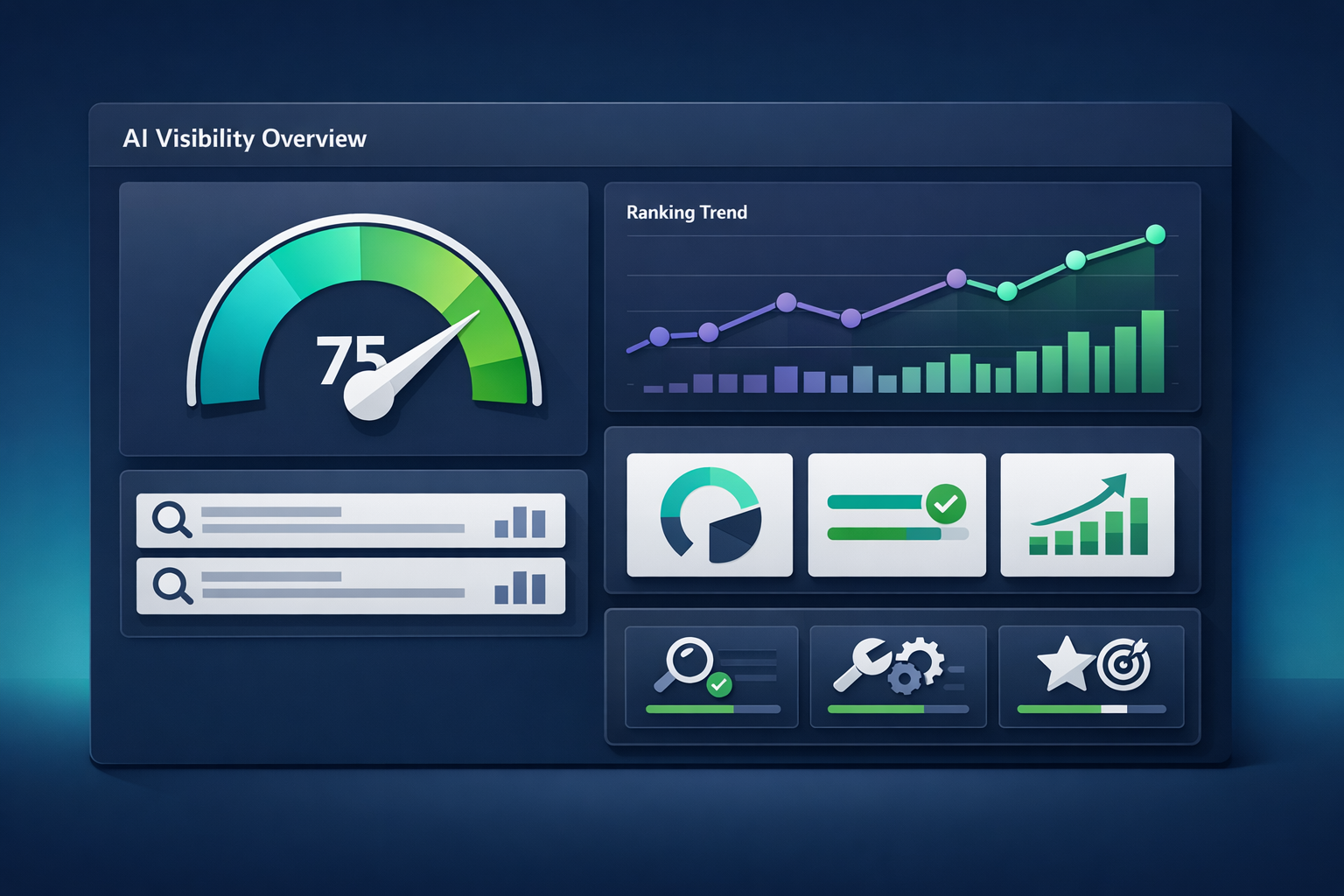
Wix’s AI Visibility Overview is best understood as a monitoring layer for this new surface: an attempt to operationalize “am I showing up in the answer?” across major LLM platforms. TechRadar frames it as a tool to track citations, sentiment, and competitive context as AI answers increasingly intercept clicks. \ Wix’s own documentation is more explicit: it tracks mentions/citations in AI responses, compares against competitors, and even monitors traffic coming from AI platforms.
If you want the broader measurement framework—definitions, KPIs, reporting design—use Complete Guide to AI Visibility Monitoring. This briefing goes deep on a narrower point: why AI mention/citation monitoring is becoming the practical bridge between classic SEO and AI-era discoverability—and how to use Wix’s tool without turning it into a vanity dashboard.
**The shift in one screen (what’s changing in search visibility)**
- AI Overviews are already a meaningful surface area: ~15.69% trigger rate in Nov 2025, after a 24.61% peak in Jul 2025.
- Clicks are being intercepted: In a BFSI dataset (40,000 keywords), AI Overview presence rose from 6.86% (Oct 2024) to 29.07% (May 2025) while overall top-10 CTR fell 36% (5.7% → 3.66%).
- Visibility is no longer synonymous with rank: You can “win” a query by being summarized and cited even if you’re not #1—and you can “lose” while ranking well if the answer resolves intent without a click.
:::
AI visibility monitoring is shifting SEO from rankings to “being cited”
Thesis: AI answers reward brands that are easy to summarize and trust
Our analysis: AI answer engines behave less like “ten blue links” and more like dynamic compilers of sources. They prefer content that is:
- Easy to extract (clear definitions, structured sections, unambiguous claims)
- Easy to attribute (explicit brand/entity signals, consistent naming, credible authorship)
- Easy to justify (original data, methodology, citations, “why this is true”)
This is why traditional rank tracking is necessary but no longer sufficient. You can rank well and still lose mindshare—and sometimes revenue—if the AI answer resolves the user’s intent without a click.
The CTR risk is not hypothetical. TechMagnate’s study (40,000 BFSI keywords) reports AI Overview presence rising from 6.86% (Oct 2024) to 29.07% (May 2025), while overall top-10 CTR fell from 5.7% to 3.66% (-36%) in the same window.
Actionable recommendation: Treat “AI visibility” as a first-class KPI alongside rankings: pick 20–50 revenue-adjacent queries and start tracking whether your brand is cited in AI answers, not just where you rank.
What “visibility” means in AI Overviews and chat-based results (vs. SERP rank)
In classic SEO, visibility is often shorthand for rank, impressions, and clicks. In AI surfaces, visibility becomes a bundle of different signals:
- Mention: your brand/domain appears in the generated answer
- Citation: your site is linked or referenced as a source
- Theme coverage: which topics/queries trigger inclusion
- Competitive substitution: which competitor is cited instead of you for the same concept
Wix’s AI Visibility Overview is positioned precisely here: not as a replacement for technical SEO, but as instrumentation for whether your site is being surfaced in AI-generated content.
Actionable recommendation: Rewrite your SEO reporting headline from “top keywords” to “top questions where we are/aren’t cited,” and force every content team to review it monthly.
What Wix’s AI Visibility Overview tool appears to measure—and why those metrics matter
Core monitoring signals: mentions, citations, query themes, and page-level surfacing
Wix’s Help Center describes a workflow where you select an AI platform (ChatGPT, Gemini, Perplexity, Claude) and Wix generates an initial set of questions based on your business type; those questions are then sent to the selected platform, producing an AI visibility score and underlying visibility data. \ TechRadar adds that the tool supports tracking citations, adjusting queries, monitoring sentiment, and competitor comparisons.
From an executive lens, these are the monitoring primitives that matter:
Actionable recommendation: Don’t start by tracking everything. Start by tracking one “money cluster” (pricing, comparisons, alternatives, implementation) and one “trust cluster” (definitions, compliance, methodology).
The hidden value: trendlines and deltas over time, not one-off screenshots
AI answers are volatile: model updates, retrieval changes, and UI experiments can reshuffle sources. That’s why directionality is more actionable than absolute counts.
A practical KPI table (what we recommend teams maintain internally) looks like this:
| KPI (cluster-level) | Baseline | 30 days | 60 days | 90 days | Why it matters |
|---|---|---|---|---|---|
| AI mentions (count) | X | Δ | Δ | Δ | Presence in answers |
| Citation rate (%) | X% | Δ | Δ | Δ | Source-worthiness |
| Topic coverage (# queries with inclusion) | X | Δ | Δ | Δ | Breadth in a cluster |
| “Competitor substitution” rate (%) | X% | Δ | Δ | Δ | Lost share of explanation |
Benchmarks vary wildly by industry and site size; the point isn’t the number—it’s whether your interventions move the deltas.
Actionable recommendation: Set a rule: no one is allowed to celebrate a single-week spike. Only 4-week rolling changes count as “progress.”
:::
How to interpret AI visibility data without fooling yourself (biases, volatility, and attribution)
The volatility problem: model updates, query rewrites, and personalization
Here’s the provocative claim: many teams will misread AI visibility dashboards the way they once misread “average position”—as a direct revenue lever. It’s not.
AI systems rewrite queries, personalize responses, and change retrieval behavior. Even the same user can get different citations over time. Semrush’s own data shows AI Overview triggering rates moving materially across 2025 (6.49% in January → 24.61% in July → 15.69% in November), underscoring how unstable the surface itself can be.
Actionable recommendation: Lock a fixed query set for trend tracking (your “AI visibility panel”), and only revise it quarterly—otherwise you’ll confuse measurement changes with performance changes.
Attribution reality: AI visibility is an influence metric, not a last-click metric
Wix notes the ability to “monitor traffic coming from AI platforms.” \ That’s useful—but executives should assume AI visibility behaves more like brand influence than direct-response media.
A sober interpretation framework:
- Treat mentions/citations as leading indicators of consideration
- Validate with downstream signals:
- branded search lift
- direct traffic
- assisted conversions
- demo requests / trial starts
- newsletter signups
A simple internal study we recommend (and that many teams can run without new tooling):
- Track weekly AI mention count vs. weekly branded search volume and direct traffic for 8–12 weeks
- Compute correlations; document confidence caveats (seasonality, campaigns, PR spikes)
Actionable recommendation: Put AI visibility and branded search in the same dashboard view. If they never move together over 90 days, your “visibility” may be cosmetic.
:::
A focused workflow: using Wix’s tool to drive content decisions that AI systems prefer to cite
From insight to action: pick one topic cluster and build “citation-ready” pages
The fastest path to measurable lift is not “optimize the whole site for AI.” It’s to pick one cluster where AI answers routinely appear and where citations influence vendor selection.
Example cluster types that tend to be citation-friendly:
- “What is X?” definitions (category ownership)
- “X vs Y” comparisons (competitive substitution battleground)
- “Best X for Y” shortlists (inclusion matters more than rank)
- “Pricing / cost / ROI” explainers (high-intent, high scrutiny)
Then build citation-ready pages:
- Primary-source data (your dataset, your benchmarks, your methodology)
- Clear definitions (one-paragraph summary + expanded section)
- Structured FAQs (explicit Q/A formatting for extractability)
- Named authors + credentials (reduce trust ambiguity)
- Transparent methodology for any claims (why your numbers are defensible)
This aligns with Wix’s positioning that the tool helps you understand and shape how AI represents your brand in AI responses.
Actionable recommendation: Commit to shipping one “source page” per month per cluster (not five mediocre posts per week). AI systems cite sources; they don’t reward volume for its own sake.
Operationalizing: cadence, owners, and acceptance criteria
A workable operating model:
- Weekly (30 minutes): monitor Wix AI Visibility Overview deltas for your fixed query panel \
- Monthly: update 2–4 pages based on “competitor substitution” findings
- Quarterly: refresh the query set, re-baseline, and decide whether to expand to a second cluster
Acceptance criteria (example):
- +20% citation rate on the fixed query panel in 60–90 days
- +10 net-new queries where you’re cited in the target cluster
Mini case-style example (hypothetical, but operationally realistic):
- Baseline: cited on 6/40 target queries (15%)
- After 60 days + 6 page upgrades: cited on 12/40 (30%)
- Outcome: branded search +8% (directional), demo assists +5% (directional)
Actionable recommendation: Assign a single owner (not a committee). AI visibility programs fail when “everyone” owns them.
Counterpoint: AI visibility tools can become vanity dashboards—unless you tie them to strategy
Where monitoring stops helping: chasing mentions without differentiation
There’s a real risk: teams will chase mentions by endlessly tweaking copy to match what the model “seems to like,” producing shallow, homogenized content. That’s how you end up with dashboards that look better while your differentiation gets worse.
The broader market context is also shifting fast. Implicator reports Apple is testing Google’s Gemini to power a Siri “answer engine” overhaul targeted for spring 2026 (internally “World Knowledge Answers”), with a planner/search/summarizer architecture and Google handling summaries while Apple keeps personal data processing. \ Reuters similarly reported Apple licensing Google’s Gemini for a major Siri overhaul, citing Bloomberg. \ If Siri becomes a mainstream answer surface, “being cited” won’t be a Google-only problem.
Separately, Perplexity’s Comet browser illustrates a second-order issue: if AI browsing layers are vulnerable, the trust stack around AI answers becomes part of visibility strategy. Wikipedia documents Comet’s release timeline and notes security concerns including a “CometJacking” attack vector disclosed by LayerX. \ Even if your content is citation-ready, the ecosystem delivering it is still maturing.
Actionable recommendation: Build defensibility, not just visibility. If you can’t articulate what only your brand can say (data, perspective, framework), you’re optimizing for temporary inclusion.
Call to action: treat AI visibility as a product signal, not a marketing trophy
The strategic stance we recommend: the goal is not “more mentions.” The goal is being the best source for a narrow set of questions—and using monitoring to verify whether the market agrees.
If you want the full system—metrics, tooling options, reporting cadence, governance—reference the complete guide on AI Visibility Monitoring.
Actionable recommendation (60–90 day plan):
- Pick one cluster
- Publish one original insight (dataset, calculator, benchmark, or decision framework)
- Use Wix’s AI Visibility Overview to measure citation lift against a fixed query panel over 60–90 days
:::comparison
:::
✓ Do's
- Lock a fixed “AI visibility panel” of revenue-adjacent queries and keep it stable for trend tracking (revise quarterly).
- Prioritize deltas (4-week rolling changes) over one-off screenshots because AI answers and citations reshuffle frequently.
- Use competitor substitution findings to drive page upgrades in one cluster (comparisons, pricing, definitions) rather than spreading effort across the whole site.
✕ Don'ts
- Don’t treat mentions/citations as a direct last-click revenue metric; validate with branded search, direct traffic, and assisted conversions.
- Don’t expand tracking to “everything” on day one; start with a money cluster and a trust cluster to keep decisions actionable.
- Don’t chase inclusion by homogenizing content—without defensible data/methodology, visibility gains are fragile. :::
Learn More: Explore our generative engine optimization and ai search optimization guide for more insights.
Key Takeaways
- AI visibility is now a separate surface area from rank: AI Overviews triggered for ~15.69% of queries in Nov 2025 (after a 24.61% peak in Jul 2025), so rank-only reporting can miss whether you’re present in answers.
- CTR compression is a real risk when AI answers appear: In a 40,000-keyword BFSI study, AI Overview presence rose (6.86% → 29.07%) while overall top-10 CTR fell 36% (5.7% → 3.66%).
- Wix’s AI Visibility Overview is best used as instrumentation, not a replacement for SEO: It’s positioned to track mentions/citations, competitor comparisons, and AI-platform traffic across ChatGPT, Gemini, Perplexity, and Claude.
- Trendlines beat snapshots: Because AI citations are volatile, directionality (rolling deltas) is more actionable than absolute counts.
- Treat AI visibility as influence, then validate: Pair mentions/citations with branded search lift, direct traffic, and assisted conversions to avoid “cosmetic visibility.”
- Win by building citation-ready sources: Original data, clear definitions, structured FAQs, named authors, and transparent methodology increase extractability and trust—conditions AI systems tend to reward.
- Governance matters: Assign a single owner, operate weekly/monthly/quarterly cadences, and tie monitoring to specific cluster decisions to avoid vanity dashboards.
FAQ
What is Wix’s AI Visibility Overview tool and what does it track?
Wix describes it as an AI-powered tool to track how often your site is mentioned and cited in AI responses, compare against competitors, see sources, and monitor AI-platform traffic; it supports platform tabs like ChatGPT, Gemini, Perplexity, and Claude.
How is AI visibility different from traditional keyword rankings?
Rankings measure position in a list of links. AI visibility measures whether you’re included and attributed inside AI-generated answers—often before a user ever sees organic results.
Why is volatility such a big issue in AI visibility reporting?
Because AI systems can change triggering rates, rewrite queries, and reshuffle citations as models and retrieval behavior update. Semrush’s 2025 data shows AI Overview triggering moving from 6.49% (Jan) to 24.61% (Jul) to 15.69% (Nov), illustrating how much the surface itself can shift.
Do AI mentions and citations increase website traffic?
Sometimes, but not reliably. Wix notes AI-driven traffic monitoring, yet AI visibility should be treated primarily as an influence metric and validated with branded search, direct traffic, and assisted conversions.
How often should you check AI visibility metrics?
Weekly for directional movement (rolling trends), monthly for content decisions, quarterly for re-baselining query panels—because the AI Overview surface and model behavior changes over time.
What should you do if competitors are cited instead of your site in AI answers?
Don’t “rewrite to chase the model.” Identify the specific concept where they’re winning (definition, comparison, data point), then publish a citation-ready source page with original evidence and clear structure. Use monitoring to confirm substitution declines over 60–90 days.

Founder of Geol.ai
Senior builder at the intersection of AI, search, and blockchain. I design and ship agentic systems that automate complex business workflows. On the search side, I’m at the forefront of GEO/AEO (AI SEO), where retrieval, structured data, and entity authority map directly to AI answers and revenue. I’ve authored a whitepaper on this space and road-test ideas currently in production. On the infrastructure side, I integrate LLM pipelines (RAG, vector search, tool calling), data connectors (CRM/ERP/Ads), and observability so teams can trust automation at scale. In crypto, I implement alternative payment rails (on-chain + off-ramp orchestration, stable-value flows, compliance gating) to reduce fees and settlement times versus traditional processors and legacy financial institutions. A true Bitcoin treasury advocate. 18+ years of web dev, SEO, and PPC give me the full stack—from growth strategy to code. I’m hands-on (Vibe coding on Replit/Codex/Cursor) and pragmatic: ship fast, measure impact, iterate. Focus areas: AI workflow automation • GEO/AEO strategy • AI content/retrieval architecture • Data pipelines • On-chain payments • Product-led growth for AI systems Let’s talk if you want: to automate a revenue workflow, make your site/brand “answer-ready” for AI, or stand up crypto payments without breaking compliance or UX.
Related Articles

Anthropic's Claude Bots: Navigating the New Norms of AI Crawling
How to detect, allow, or block Anthropic’s Claude bots, monitor AI crawl behavior, and protect AI Visibility for Generative Engine Optimization.

Anthropic’s Model Context Protocol (MCP) Gains Industry Adoption: What It Means for AI Visibility Monitoring
Deep dive on MCP adoption and why standardized tool/context logging improves AI visibility monitoring, governance, and auditability across agents.