Anthropic's Claude Bots: Navigating the New Norms of AI Crawling
How to detect, allow, or block Anthropic’s Claude bots, monitor AI crawl behavior, and protect AI Visibility for Generative Engine Optimization.
Anthropic's Claude Bots: Navigating the New Norms of AI Crawling
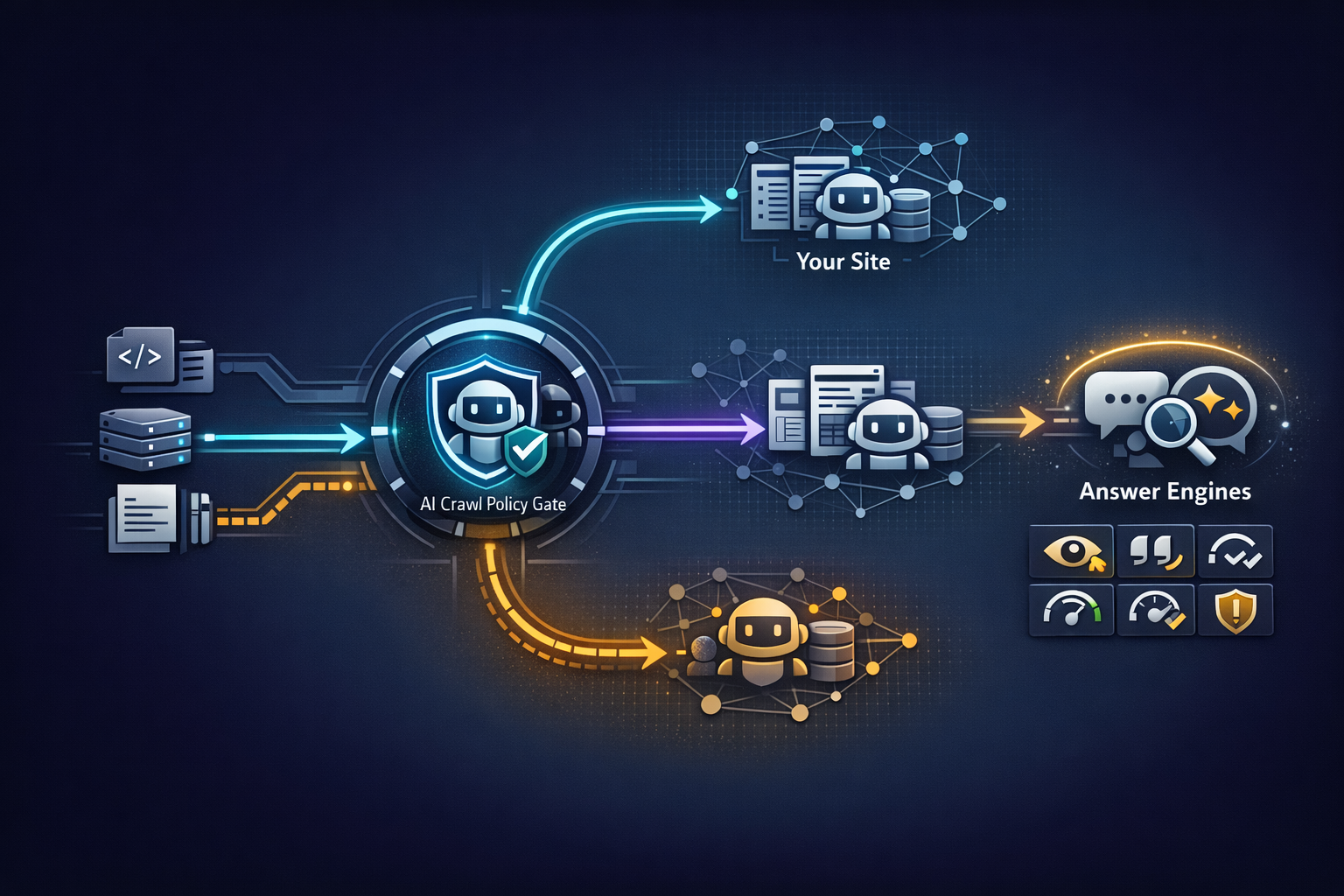
Anthropic’s Claude bots change a familiar SEO question (“should I allow crawlers?”) into an access-policy decision for multiple AI use cases: training, search-like indexing, and user-request fetching. The practical goal is to control what Claude can retrieve while protecting performance, sensitive content, and your AI Visibility (how often your pages are surfaced, referenced, or cited by answer engines). This guide shows how to detect Claude activity, verify it against impersonators, implement path-level rules safely, and set up a monitoring loop that ties crawl behavior to Generative Engine Optimization outcomes.
AI assistants increasingly fetch and summarize web content on-demand. If you treat all AI bots the same, you risk either blocking legitimate retrieval (reducing citations) or allowing broad access that creates compliance, performance, or competitive risks. Anthropic’s move toward more granular bots makes “selective allowance” a realistic default.
For broader context on how AI answer engines decide what to cite (and why non-traditional sources can win), apply the principles in optimize for user-generated content in AI citations—the same “retrievability + trust signals” logic applies to Claude crawling decisions.
Prerequisites: What you need before changing anything
Confirm your goal: AI Visibility vs. access control
Start by writing down the exact decision you’re making and the tradeoff you accept. Most teams fall into one of three policy models:
- Open: allow Claude to crawl most public content to maximize retrieval and citation potential.
- Selective: allow high-value directories (e.g., /docs/, /blog/, /pricing/) but restrict accounts, internal tools, and low-signal pages.
- Closed: block Claude bots broadly (usually for regulated industries, proprietary knowledge bases, or strict licensing constraints).
If your primary objective is AI Visibility, selective access is often the best default: it enables citations from authoritative pages without exposing sensitive surfaces.
Collect baselines: logs, robots.txt, and key pages
Before touching robots.txt or bot rules, capture a baseline so you can attribute changes. Export 30–90 days of server/CDN logs (or enable logging now) and inventory what already governs access:
- Current robots.txt rules and sitemap locations
- CDN/WAF bot management policies (these can override robots directives)
- Rate limiting, geo-blocking, and challenge pages that might cause 403/429 spikes
Define success metrics for Generative Engine Optimization
Pick 3–5 priority URLs (money pages, docs, pricing, comparisons) and a small tracked query set you care about. Your goal is to connect crawl access to downstream outcomes (mentions/citations), not just “more bot hits.” Baseline metrics to capture:
Baseline AI Crawl Metrics to Capture (Before Policy Changes)
A simple checklist of baseline measurements to record from logs/CDN analytics before adjusting robots.txt or WAF rules.
Version-control robots.txt and WAF rules. Store: (1) the change request, (2) the exact diff, (3) rollout time, and (4) the baseline snapshot. This turns “AI crawling” into an experiment you can roll back in minutes.
Step 1 — Detect Claude bot activity in your logs (and separate it from lookalikes)
Identify likely Claude user agents and request patterns
Start with what you can observe: user-agent strings, request rates, and the paths being fetched. Search your logs for user agents referencing Anthropic/Claude and group by UA + IP + behavior (burstiness, depth, and error rate). Look for patterns like repeated fetches of documentation, pricing, or FAQ pages—these often correlate with answer-engine retrieval.
Validate via reverse DNS/IP intelligence and bot management tools
Assume impersonation is possible. Flag suspicious traffic that “claims” to be an AI bot but shows high 4xx rates, inconsistent UA strings, or abnormal bursts. Then validate using:
- Reverse DNS and forward-confirmed reverse DNS (FCrDNS) checks for the requesting IPs
- ASN mapping and IP reputation signals (via your CDN/WAF or threat intel provider)
- Bot management “verified bot” classifications where available
Create a repeatable “AI crawler fingerprint” checklist
Document an SOP that classifies traffic as Verified Claude, Suspected Claude, or Impersonator. Your checklist should include: UA string, IP/ASN, reverse DNS results, request cadence, top paths, and error rate. This is especially important as multi-model systems become more common (where one product may route requests across several models).
For an example of how “one interface, many models” changes traffic patterns and attribution, see Perplexity’s Model Council analysis.
Daily Requests: Verified vs. Suspected Claude Traffic (Template)
Use this to track whether your verification efforts reduce impersonators and whether policy changes impact legitimate Claude crawling.
If you want a practical workflow for log-driven crawl analysis (segments, response codes, and directory hotspots), apply the same crawl-data discipline used in use crawl data to improve GEO—the same segmentation logic applies to AI bots.
Step 2 — Set your access policy: allow, block, or segment Claude crawling with robots.txt + headers
Choose a policy model (open, selective, or closed)
Decide policy by content type. Public marketing pages and documentation can be allowed to improve retrieval. Gated content, PII, internal tools, and proprietary documentation should be restricted. Treat robots.txt as a coordination mechanism, not a security boundary.
Policy Models for Claude Crawling
| Model | Best for | How it works | Primary risk |
|---|---|---|---|
| Open | Publishers, docs-first SaaS, brands seeking maximum citations | Allow broad crawling of public site sections | Unintended exposure of low-value pages; higher crawl load |
| Selective (recommended default) | Most organizations with mixed public + sensitive content | Allow specific directories; restrict accounts/admin/internal | Misconfiguration can block key pages if rules are too broad |
| Closed | Regulated, proprietary, or licensing-constrained content | Block Claude bots broadly; rely on other channels for visibility | Reduced AI retrieval/citation potential |
Implement robots.txt rules safely (with examples)
Keep rules readable and minimal. Avoid broad disallows that accidentally block your entire site or essential directories. Segment by path so you can explicitly allow what you want cited (e.g., /docs/), while restricting what you don’t (e.g., /account/).
Robots.txt pattern (selective access example)
User-agent: ClaudeBot
Disallow: /account/
Disallow: /admin/
Disallow: /internal/
Allow: /docs/
Allow: /blog/

Sitemap: https://example.com/sitemap.xml
If content is truly sensitive (PII, customer data, internal docs), use authentication, authorization, signed URLs, or network controls. Robots directives can be ignored by non-compliant crawlers and do not prevent direct access.
Use noindex/nosnippet and authentication for sensitive content
For pages that should be accessible to users but not surfaced or excerpted by engines, use meta robots directives (e.g., noindex, nosnippet) or X-Robots-Tag headers where appropriate. For anything confidential, require login. After changes, validate behavior by observing subsequent crawl attempts and response codes in logs and CDN dashboards.
| Control | What it does | When to use | Notes |
|---|---|---|---|
| robots.txt | Requests coordination (allow/disallow by path) | Segmenting public vs. non-public areas | Not enforcement; may be ignored by bad actors |
| Meta robots / X-Robots-Tag | Indexing/snippet directives (noindex/nosnippet, etc.) | Preventing surfacing/excerpts while still serving users | Depends on crawler compliance; still not security |
| Authentication / authorization | Enforces access control | Sensitive content, PII, customer portals | Best practice for true protection |
Anthropic’s introduction of distinct bots makes these decisions more granular for webmasters; see the breakdown and implications in Search Engine Journal’s coverage.
Step 3 — Optimize for AI crawling outcomes (without “opening the floodgates”)
Improve retrievability: sitemaps, internal links, and clean status codes
Once you’ve chosen what Claude can access, make that subset easy to retrieve. Focus on technical hygiene that reduces crawler confusion and wasted fetches:
- Consistent 200 responses on allowed pages; fix soft-404s and flaky edge behavior.
- Avoid redirect chains; keep canonicals accurate so citations point to the right URL.
- Publish an XML sitemap for the allowed subset; keep lastmod accurate to encourage efficient recrawls.
Increase Citation Confidence: structured data and entity clarity
Citations don’t come only from access—they come from clarity. Improve machine understanding with Schema.org where it fits (Organization, Article, FAQ, Product/SoftwareApplication). Then write “entity-first”: define the entity, key attributes, comparisons, constraints, and “who it’s for” early on the page. This reduces the chance an LLM mis-ranks or misinterprets your content when assembling an answer.
On the research side, LLM-based ranking can have unexpected failure modes; see the discussion of vulnerabilities in The Ranking Blind Spot. Your best mitigation as a publisher is to be explicit: unambiguous headings, definitions, and structured facts.
Create an “AI-crawlable” content subset for Generative Engine Optimization
A practical compromise is to create a dedicated directory you explicitly allow for AI crawling (for example, /resources/ai/). Populate it with authoritative explainers, comparisons, and “how it works” pages that are safe to quote. Treat this directory as your citation surface area: keep it internally linked, updated, and aligned to your product’s real constraints.
Schema Adoption vs. AI Visibility (Conceptual Tracking View)
Track whether pages with valid structured data correlate with higher AI mentions/citations over time. Replace example values with your monitoring data.
As AI products evolve into more agentic “thought partner” search experiences, retrieval and summarization behaviors will keep shifting. For deeper coverage on how this reframes optimization, explore Google’s Gemini 3 and what it means for GEO.
Step 4 — Monitor, troubleshoot, and avoid common mistakes (AI Visibility Monitoring loop)
Common mistakes that break AI Visibility
- Accidentally disallowing the entire site (or key folders) with an overly broad rule.
- Forgetting subdomains (docs., app., help.)—each may need its own robots policy and logging view.
- Relying on robots.txt for security instead of auth controls.
- Blocking resources or templates that cause unstable rendering or inconsistent canonicalization.
Troubleshooting checklist (403/429 spikes, crawl stalls, wrong pages crawled)
If you see 403/401 spikes
Check WAF challenges, bot rules, geo blocks, and authentication walls. Confirm whether verified Claude traffic is being challenged. If appropriate, allowlist verified bot signals rather than raw IPs (IP ranges can change).
If you see 429 spikes
Tune rate limits to distinguish verified bots from unknown automation. Improve caching on allowed directories and consider lighter responses for crawler requests (e.g., minimize expensive personalization).
If crawl volume stalls after robots changes
Validate robots.txt is reachable (200), not cached incorrectly, and contains the intended rules. Confirm you didn’t block sitemap URLs or key hubs that feed internal discovery.
If the wrong pages are being crawled
Reduce internal links to low-value pages, add noindex where appropriate, and refine robots rules by path. Ensure canonical tags point to the preferred versions to concentrate citations.
Ongoing monitoring cadence and alerts
Build a lightweight “AI Crawl Health” scorecard and review it weekly for the first month after any policy change, then biweekly/monthly. Set alerts for sudden drops in verified Claude requests, spikes in suspected bot traffic, and changes in AI Visibility (mentions/citations) for your tracked query set. If you’re seeing more agent-based browsing experiences emerge, it’s also useful to understand how AI-native browsers can change fetch behavior; see background on Perplexity’s Comet browser.
AI Crawl Health Scorecard (Weekly Dashboard Template)
Track verified AI bot requests, error rate, median response time, and top directories crawled. Populate with real values from logs/CDN.
Key Takeaways
Treat Claude crawling as an access-policy decision: open, selective (usually best), or closed—based on content sensitivity and AI Visibility goals.
Verify before you allowlist: combine user-agent analysis with reverse DNS/ASN intelligence and WAF/CDN bot signals to separate real bots from impersonators.
Use robots.txt for segmentation, not security; protect sensitive content with authentication and enforceable controls.
Optimize the allowed subset for citation outcomes: clean 200s, accurate canonicals, strong internal linking, and structured data + entity-first writing.
FAQ: Claude Bots and AI Crawling

Founder of Geol.ai
Senior builder at the intersection of AI, search, and blockchain. I design and ship agentic systems that automate complex business workflows. On the search side, I’m at the forefront of GEO/AEO (AI SEO), where retrieval, structured data, and entity authority map directly to AI answers and revenue. I’ve authored a whitepaper on this space and road-test ideas currently in production. On the infrastructure side, I integrate LLM pipelines (RAG, vector search, tool calling), data connectors (CRM/ERP/Ads), and observability so teams can trust automation at scale. In crypto, I implement alternative payment rails (on-chain + off-ramp orchestration, stable-value flows, compliance gating) to reduce fees and settlement times versus traditional processors and legacy financial institutions. A true Bitcoin treasury advocate. 18+ years of web dev, SEO, and PPC give me the full stack—from growth strategy to code. I’m hands-on (Vibe coding on Replit/Codex/Cursor) and pragmatic: ship fast, measure impact, iterate. Focus areas: AI workflow automation • GEO/AEO strategy • AI content/retrieval architecture • Data pipelines • On-chain payments • Product-led growth for AI systems Let’s talk if you want: to automate a revenue workflow, make your site/brand “answer-ready” for AI, or stand up crypto payments without breaking compliance or UX.
Related Articles

Anthropic’s Model Context Protocol (MCP) Gains Industry Adoption: What It Means for AI Visibility Monitoring
Deep dive on MCP adoption and why standardized tool/context logging improves AI visibility monitoring, governance, and auditability across agents.
AI Visibility Overview Tool by Wix: Why Monitoring AI Search Mentions Is Becoming the New SEO Baseline
Opinionated analysis of Wix’s AI Visibility Overview tool—what it measures, where it helps, and why AI mention tracking is the next SEO baseline.