Beyond Page One: Structuring Content for LLM Optimization
Why LLM optimization demands Structured Data-first content architecture—templates, entity relationships, and measurable signals that drive citations.
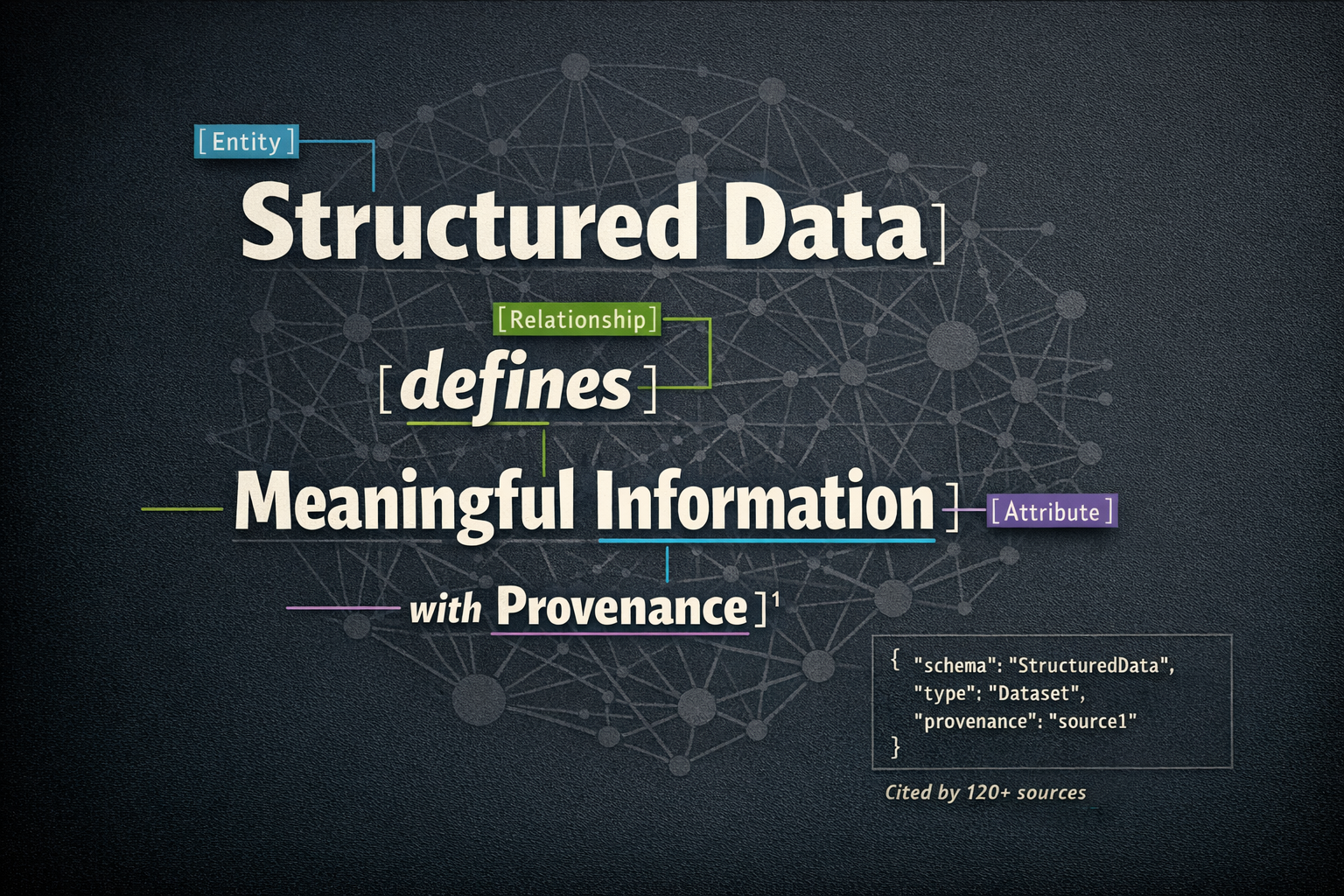
Beyond Page One: Structuring Content for LLM Optimization
LLM optimization isn’t about “getting to page one.” It’s about making your content easy for answer engines to extract, attribute, and recompose into synthesized responses (AI Overviews, chat answers, “best X” summaries). That shift changes what “good structure” means: instead of optimizing only for clicks, you optimize for machine-readable meaning—entities, attributes, relationships, and provenance. The practical bridge is Structured Data (Schema.org/JSON-LD) paired with an answer-first information architecture that gives LLMs a clean extraction surface while still reading well for humans.
Traditional SEO structure primarily optimizes for discovery and clicks. LLM optimization optimizes for extraction (can the model pull the right facts?), attribution (will it cite you?), and recomposition (can your content be safely reused in answers?).
For a forward-looking comparison of how structured formats are evolving in modern models and monitoring, see: OpenAI GPT-5.4 Launch (2026): What the New Structured Data Capabilities Mean for AI Visibility Monitoring.
The thesis: LLMs don’t “rank” your page—they assemble answers from structured meaning
From blue links to synthesized responses: why page-one thinking is obsolete
In classic search, your content’s job is to win a click. In answer engines, your content’s job is to be a trustworthy component in an assembled response. That means the “unit of value” shifts from the page to the extractable claim (definition, criteria list, comparison row, step, statistic) plus its provenance (who said it, when, based on what). Practitioner guides increasingly emphasize citation-ready formatting and measurable signals beyond rank—especially as AI answer experiences expand across engines and surfaces.
For deeper context on how LLMs select and present citations, reference: https://www.tomkelly.com/how-llms-choose-citations/ and the structured-content report at https://www.airops.com/report/structuring-content-for-llms.
What LLMs actually need: entities, attributes, and relationships (not just keywords)
LLMs and retrieval systems work best when they can disambiguate what you’re talking about (entities), what is true about it (attributes), and how it connects to other things (relationships). Keywords still matter, but mostly as hints for retrieval. The durable layer is meaning: a clear primary entity, consistent naming, and explicit relationships like “this product is made by this organization,” “this definition applies under these constraints,” or “this claim is supported by these sources.”
Why “page-one” thinking breaks: outcomes shift from clicks to extracted answers
Illustrative trendline showing the strategic shift from click-centric optimization toward answer-centric optimization (extraction + attribution) as AI answer surfaces expand.
Structured Data is the canonical mechanism to express that meaning in a standardized way, typically via Schema.org vocabulary encoded as JSON-LD. It doesn’t replace content; it aligns content with machine understanding.
The core argument: “LLM-ready” content starts with an entity model, then Structured Data
Map your entity set: primary entity, supporting entities, and disambiguation
Start by writing an entity model in plain language before you touch markup. For each URL/template, define:
- Primary entity: what the page is “about” (e.g., a concept, product, organization, or procedure).
- 5–10 supporting entities: the minimum set needed for the answer to be correct (people, tools, standards, competitors, regions, metrics).
- Disambiguation cues: alternative names, acronyms, and “not to be confused with” clarifiers.
Encode relationships: sameAs, about, mentions, author, publisher, and citations
Once the entity set is clear, encode relationships that reduce ambiguity and increase trust signals:
- Identity alignment: use
sameAsto point to canonical profiles (e.g., Wikidata, official social profiles) when appropriate. - Topical clarity:
aboutandmentionsto connect the page to key entities and reduce “topic drift.” - Provenance: consistent
author,publisher, and dates (published/modified). - Evidence: cite sources in-page (human-visible) and keep them stable; some ecosystems also leverage structured references (where supported) for datasets and studies.
Choose the minimum viable Schema.org types (avoid markup bloat)
Opinionated rule: fewer, higher-confidence properties beat sprawling, error-prone markup. Pick the smallest set that correctly describes the page and can be kept consistent across templates (e.g., Article + Organization + optional FAQPage for pages that truly contain FAQs). Validate relentlessly; correctness compounds.
Mini-audit framework: validated Structured Data correlates with more eligibility signals
Illustrative comparison of pages with validated JSON-LD vs. no JSON-LD, showing typical directional improvements in rich result eligibility and structured extraction signals (values are example targets for an internal audit).
If you want engine-specific perspectives on indexing/citation behavior, see: https://www.ranktracker.com/blog/comparing-llms-index-cite-best/.
Content architecture patterns that LLMs can reliably parse (and humans still enjoy)
Answer-first blocks: definitions, constraints, and decision criteria
Recommended “extraction surface” (copy/paste template)
Definition (2–3 sentences): State what X is, who it’s for, and the boundary conditions (what it is not).
Decision criteria (5–7 bullets): List the factors that determine the right choice (cost, accuracy, latency, compliance, integration).
Quick comparison (table): Summarize options in a compact, scannable format before the long-form narrative.
This pattern works because it creates stable, high-signal blocks that can be quoted directly. It also reduces the chance an LLM “fills in gaps” when your constraints and definitions are explicit.
Modular sections: reusable chunks with stable headings and scoped claims
Structure H2/H3s so each module answers one question and contains one claim set. Avoid “mega sections” that mix definitions, how-tos, and comparisons. Stable headings help retrieval systems and downstream summarizers align passages to intents (e.g., “What it is,” “How it works,” “Limitations,” “Alternatives,” “Implementation checklist”).
Human-friendly structure that also improves machine extraction
| Module type | Best for extraction | How to structure it |
|---|---|---|
| Definition block | Direct quoting + disambiguation | 2–3 sentences + “not to be confused with” line |
| Criteria bullets | Decision support + list extraction | 5–7 bullets with parallel grammar |
| Comparison table | Option synthesis | 3–6 rows, consistent units, notes column |
| Steps/checklist | Procedural answers | Numbered steps; prerequisites and outputs per step |
| FAQ module | Long-tail intents + PAA coverage | 3–6 questions; answers <120 words each |
Evidence scaffolding: sources, dates, and provenance baked into the page
Answer engines increasingly reward verifiability. Make provenance obvious:
- Put “Last updated” near the top and keep it accurate.
- Use named authors with bios and credentials when relevant (and match Structured Data author markup).
- Cite primary sources and standards; keep citations close to the claim they support.
- If you publish original numbers, explain methodology briefly (what you counted, over what period).
Test design: answer-first blocks vs. narrative-only (what you measure)
Illustrative scatter-style view: pages with answer-first blocks tend to cluster higher on snippet/PAA capture and citation observations (values represent a measurement plan, not universal results).
Counterpoint: Structured Data won’t save weak content—here’s where it fails (and how to avoid it)
The three common failure modes: inconsistency, over-markup, and unverifiable claims
If your JSON-LD says one thing and your visible page says another (pricing, availability, authorship, dates), you create a trust gap. Structured Data is an amplifier—when it amplifies contradictions, you risk invalidation or loss of enhanced visibility.
The most common failure modes in LLM-oriented structuring projects are operational, not conceptual:
- Inconsistency: different templates encode different “truths” about the same entity (e.g., varying organization names, author IDs, or definitions).
- Over-markup: adding every possible property without governance, increasing error rate and maintenance burden.
- Unverifiable claims: bold assertions with no sources, dates, or methodology—easy for models to ignore or replace with other sources.
When Schema Markup backfires: manual actions, invalidation, or trust erosion
Schema can backfire when it’s used to “claim” things the page doesn’t substantiate (e.g., marking up FAQs that aren’t present, inflating reviews, or misrepresenting authors). Even without penalties, invalid markup can quietly remove rich-result eligibility and weaken the consistency signals that help retrieval systems match your content to the right entity and intent.
Schema QA audit: typical error categories to track (stacked view)
Illustrative distribution of common JSON-LD issues found in audits; use as a checklist for governance and CI validation.
What to do instead: validation, governance, and “schema QA”
Create an entity dictionary
Define canonical names, IDs/URLs, and “sameAs” targets for your Organization, Authors, Products, and key Concepts. Treat it like a source of truth shared across templates.
Standardize template-level markup
Make the base schema consistent (e.g., Article + Organization + BreadcrumbList). Add specialized types only where the page format truly supports them (FAQPage/HowTo).
Validate in CI and audit periodically
Run structured data tests automatically on template changes. Then perform quarterly audits to catch content/markup mismatch, missing required fields, and entity drift.
What to measure: proving LLM optimization impact beyond rankings
Visibility metrics: rich result eligibility, PAA coverage, and snippet capture
If your KPI is still only “rank,” you’ll miss the win. Track whether your content is being selected as an input into answers. Practical visibility metrics include: rich result eligibility/errors in Search Console, impressions and CTR by query class, featured snippet wins, and People Also Ask (PAA) footprint for your entity set.
Attribution metrics: citations/mentions in AI answers and referral patterns
Attribution is messy but measurable enough to manage. Start with a repeatable sampling method: a fixed list of prompts/queries, checked weekly across key engines, recording whether you’re cited, where, and for which claim block (definition, table row, FAQ answer). Pair that with referrer analysis and server logs to detect emerging AI referral sources and bot activity patterns.
A pragmatic measurement stack: Search Console + log files + third-party AI visibility tools
| Metric | How to measure | 30-day success signal |
|---|---|---|
| Structured Data validity | Schema tests + Search Console enhancements reports | Errors down; eligible URLs up |
| Entity consistency | Template checks + entity dictionary compliance | Fewer mismatches across templates |
| Snippet/PAA footprint | SERP tracking + query set monitoring | More queries with SERP features captured |
| AI citations/mentions | Weekly prompt sampling + screenshots + logs/referrers | Citations appear for your definition/table blocks |
| Assisted conversions | Attribution model + landing page cohorts | Lift in conversion rate for optimized templates |
Pick one high-traffic template. Add (1) a definition + criteria + comparison block above the fold, and (2) minimum viable JSON-LD (Article + Organization + author + dates). Measure the scorecard weekly for 30 days, then expand to adjacent templates.
Key Takeaways
LLM optimization is about extractable, attributable claims—not just rankings and clicks.
Build an entity model first (primary entity + supporting entities), then encode it with minimal, validated Schema.org/JSON-LD.
Use answer-first modules (definition, criteria bullets, comparison tables, FAQs) to create a reliable extraction surface for LLMs and humans.
Measure impact with a scorecard: schema validity, entity consistency, snippet/PAA footprint, citation observations, and assisted conversions.
FAQ: Structuring Content for LLM Optimization
Further reading on practical tactics for earning citations across answer engines: https://surferseo.com/blog/llm-citations/ and https://www.maximuslabs.ai/ai-search-101/geo/strategy.

Founder of Geol.ai
Senior builder at the intersection of AI, search, and blockchain. I design and ship agentic systems that automate complex business workflows. On the search side, I’m at the forefront of GEO/AEO (AI SEO), where retrieval, structured data, and entity authority map directly to AI answers and revenue. I’ve authored a whitepaper on this space and road-test ideas currently in production. On the infrastructure side, I integrate LLM pipelines (RAG, vector search, tool calling), data connectors (CRM/ERP/Ads), and observability so teams can trust automation at scale. In crypto, I implement alternative payment rails (on-chain + off-ramp orchestration, stable-value flows, compliance gating) to reduce fees and settlement times versus traditional processors and legacy financial institutions. A true Bitcoin treasury advocate. 18+ years of web dev, SEO, and PPC give me the full stack—from growth strategy to code. I’m hands-on (Vibe coding on Replit/Codex/Cursor) and pragmatic: ship fast, measure impact, iterate. Focus areas: AI workflow automation • GEO/AEO strategy • AI content/retrieval architecture • Data pipelines • On-chain payments • Product-led growth for AI systems Let’s talk if you want: to automate a revenue workflow, make your site/brand “answer-ready” for AI, or stand up crypto payments without breaking compliance or UX.
Related Articles

What a GEO Platform Actually Costs in 2026: The Pricing Guide Vendors Won't Write
Real published prices for the Generative Engine Optimization tool market in 2026: self-serve entry tiers, enterprise quote walls, metering math, and honest tool-versus-consultant economics.

ChatGPT Optimization in 2026: A Working Checklist for Getting Your Brand Cited, Not Just Ranked
How ChatGPT retrieves and cites sources in July 2026, with a sourced Generative Engine Optimization checklist covering crawler access, extractable answers, entity signals, and measurement.