Generative Engine Optimization (GEO / AEO) Adoption Surges in 2026—What It Means for AI Browser Security
2026 sees rapid Generative Engine Optimization adoption as AI Overviews and answer engines reshape discovery. Implications for AI browser security and trust.

Generative Engine Optimization (GEO / AEO) Adoption Surges in 2026—What It Means for AI Browser Security
In 2026, Generative Engine Optimization (GEO)—often used interchangeably with Answer Engine Optimization (AEO)—shifted from a “nice-to-test” tactic to a planned budget line item. The reason is simple: discovery is increasingly mediated by AI Overviews, answer engines, and AI-first browsers that summarize, recommend, and sometimes complete tasks without a traditional click. That changes what “winning search” means: brands now optimize to be cited and trusted inside AI answers—not only to rank in a SERP. And because AI browsers rely on automated source selection, the security and trust layer (authenticity, integrity, provenance, and tamper resistance) becomes a hard constraint on GEO outcomes: if your content isn’t “safe-to-cite,” it won’t be surfaced—no matter how good it is.
GEO is the practice of increasing AI visibility and citation confidence across answer engines (ChatGPT-style experiences, Perplexity, Google AI Overviews, and AI browsers), by making content easier to retrieve, verify, and cite—while reducing the risk that your pages can be spoofed, poisoned, or hijacked.
What changed in 2026: GEO moves from experiment to budget line item
News hook: AI Overviews, answer engines, and AI browsers reshape click paths
The 2026 “click path” is often: question → AI summary → a small set of citations (or none) → optional follow-up. Users increasingly accept an answer without opening multiple tabs. AI browsers and copilots amplify this by summarizing pages in-line and navigating on the user’s behalf. Perplexity’s Comet browser is frequently cited as an example of AI-native navigation patterns that compress exploration into an agentic workflow rather than a list of blue links. Source: Comet (browser) overview.
Why 2026 is the inflection point (procurement, tooling, and measurement)
Two things made GEO “enterprise real” in 2026: (1) procurement—teams could justify spend because AI answer surfaces measurably impacted pipeline; and (2) tooling—AI visibility tracking and citation monitoring matured enough to be operationalized. Industry guidance increasingly frames GEO/AEO as a standard practice: create short, citable answer blocks; strengthen entity and brand signals; and invest in monitoring across multiple engines. Source: Search Engine Land GEO guide (2026).
Illustrative GEO adoption indicators (2024–2026)
An example way to visualize the 2024–2026 shift: more AI answer surfaces, higher budget reallocation, and larger shares of discovery happening in answer-first interfaces. Replace with your measured data from your analytics, SERP tracking, and surveys.
The security connection emerges here: when AI browsers summarize and route users, they must decide what to trust. That decision directly affects whether your content is eligible to be cited, recommended, or used as a step in an agentic workflow.
The core mechanic: citation confidence becomes the new ranking signal (and new attack surface)
How answer engines select sources: retrieval, synthesis, and citations
Most answer engines follow a similar high-level pipeline:
- Crawl/index: content is discovered and stored (or fetched on demand).
- Retrieval: the system selects candidate documents for the query (often via embeddings + traditional signals).
- Entity/knowledge alignment: sources are evaluated for entity consistency (brand, product, people, organizations) and topical fit.
- Synthesis: the model composes an answer, potentially combining multiple sources.
- Citation (or no citation): the system chooses which sources to show, link, or attribute.
As “deep research” and agentic browsing features expand, this pipeline can run iteratively: the system plans, fetches, verifies, and refines. That increases the importance of source reliability and the risk of poisoned or manipulated content entering the loop. Background context: Reasoning models / deep research concepts.
Citation Confidence and AI Visibility: what can be measured in 2026
Definition: Citation Confidence
Citation Confidence is the estimated probability that a given page/domain will be cited (linked or attributed) by an answer engine for a defined query cluster, under a defined context (location, personalization, model version, and time).
This differs from traditional rank tracking in two important ways:
- It’s multi-source and compositional: you can “lose” a citation without losing topical relevance if another source becomes more trusted or more extractable.
- It’s trust-sensitive: security posture, provenance cues, and entity consistency can matter as much as keyword relevance.
From a security perspective, “citation confidence” is also a new attack surface. If being cited drives brand outcomes, attackers may attempt citation hijacking via compromised sites, spoofed brands, malicious redirects, or structured data manipulation designed to look authoritative to machines.
Example: Citation Confidence vs. trust/structure signals (illustrative)
A conceptual view: pages with stronger entity clarity and trust signals tend to have higher citation frequency. Replace with your tracked query set (50–200+ queries) and observed citations per engine over time.
Why adoption is rising: three enterprise drivers (and one security constraint)
Driver 1: traffic volatility and the move to ‘answer-first’ discovery
As AI answers reduce downstream clicks, brands pursue visibility inside the answer: citations, brand mentions, recommended sources, and “best option” shortlists. This is especially true for high-intent informational queries that historically fed consideration-stage traffic.
Driver 2: measurable AI visibility KPIs replace rank-only reporting
By 2026, reporting is expanding beyond rank to answer-surface outcomes. Common GEO KPIs include:
- Citation share-of-voice: your % of citations across a query set and engine mix.
- Answer inclusion rate: how often your domain appears anywhere in the answer experience (cited or mentioned).
- Entity coverage: whether the engine correctly associates your brand/products/experts with the right entities and attributes.
- Output sentiment and accuracy: how your brand is described in answers (particularly in regulated categories).
Driver 3: content ops gets structured (schema, entities, knowledge graphs)
GEO rewards content that machines can reliably interpret: clear entities, stable canonical URLs, consistent naming, and structured data. It’s not just “add Schema.org”—it’s aligning pages to a coherent entity model so retrieval and synthesis can safely extract the right facts. Wikipedia’s overview frames GEO as the next frontier beyond classic SEO, reflecting how quickly the practice has entered mainstream marketing vocabulary. Reference: Generative engine optimization (Wikipedia).
Constraint: security and authenticity signals increasingly gate citations
The more answer engines optimize for “trusted” sources, the more security becomes a prerequisite for GEO. AI browser security threats—phishing, prompt-injection via page content, malicious redirects, and third-party supply-chain scripts—can reduce a site’s eligibility to be cited or recommended. Even when engines don’t expose their trust scoring, the practical effect is visible: unstable pages, confusing ownership signals, or suspicious behaviors tend to be avoided in high-stakes topics.
Illustrative enterprise GEO adoption signals (2025–2026)
A practical way to quantify adoption: count job postings and tooling mentions over time. Values below are illustrative indexes to show the measurement approach.
Security implications for GEO in AI browsers: trust, provenance, and ‘safe-to-cite’ content
How AI browsers and copilots change the threat model for content
AI browsers don’t just display pages—they interpret them. In-page summarization and agentic navigation mean your content can be extracted, recombined, and used as an instruction source. This raises two security-relevant risks for GEO:
- Compromise impact increases: if a high-citation page is compromised, the attacker can influence many downstream answers quickly (amplified distribution).
- Instructional content becomes executable context: content that looks like “steps” or “recommended actions” may be over-weighted by agents, making prompt-like injections more dangerous.
If your best GEO pages are not protected like critical assets, you’re optimizing a surface that attackers can target. In 2026, the “citation surface” (pages most likely to be retrieved and cited) should be treated as a security-scoped inventory with monitoring, change control, and incident response playbooks.
Practical ‘safe-to-cite’ checklist: authenticity, integrity, and clarity
Lock down identity signals (authenticity)
Make ownership obvious to both humans and machines: consistent organization name, contact details, and about pages; stable author pages; and Organization/Person structured data that matches on-site reality. Avoid “floating” brand variants across subdomains without clear relationships.
Reduce tamper opportunities (integrity)
Harden the pages most likely to be cited: strict redirect hygiene, no mixed content, minimal third-party scripts on citation pages, and strong dependency governance. Treat schema and metadata as production code with reviews and rollbacks.
Make extraction safe (clarity)
Provide short, unambiguous answer blocks with definitions, constraints, and dates. When summarization is likely, ensure key caveats are adjacent to the claim (not buried after multiple scrolls). This reduces the chance an AI browser extracts a misleading partial truth.
Add provenance cues (traceability)
Use visible “last updated” dates, change logs for sensitive pages, and clear citations to primary sources. If you publish research, document methodology. These cues help engines justify citation selection and help users verify claims.
Where structured data helps—and where it can be abused
Structured data improves machine understanding (entities, relationships, and content types), which can improve retrieval and citation selection. But it also introduces abuse modes: schema spam, fake author entities, and markup that contradicts the visible page. In an AI browser context, misleading markup can be used to steer retrieval or to make a compromised page look legitimate.
| Schema / signal | GEO benefit | Security risk to manage |
|---|---|---|
| Organization / Person | Entity clarity; improves attribution and disambiguation | Entity spoofing (fake authors, fake org relationships) if markup isn’t governed |
| Article (headline, dateModified, author) | Extractability; freshness cues; better summarization | Manipulated dates or authorship to look “fresh” or “expert” |
| FAQPage / HowTo (when appropriate) | Clear Q/A extraction; supports answer blocks | Schema spam that over-claims coverage or injects misleading steps |
Safe-to-cite audit dimensions for top GEO pages
A simple scoring model you can use to align GEO and security: score each high-citation page across trust and integrity dimensions, then prioritize fixes where citation value is high and risk is high.
Operationally, the winning pattern is cross-functional: GEO teams identify the pages and query clusters that matter; security teams harden those pages and their dependencies; and analytics teams monitor citation volatility and suspicious changes (content diffs, redirect changes, schema edits).
What happens next: 2026–2027 predictions for GEO under tightening trust and regulation
Prediction: engines weight provenance and entity verification more heavily
As answer engines mature, they will likely increase reliance on provenance indicators and entity verification to reduce misinformation and brand impersonation. Expect more emphasis on consistent entity signals across the open web, clear ownership, and verifiable “who said what” metadata—especially in YMYL-style topics (health, finance, security).
Prediction: ‘citation share’ becomes a board-level metric in regulated sectors
In regulated industries, AI answers can become a reputational and compliance risk. As a result, “citation share-of-voice” and “safe-to-cite compliance” will be treated like a brand protection metric: if your company is misrepresented, absent, or cited from a compromised page, the impact can be immediate.
What to watch: platform changes, standards, and enforcement
- Citation format volatility: how many citations appear, where they appear, and whether they’re deep links or homepages.
- AI browser security UX: content warnings, provenance badges, and “why this source” explanations.
- Model/provider safety posture: ongoing investments in safety and policy can indirectly shift what sources are considered acceptable to cite.
Monitoring idea: citation volatility on sensitive topics (illustrative)
Track changes in citations per answer and domain share over time to spot algorithm shifts or emerging manipulation. Values below are illustrative.
GEO adoption rises fastest where trust is hardest to earn. In AI browsers, security isn’t separate from discoverability—it’s part of the ranking system.
Key Takeaways
2026 made GEO/AEO a budgeted discipline because AI answers and AI browsers compress the user journey; brands now compete to be cited, not just to rank.
Citation Confidence is the new “ranking” proxy: it’s multi-source, highly trust-sensitive, and measurable via citation tracking across query clusters.
AI browser security expands the threat model: compromised high-citation pages can poison many downstream answers; trust signals increasingly gate eligibility to be cited.
The practical play is cross-functional: treat “citation surface” pages as critical assets and govern structured data, redirects, and third-party scripts like production code.
FAQ

Founder of Geol.ai
Senior builder at the intersection of AI, search, and blockchain. I design and ship agentic systems that automate complex business workflows. On the search side, I’m at the forefront of GEO/AEO (AI SEO), where retrieval, structured data, and entity authority map directly to AI answers and revenue. I’ve authored a whitepaper on this space and road-test ideas currently in production. On the infrastructure side, I integrate LLM pipelines (RAG, vector search, tool calling), data connectors (CRM/ERP/Ads), and observability so teams can trust automation at scale. In crypto, I implement alternative payment rails (on-chain + off-ramp orchestration, stable-value flows, compliance gating) to reduce fees and settlement times versus traditional processors and legacy financial institutions. A true Bitcoin treasury advocate. 18+ years of web dev, SEO, and PPC give me the full stack—from growth strategy to code. I’m hands-on (Vibe coding on Replit/Codex/Cursor) and pragmatic: ship fast, measure impact, iterate. Focus areas: AI workflow automation • GEO/AEO strategy • AI content/retrieval architecture • Data pipelines • On-chain payments • Product-led growth for AI systems Let’s talk if you want: to automate a revenue workflow, make your site/brand “answer-ready” for AI, or stand up crypto payments without breaking compliance or UX.
Related Articles
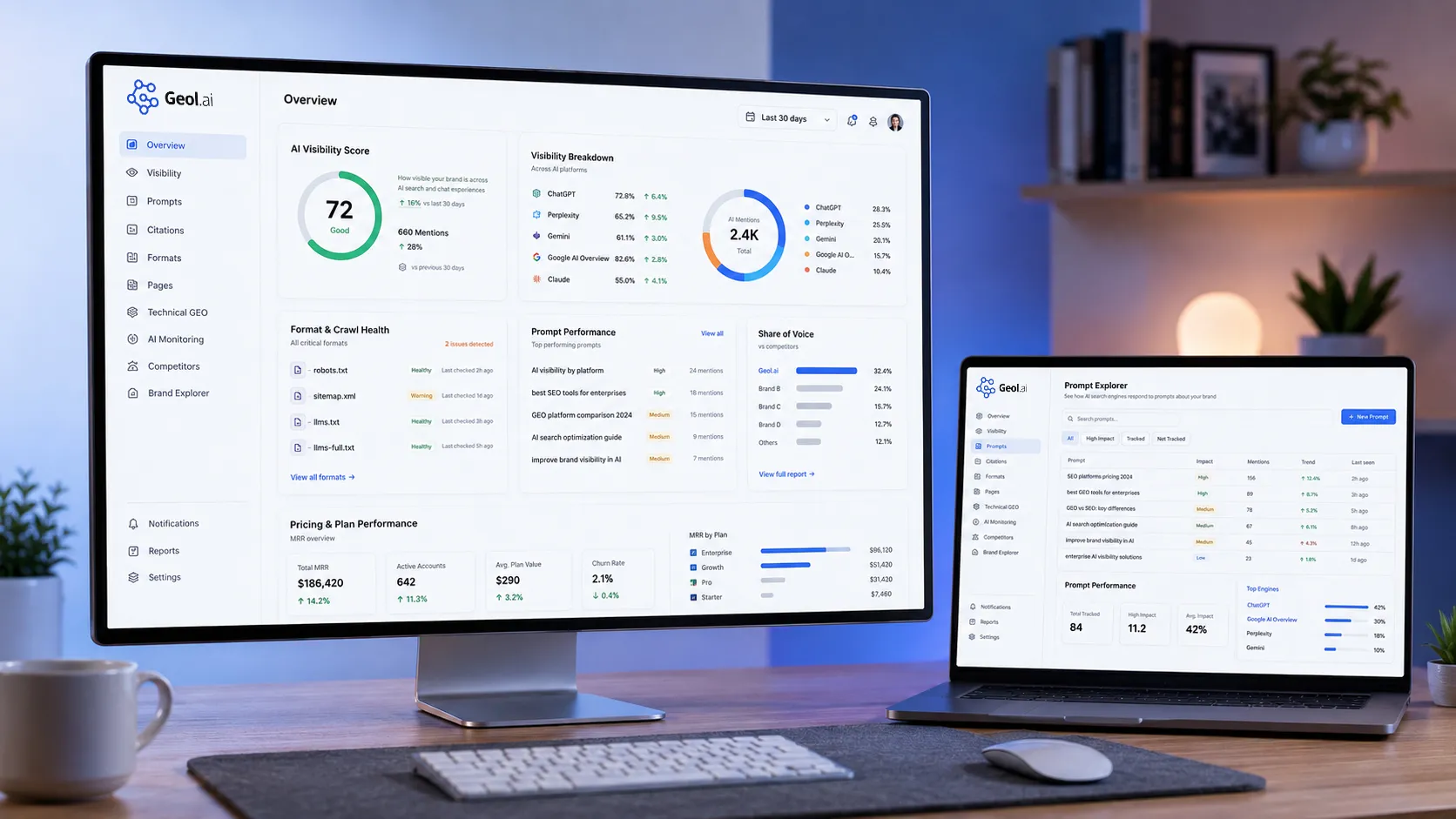
What a GEO Platform Actually Costs in 2026: The Pricing Guide Vendors Won't Write
Real published prices for the Generative Engine Optimization tool market in 2026: self-serve entry tiers, enterprise quote walls, metering math, and honest tool-versus-consultant economics.
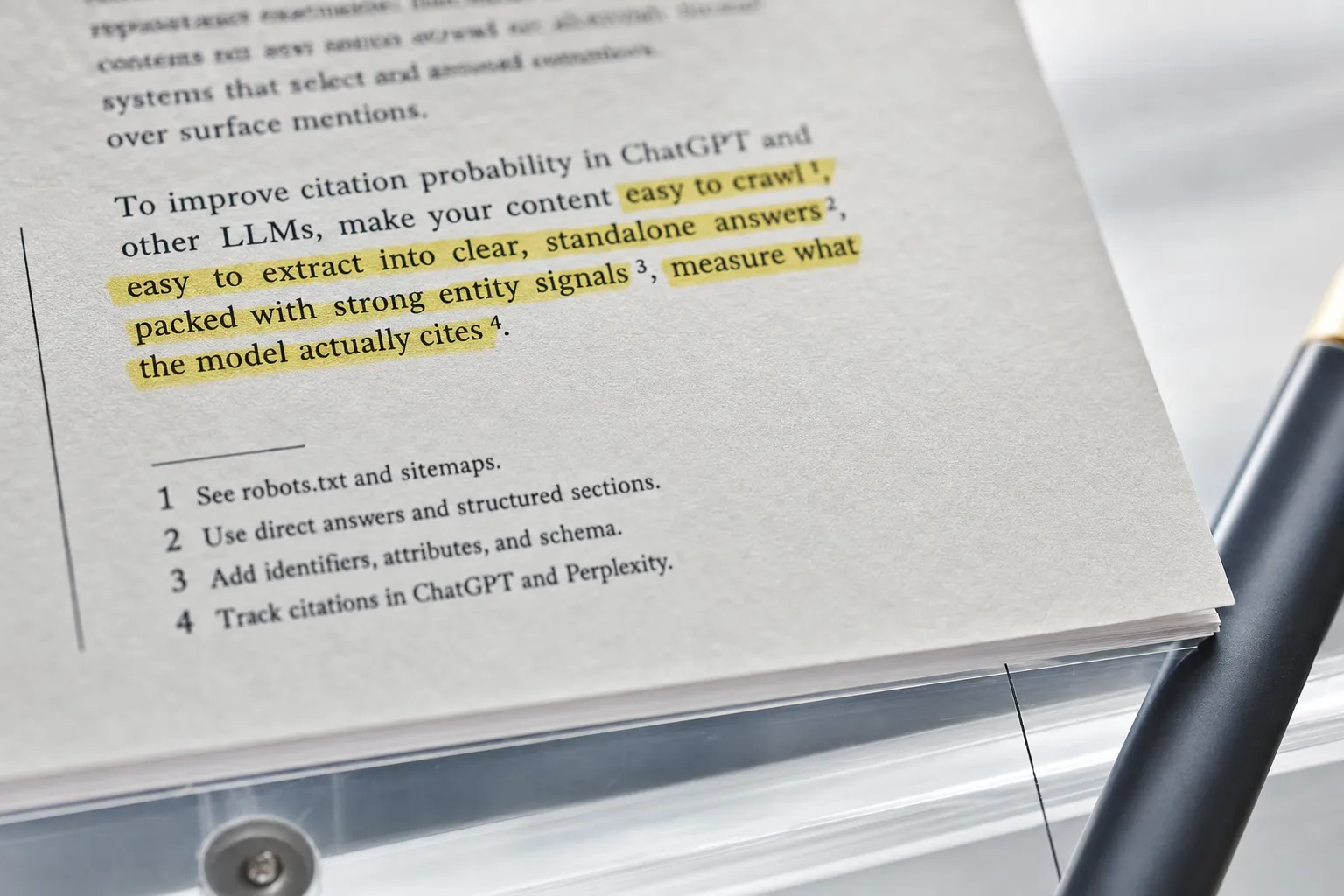
ChatGPT Optimization in 2026: A Working Checklist for Getting Your Brand Cited, Not Just Ranked
How ChatGPT retrieves and cites sources in July 2026, with a sourced Generative Engine Optimization checklist covering crawler access, extractable answers, entity signals, and measurement.