How to Evaluate GEO Tools: AI Visibility, Citations, and What to Measure
A practical rubric for comparing GEO measurement tools by AI visibility, citation confidence, and uncited brand recall.
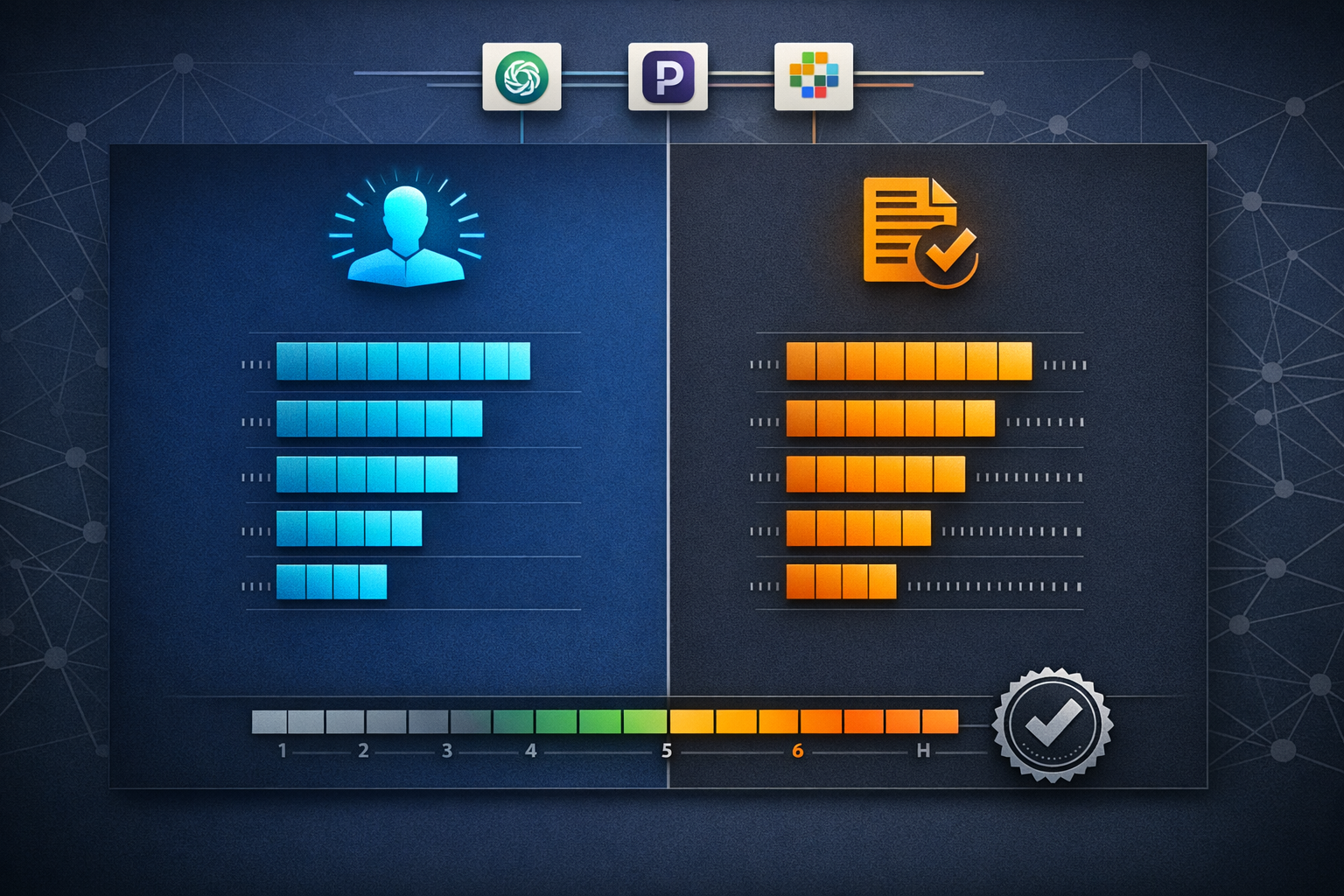
How to Evaluate GEO Tools: AI Visibility, Citations, and What to Measure
The “best” GEO (Generative Engine Optimization) tool depends on what you’re trying to measure: AI Visibility (are you being retrieved/mentioned in answers), Citation Confidence (are you being cited as a source), or uncited recommendation / brand recall (are you being recommended without links). This spoke review gives you a practical rubric, a category-level comparison, and a repeatable benchmark approach so you can choose the right platform (or build a custom stack) for tracking visibility across ChatGPT-style assistants, Perplexity-style answer engines, and Google AI Overviews.
For deeper coverage on how “thought partner” search changes measurement expectations, see our briefing on Google's Gemini 3: Transforming Search into a 'Thought Partner'—What It Means for Generative Engine Optimization.
How to evaluate Generative Engine Optimization tools (criteria + scoring rubric)
Define the outcomes: AI Visibility vs Citation Confidence
Start by naming the outcome you’re optimizing for—because different tools are “accurate” in different ways:
- AI Visibility (retrieval/mention): Your brand, product, experts, or pages appear in the answer text—even if there’s no hyperlink.
- Citation Confidence (linked/source citation): The answer engine explicitly cites your domain/URL as supporting evidence.
- Uncited recommendation / brand recall: You’re recommended (e.g., “Top tools include X”) but not cited. This is common in assistant UX and is harder to validate without raw snapshots.
Minimum viable feature set for GEO tracking
Before you compare vendors, confirm the tool can reliably do the basics for both visibility and citations:
- Engine coverage: tracks the answer surfaces you care about (e.g., Perplexity-style citations vs assistant-style mentions vs Google AI Overviews).
- Query set + prompt library management: versioned queries, tags (intent/entity), and the ability to freeze a “benchmark set.”
- Answer/SERP capture: stores raw snapshots (answer text, citations, timestamps, locale/device where applicable).
- Citation extraction + normalization: maps citations to canonical URLs/domains, handles duplicates, and preserves evidence text around the citation.
- Change detection: alerts on material answer shifts, citation swaps, or new competitors entering the answer.
Scoring rubric: accuracy, coverage, repeatability, and actionability
A practical rubric keeps your evaluation objective. Use weights to reflect how much you care about measurement validity vs workflow vs cost. Example weighting (adjust to your org):
| Criterion | Weight | What it measures | Maps most to |
|---|---|---|---|
| Measurement validity | 30% | Raw snapshots, citation parsing accuracy, deduping, clear methodology, low false positives | Citation Confidence |
| Coverage | 25% | Engines/regions/devices, query volume limits, competitor set breadth | AI Visibility |
| Workflow + governance | 20% | Query library versioning, permissions, audit logs, annotations for content/schema changes | Both |
| Integrations + export | 15% | API/export, BI connectors, Search Console/analytics join keys, webhook alerts | Actionability |
| Cost + scalability | 10% | Pricing bands, overage model, query scaling, seats | Both |
Sample score calculation: if a tool scores 4/5 on validity, 3/5 on coverage, 5/5 workflow, 3/5 integrations, 2/5 cost, then total = (4×0.30)+(3×0.25)+(5×0.20)+(3×0.15)+(2×0.10)=3.65/5.
Run the same fixed query set, on the same schedule, with the same locale/device assumptions. If a vendor can’t provide raw answer snapshots and timestamps, you can’t audit volatility or citation parsing errors—treat that as a major validity risk.
External context: citation behavior varies by engine and is evolving. Studies and industry analyses highlight shifting citation patterns and source preferences, which makes reproducible snapshots and longitudinal tracking essential (see Semrush’s analysis and AirOps’ report on AI search visibility metrics).
Side-by-side comparison table: top GEO tool categories (and when each wins)
Most buying decisions aren’t about a specific vendor—they’re about the measurement approach. Below is a category comparison you can use to shortlist tools quickly.
| Category | Typical strengths | Common gaps | Best for |
|---|---|---|---|
| 1) AI answer monitoring & citation trackers | Prompt/query libraries, answer snapshots, citation extraction, change alerts, share-of-voice in answers | Engine coverage varies; reproducibility controls may be limited; some use opaque “visibility scores” | Teams prioritizing GEO-specific measurement and fast iteration |
| 2) SEO suites adding AI Overviews tracking | Unified SEO context (rank, links, site health), reporting maturity, stakeholder-friendly dashboards | Prompt-level repeatability and citation parsing can be weaker; may focus mainly on Google surfaces | SEO-led orgs that need GEO inside existing reporting + governance |
| 3) Custom measurement (scripts + logs + LLM eval) | Maximum transparency, tailored prompts, auditability, regulated workflows, custom KPIs and QA | Engineering time; rate limits; brittle scrapers; requires experimental design discipline | Enterprises needing control, compliance, or custom entity-level measurement |
If you’re also tracking traditional SEO changes, keep in mind that technical performance can still gate visibility. Industry coverage of Google’s March 2026 update wave emphasized page experience signals (Core Web Vitals) as a practical constraint on organic performance (see QuantifiMedia’s recap) and the importance of monitoring spam enforcement impacts (see Search Engine Journal).
Deep-dive reviews (pick 3–5 representative options) using the same rubric
Below are representative options (by approach). Use the same rubric sections for every vendor you evaluate so the comparison stays apples-to-apples.
Option A: Dedicated AI answer monitoring platform (strengths/limits)
- Setup time: Typically fastest (days). Import query sets, tag by entity/intent, start scheduled captures.
- Coverage: Usually strongest on answer snapshots and citations; engine breadth varies—confirm which surfaces are first-class vs “best effort.”
- Measurement validity: Good if raw snapshots + citation URLs are stored. Watch for composite scores without audit trails.
- Reporting: Strong answer-level diffs, share-of-voice, and competitor citations; sometimes weaker at joining to web analytics.
- Integrations: Look for exports, API, and annotation workflows (content/schema change logs).
- Actions enabled: Identify missing entities, weak evidence formatting, and which URLs win citations for each intent cluster.
Option B: Enterprise SEO suite with AI Overviews tracking (strengths/limits)
- Setup time: Moderate (1–3 weeks) if you already use the suite; faster stakeholder rollout via existing dashboards.
- Coverage: Often best on Google surfaces and traditional SEO context; may not capture assistant-style uncited mentions well.
- Measurement validity: Can be strong for SERP-based captures; validate how AI Overviews are detected and whether snapshots are stored for audit.
- Reporting: Excellent for exec reporting, trend lines, and tying to rankings/technical fixes; sometimes less granular at prompt-level reproducibility.
- Actions enabled: Prioritize pages that already rank but fail to earn citations; align GEO work with technical SEO and content ops.
Option C: Custom stack for GEO measurement (strengths/limits)
- Setup time: Slowest (weeks) but most controllable. Typical components: query runner, snapshot store, citation parser, evaluator, BI layer.
- Coverage: Whatever you build—great for bespoke locales/entities; constrained by API access and ToS limitations for scraping.
- Measurement validity: Highest potential if you store everything (prompt, parameters, output, citations, model/version, run context).
- Reporting: As good as your BI and taxonomy. You can segment by entity graph, funnel stage, regulated claims, or product line.
- Actions enabled: Tight experimentation loops: annotate content/schema releases and measure causal impact on citations/mentions.
Be cautious if you see: (1) no raw snapshots, (2) “visibility scores” without definitions, (3) no control over query versions/parameters, (4) citations that can’t be normalized to canonical URLs, (5) no segmentation by entity/topic, or (6) no way to export data for independent validation.
Mini-benchmark: what to measure across tools (2–4 weeks)
To compare platforms fairly, run the same 20–50 queries across tools for 2–4 weeks and track: (a) citation capture rate, (b) unstable/duplicate answers %, (c) time-to-detect change, and (d) correlation with known site changes (content updates, internal linking, Schema changes).
Example benchmark outcomes across GEO tool approaches (illustrative)
Illustrative benchmark of how different approaches might perform on core measurement outcomes over 4 weeks. Use your own query set and definitions.
Why volatility matters: assistant outputs can vary due to model updates, retrieval changes, personalization, and regional differences. Content strategy guidance increasingly emphasizes LLM-specific optimization concepts and the need to design for how models select evidence (see Ranktracker’s LLMO overview and Contently’s analysis of community-driven citations).
What the numbers should look like: KPIs and dashboards for AI Visibility
Core KPIs: retrieval rate, citation rate, share-of-voice in answers
Define KPIs with simple formulas your team can audit. Examples for a fixed query set and time window:
- AI Visibility % (retrieval rate): answers where your brand/entity is mentioned ÷ total tracked answers.
- Citation rate % (Citation Confidence): answers that cite your domain/URL ÷ total tracked answers.
- Answer share-of-voice (SOV): your citations/mentions ÷ total citations/mentions across all brands for the query set.
Segmenting by entity, intent, and funnel stage
Keyword-only tracking hides why you win or lose citations. Segment by: (1) entity (brand, product, people), (2) relationship ("X vs Y", "best for", "pricing"), and (3) intent (learn, compare, buy, troubleshoot). This mirrors how answer engines assemble responses around entities and evidence.
Attribution: connecting GEO metrics to traffic, leads, and brand lift
Treat GEO metrics as leading indicators, not last-click truth. Where possible, validate with assisted conversions, branded search lift, direct/referral patterns, and sales enablement signals. Also annotate major technical changes—performance and spam enforcement can affect what gets surfaced and trusted.
Sample weekly KPI trend: AI Visibility vs Citation Rate (illustrative)
Illustrative trend showing how visibility can rise before citation rate improves after content and structured data changes.
A useful GEO dashboard typically drills: Query set → Engine/surface → Entity/topic → Page/URL → Mention vs citation → Extracted snippet + citation URLs → Change log + annotations (content/schema/PR releases). If your tool can’t preserve the evidence trail, it’s hard to improve citation confidence systematically.
Recommendations: which GEO tool approach to choose (by team size and maturity)
Decision tree: pick the right tool type in 5 questions
- Do you need auditability (raw snapshots, change logs) for compliance or exec trust? If yes → favor custom stack or a dedicated monitoring platform with exports.
- Is Google AI Overviews your primary surface and you already run an SEO suite? If yes → start with the suite add-on, then layer a GEO-specific tool for prompt-level depth.
- Do you need fast insights with minimal engineering? If yes → dedicated AI monitoring platform.
- Do you need custom entity taxonomies, regulated claim checks, or bespoke locales? If yes → custom stack (or vendor + custom warehouse).
- Do you need unified reporting across SEO + GEO + content operations? If yes → suite-first or vendor with strong BI integration.
Budget scenarios: lean, growth, enterprise
A practical way to think about spend is “cost per validated insight.” If you can’t reproduce an answer and inspect citations, you’ll spend more time debating the data than improving it.
Resource requirements by GEO measurement approach (typical ranges)
Typical ongoing effort and time-to-insight once initial setup is complete. Ranges vary by query volume, number of engines, and governance needs.
Implementation checklist: 30-day rollout plan
Week 1 — Define scope + query set
Pick 20–50 queries that represent your revenue and reputation: top products, “best X for Y,” comparisons, and troubleshooting. Tag each query by entity and intent. Freeze a benchmark version.
Week 2 — Instrument snapshots + governance
Configure engine coverage, locales, and capture frequency. Ensure raw answer snapshots and citation URLs are stored. Set roles, permissions, and an annotation process for content/schema releases.
Week 3 — Establish KPIs + QA
Compute baseline AI Visibility %, citation rate %, and SOV. QA citation parsing (canonicalization, duplicates, redirects). Identify the top 10 “high-visibility / low-citation” queries.
Week 4 — Run 2–3 controlled improvements
Ship targeted updates: clarify entities, add evidence sections, improve internal linking, and (where appropriate) structured data. Annotate changes, then monitor time-to-detect and citation shifts.
Key Takeaways
Choose tools based on outcome: AI Visibility (mentions) vs Citation Confidence (citations) vs uncited recommendations—each requires different validation.
Measurement validity hinges on raw snapshots, reproducible query sets, and accurate citation normalization; opaque scoring without evidence is a reliability risk.
Compare categories first: dedicated AI monitoring tools for GEO depth, SEO suites for unified context, custom stacks for maximum auditability and tailoring.
A 20–50 query benchmark over 2–4 weeks (capture rate, volatility, change detection, correlation to site changes) is usually enough to pick a winner confidently.
FAQ: GEO tools, AI citations, and tracking limitations
Frequently Asked Questions
If you want to future-proof your approach, prioritize tooling that supports audit trails and longitudinal analysis—answer engines and citation patterns shift over time, and your measurement system needs to be stable enough to detect real improvements rather than noise.

Founder of Geol.ai
Senior builder at the intersection of AI, search, and blockchain. I design and ship agentic systems that automate complex business workflows. On the search side, I’m at the forefront of GEO/AEO (AI SEO), where retrieval, structured data, and entity authority map directly to AI answers and revenue. I’ve authored a whitepaper on this space and road-test ideas currently in production. On the infrastructure side, I integrate LLM pipelines (RAG, vector search, tool calling), data connectors (CRM/ERP/Ads), and observability so teams can trust automation at scale. In crypto, I implement alternative payment rails (on-chain + off-ramp orchestration, stable-value flows, compliance gating) to reduce fees and settlement times versus traditional processors and legacy financial institutions. A true Bitcoin treasury advocate. 18+ years of web dev, SEO, and PPC give me the full stack—from growth strategy to code. I’m hands-on (Vibe coding on Replit/Codex/Cursor) and pragmatic: ship fast, measure impact, iterate. Focus areas: AI workflow automation • GEO/AEO strategy • AI content/retrieval architecture • Data pipelines • On-chain payments • Product-led growth for AI systems Let’s talk if you want: to automate a revenue workflow, make your site/brand “answer-ready” for AI, or stand up crypto payments without breaking compliance or UX.
Related Articles

Perplexity’s July 14 Product Drop Signals a New Playbook for AI-Native Discovery
A side-by-side review of Perplexity’s July 14 product drop and ChatGPT’s cited research model, with practical Generative Engine Optimization lessons.
What a GEO Platform Actually Costs in 2026: The Pricing Guide Vendors Won't Write
Real published prices for the Generative Engine Optimization tool market in 2026: self-serve entry tiers, enterprise quote walls, metering math, and honest tool-versus-consultant economics.