GhostCite Study Reveals High Rates of AI-Generated Fake Citations: What It Means for Citation Confidence
GhostCite findings show AI often fabricates citations. Learn how fake references reduce Citation Confidence and how to audit and mitigate risk.

GhostCite Study Reveals High Rates of AI-Generated Fake Citations: What It Means for Citation Confidence
The GhostCite study argues that modern AI systems can output citations that look academically “correct” but don’t actually exist—and that this behavior can meaningfully distort how teams measure and improve Citation Confidence (the measurable likelihood an AI answer engine will cite a specific piece of content for relevant queries). If your GEO program treats any citation-shaped reference as “a win,” you risk optimizing toward an illusion: fabricated or misattributed sources inflate performance reports, misdirect investment, and reduce trust in AI-driven discovery.
A citation in an AI answer is only evidence of visibility if it is verifiable (resolves to a real source) and correctly attributed (points to the right work and supports the claim). Otherwise, “Citation Confidence” becomes a vanity metric.
Primary reference: GhostCite on arXiv (The Integrity Crisis in AI-Generated Content: Addressing 'Ghost Citations').
Executive Summary: GhostCite’s Key Findings and the Citation Confidence Problem
What GhostCite tested (models, prompts, and citation formats)
GhostCite evaluates how often AI systems produce “ghost citations”—references that appear plausible (author, title, venue, year, DOI/URL) but fail verification. The study emphasizes that citation formatting pressure (e.g., “include scholarly sources,” “give 10 references,” “use APA/IEEE”) can condition models to generate citation-shaped text even when the model lacks reliable retrieval or provenance.
The headline result: fabricated citations and why they happen
The core claim is not simply that models “hallucinate,” but that they can produce citations that look structurally correct while being substantively wrong: non-existent papers, mismatched metadata, incorrect DOIs, or real venues paired with fake articles. Mechanistically, next-token prediction plus strong formatting constraints can yield highly convincing bibliographic strings—especially when the model is asked to be exhaustive, authoritative, or “academic.”
Why this matters for Citation Confidence as a measurable metric
In GEO, teams increasingly track whether AI answer engines cite their pages. GhostCite’s warning is that “citations” can be false positives—references that look like citations but don’t map to a real source. That breaks measurement in two ways:
- Inflated performance: dashboards count fabricated references as successful citations.
- Wrong optimization targets: teams optimize toward prompts/engines that “produce citations,” even if those citations are unreliable or misattributed.
For a practical lens on how AI-driven SERP features change user behavior and measurement assumptions, see our internal guide on actioning visibility shifts: hide Google’s AI Overviews from your search results. (APPLIES: understanding where answers appear helps you interpret “citation” claims and audit what’s actually being referenced.)
Deep Dive: How GhostCite Identifies “Fake Citations” and What Counts as a Failure
Operational definitions: fabricated vs. distorted vs. misattributed citations
To make citation fabrication measurable, GhostCite frames failures in ways GEO teams can adopt. A useful operational taxonomy looks like this:
- Fully fabricated: the cited work cannot be found in authoritative indexes or on publisher sites; DOI/URL doesn’t resolve; the paper/journal issue doesn’t exist.
- Distorted: the work exists, but key metadata is wrong (author list, year, volume/issue/pages) or the DOI points to a different article.
- Misattributed: the citation is real but attached to the wrong claim, wrong entity, or wrong source (e.g., the model “credits” a conclusion to a paper that doesn’t support it).
Verification workflow: databases, URLs, DOIs, and bibliographic matching
A reproducible verification checklist (adaptable for automation) typically includes:
- Parse the citation: extract title, authors, year, venue, DOI/URL/PMID.
- Resolve identifiers: test DOI via doi.org; test URL for 200 response + canonical destination (no soft-404).
- Cross-check bibliographic truth: search Crossref and publisher sites; confirm journal issue/volume/pages match.
- Backstop with scholarly indexes: Google Scholar / library catalogs for title+author matching (beware similarly named works).
- Archive checks: if a URL is dead, verify via the Internet Archive or cached versions to distinguish link rot from fabrication.
Authoritative tools and references for this workflow include Crossref (https://www.crossref.org/), the DOI resolver (https://doi.org/), and the Internet Archive (https://archive.org/).
Common failure patterns: plausible metadata, real journals, fake articles
GhostCite highlights a particularly dangerous pattern for GEO analytics: citations that “feel right” because the journal/venue is real and the metadata is plausible. In practice, models often blend real components (journal name, common author surnames, typical page ranges) into a non-existent article. For Citation Confidence measurement, these failures create the illusion that an engine is citing rigorous sources—when it is generating source-shaped artifacts.
GhostCite failure taxonomy (illustrative structure for reporting)
Use this structure to report verified vs. unverified citations by failure type. Replace values with your audited results or GhostCite-reported splits.
GhostCite is the right source to populate this distribution, but citation-rate numbers vary by model, prompt pressure, and domain. If you can’t confidently extract exact percentages from the paper, run a small internal audit and publish your own verified split using the same taxonomy.
Data Analysis: When and Why AI Citation Fabrication Rates Spike
Prompt conditions that increase fabrication (e.g., “include 10 scholarly sources”)
GhostCite’s framing implies a consistent risk pattern: the more you force citations—especially a fixed count—the more likely the model is to “complete the pattern” with invented references. In GEO terms, this means Citation Confidence should be measured under realistic user prompts (or representative engine behaviors), not under artificially citation-heavy evaluation prompts that inflate both real and fake references.
Domain sensitivity: medical/legal vs. marketing/tech
Fabrication risk is not uniform. It tends to rise when the domain is high-stakes, niche, or paywalled (where the model is less likely to have reliable access to the primary literature), and when entity names are ambiguous (e.g., similar-sounding drugs, standards, or organizations). For GEO teams, this is why Citation Confidence should be segmented by topic cluster and intent (informational vs. transactional vs. policy/compliance).
Retrieval and grounding: RAG vs. non-RAG behavior
Retrieval-augmented generation (RAG) generally reduces fabrication by attaching answers to fetched documents. But GhostCite’s broader point still applies: even with retrieval, citation mapping can fail (wrong passage-to-citation alignment, wrong bibliographic metadata, or references that don’t resolve). So the operational question becomes: does the system show provenance you can verify?
| Condition | Why fabrication risk increases | GEO measurement implication |
|---|---|---|
| Forced citation count (e.g., “10 sources”) | Model is incentivized to produce citation-shaped text even without evidence | Don’t benchmark Citation Confidence on citation-heavy prompts; use realistic queries |
| Paywalled or obscure literature | Lower access → higher likelihood of plausible fabrication | Segment by domain; require higher verification thresholds in regulated topics |
| Ambiguous entities (names, acronyms) | Higher chance of mixing metadata from multiple real sources | Track “attribution correctness,” not just “presence of a citation” |
Fabrication risk index by prompt pressure (template for GhostCite-aligned reporting)
A practical way to communicate conditional risk when exact cross-model rates vary. Replace values using GhostCite-reported results and/or your internal audit.
Context note: enterprise AI adoption is accelerating, increasing the surface area for citation errors in real workflows (see Axios coverage of enterprise assistant competition: https://www.axios.com/2026/03/09/microsoft-copilot-cowork-anthropic). High-volume usage makes verification and reporting discipline more important, not less.
Implications for GEO Fundamentals: Measuring Citation Confidence Without Being Fooled
Metric design: separating “citation-shaped output” from verified attribution
A resilient Citation Confidence measurement framework should separate four layers:
- Observed citation frequency: how often your content (or brand) appears in citations for a query set.
- Verification pass rate: how often the cited URL/DOI/title resolves and matches a real source.
- Attribution correctness: whether the citation truly points to your page/work (not a similarly named entity) and is bibliographically accurate.
- Claim alignment: whether the cited source supports the specific claim made in the answer.
Compute Verified Citation Confidence (VCC) as: Citation Confidence × Verification Rate. Optionally multiply by Claim-Alignment Rate for high-stakes domains.
Instrumentation: how to log, validate, and score citations at scale
To avoid being misled by ghost citations, implement an evidence-first logging approach:
Capture raw output + context
Store the full answer, the prompt/query, engine/model name, timestamp, locale, and any UI-provided source list. Screenshot or HTML capture helps when UIs change.
Extract citations into structured fields
Parse URLs, DOIs, titles, authors, and publication metadata. Normalize canonical URLs and strip tracking parameters.
Automate resolvability checks
Run HTTP status checks, DOI resolution, and Crossref lookups. Flag soft-404s, redirects to unrelated pages, and non-matching titles.
Human review for attribution + claim alignment
Sample citations by risk tier (regulated topics, forced-citation prompts, new engines). Verify the cited source actually supports the claim in the answer.
Report with an error taxonomy
Publish breakdowns: verified vs fabricated vs distorted vs misattributed. Track trends over time and by engine/domain.
Decision impact: why fake citations can misallocate GEO investment
If your team’s OKRs count unverified citations, you can end up funding the wrong content initiatives (or celebrating “wins” that never actually occurred). This is especially risky when enterprise AI competition pushes rapid deployment and broad usage (see additional industry context: https://www.axios.com/2026/03/11/openai-anthropic-pentagon-google and AP coverage of AI ethics concerns: https://apnews.com/article/c4210e7eddd9ad90161e7fa2da9736e2).
Worked example: Citation Confidence vs. Verified Citation Confidence
Example calculation showing how verification and alignment reduce inflated “citation” rates. Replace with your audit data.
From the example above: Citation Confidence (raw) = 40/100 = 40%. Verification Rate = 25/40 = 62.5%. Verified Citation Confidence (VCC) = 40% × 62.5% = 25%. If you add Claim-Alignment Rate = 18/25 = 72%, then Verified+Aligned Confidence = 25% × 72% = 18%.
Expert Perspectives and Mitigation: Increasing Citation Confidence While Reducing Citation Fraud Risk
Expert quote opportunities: librarians, research integrity, and RAG engineers
Quote prompt you can source: “In librarianship, a citation is only as good as its traceability—if you can’t resolve it, you don’t have a source.”
Quote prompt you can source: “Citation integrity isn’t formatting; it’s accountability. Models can mimic the form of scholarship without the underlying evidence chain.”
Quote prompt you can source: “RAG reduces hallucination, but citation mapping is a separate problem—linking the exact claim to the exact passage and the correct bibliographic record.”
Publisher and brand safeguards: structured metadata and canonical URLs
You can improve the odds of being cited correctly (and reduce misattribution) without encouraging fabrication by making your sources easier to retrieve and verify:
- Use stable, canonical URLs and consistent page titles (avoid frequent slug changes).
- Publish clear author/date fields and editorial policies; keep “last updated” honest and visible.
- Add structured metadata (e.g., schema.org Article/Organization), and ensure Open Graph + canonical tags are correct.
- Where you cite research, include outbound links that resolve (DOIs where possible) and provide full bibliographic details.
Model-side and workflow-side mitigations: retrieval, constraints, and UI cues
Operational safeguards that reduce ghost-citation risk in your organization’s workflows:
Mitigation options: what helps (and what it costs)
- Require clickable sources (URLs/DOIs) and log them for audits
- Prefer systems with provenance (retrieval traces, document IDs, passage highlighting)
- Automate resolvability checks (HTTP + DOI + Crossref) before publishing
- Separate “mentions” from “verified citations” in reporting
- Verification adds latency/cost (especially human claim-alignment review)
- Some sources are legitimately hard to resolve (paywalls, link rot)
- RAG reduces risk but doesn’t eliminate mapping errors
- Strict policies may reduce the number of citations shown (but increase trust)
| Audit KPI | Target threshold | Why it matters |
|---|---|---|
| Resolvable citation links (URL/DOI) | ≥ 90% | Filters out obvious fabrications and broken attribution chains |
| Bibliographic match accuracy | ≥ 85% | Ensures the citation points to the intended work (reduces distorted metadata) |
| Claim-alignment on audited samples | ≥ 80% (higher for regulated domains) | Prevents “real citation, wrong claim” failures that still mislead users |
Finally, keep an eye on the broader AI ecosystem: funding and open-source pushes can change which models and citation behaviors dominate (e.g., Le Monde coverage of major AI funding: https://www.lemonde.fr/en/economy/article/2026/03/10/yann-le-cun-raises-900-million-for-his-france-based-ai-start-up_6751277_19.html). That’s another reason to track Citation Confidence by engine and over time—not as a one-off benchmark.
Key Takeaways
Citation Confidence should be treated as conditional (by query, domain, and engine) because citation fabrication risk is not uniform.
Adopt a verification taxonomy (fabricated vs distorted vs misattributed) to prevent “citation-shaped output” from inflating GEO reporting.
Report Verified Citation Confidence (Citation Confidence × Verification Rate), and add claim-alignment for high-stakes topics.
Mitigate risk with provenance-first workflows: log sources, automate DOI/URL checks, and sample human reviews for alignment.
FAQ: GhostCite, fake citations, and Citation Confidence

Founder of Geol.ai
Senior builder at the intersection of AI, search, and blockchain. I design and ship agentic systems that automate complex business workflows. On the search side, I’m at the forefront of GEO/AEO (AI SEO), where retrieval, structured data, and entity authority map directly to AI answers and revenue. I’ve authored a whitepaper on this space and road-test ideas currently in production. On the infrastructure side, I integrate LLM pipelines (RAG, vector search, tool calling), data connectors (CRM/ERP/Ads), and observability so teams can trust automation at scale. In crypto, I implement alternative payment rails (on-chain + off-ramp orchestration, stable-value flows, compliance gating) to reduce fees and settlement times versus traditional processors and legacy financial institutions. A true Bitcoin treasury advocate. 18+ years of web dev, SEO, and PPC give me the full stack—from growth strategy to code. I’m hands-on (Vibe coding on Replit/Codex/Cursor) and pragmatic: ship fast, measure impact, iterate. Focus areas: AI workflow automation • GEO/AEO strategy • AI content/retrieval architecture • Data pipelines • On-chain payments • Product-led growth for AI systems Let’s talk if you want: to automate a revenue workflow, make your site/brand “answer-ready” for AI, or stand up crypto payments without breaking compliance or UX.
Related Articles
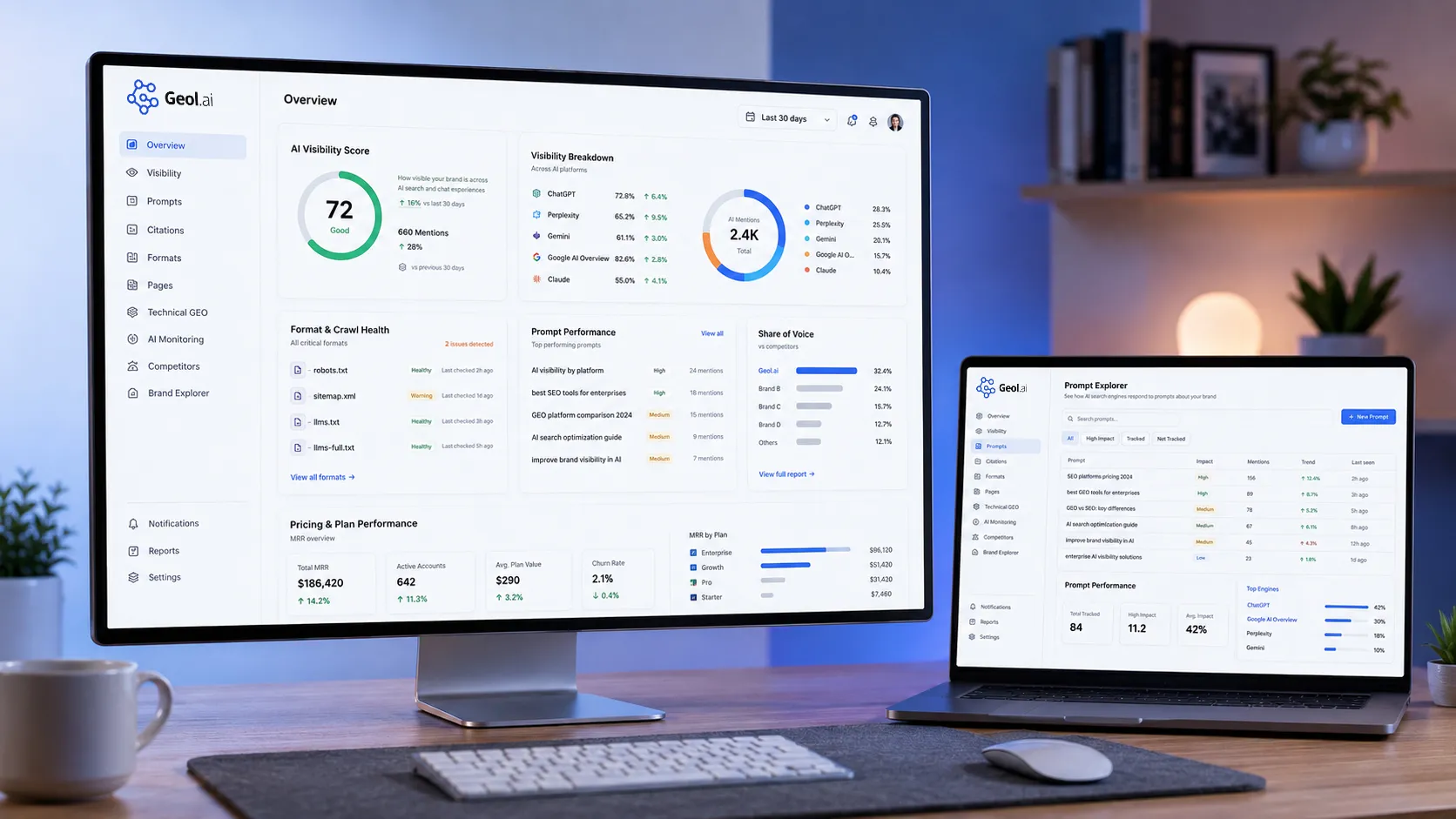
What a GEO Platform Actually Costs in 2026: The Pricing Guide Vendors Won't Write
Real published prices for the Generative Engine Optimization tool market in 2026: self-serve entry tiers, enterprise quote walls, metering math, and honest tool-versus-consultant economics.
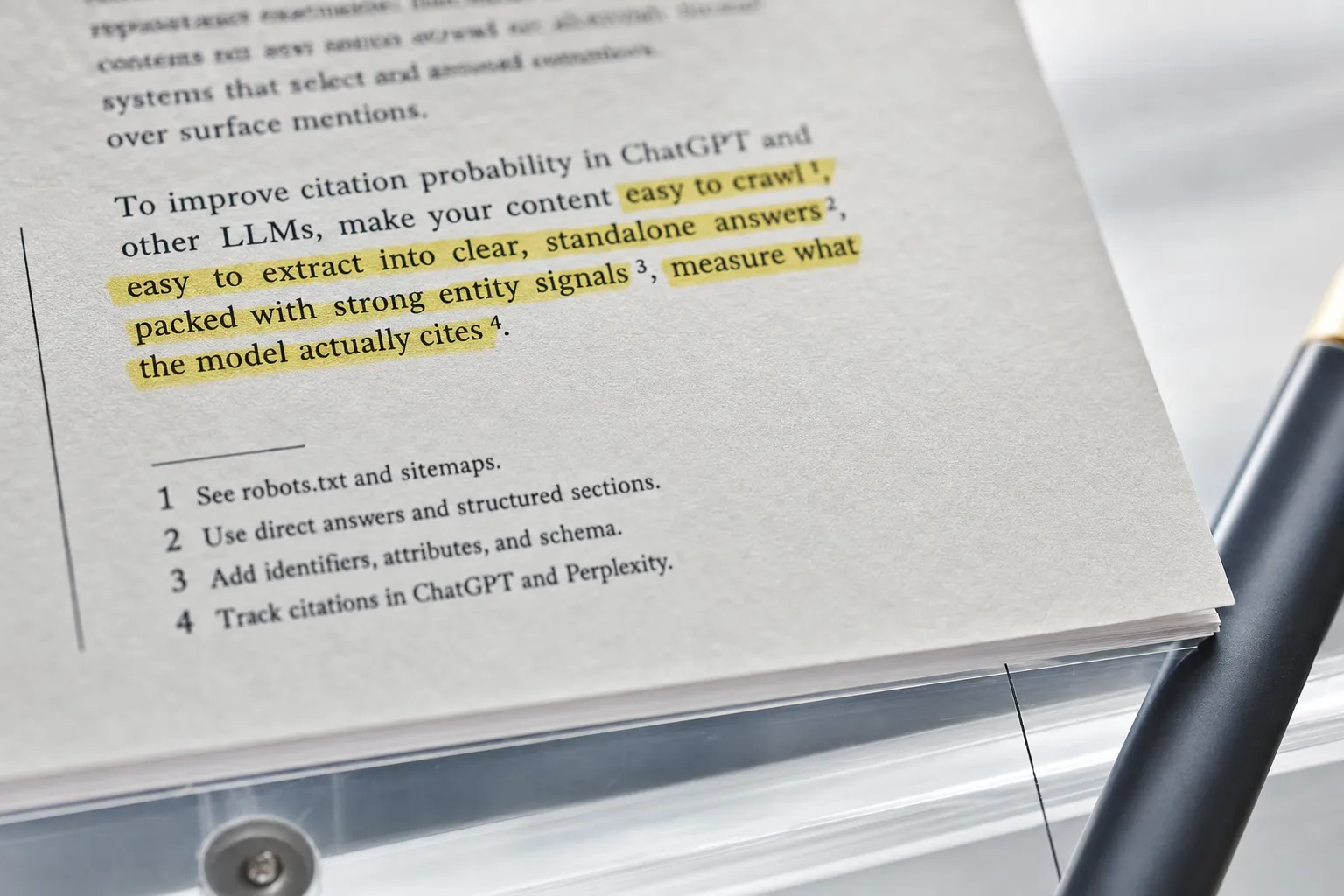
ChatGPT Optimization in 2026: A Working Checklist for Getting Your Brand Cited, Not Just Ranked
How ChatGPT retrieves and cites sources in July 2026, with a sourced Generative Engine Optimization checklist covering crawler access, extractable answers, entity signals, and measurement.