GPT-5.4 Thinking vs GPT-5.4 Pro: What the Release Signals for Knowledge Graph Grounding in Google AI Overviews
News analysis of GPT-5.4 Thinking and GPT-5.4 Pro and what they mean for Knowledge Graph grounding, citations, and visibility in Google AI Overviews.
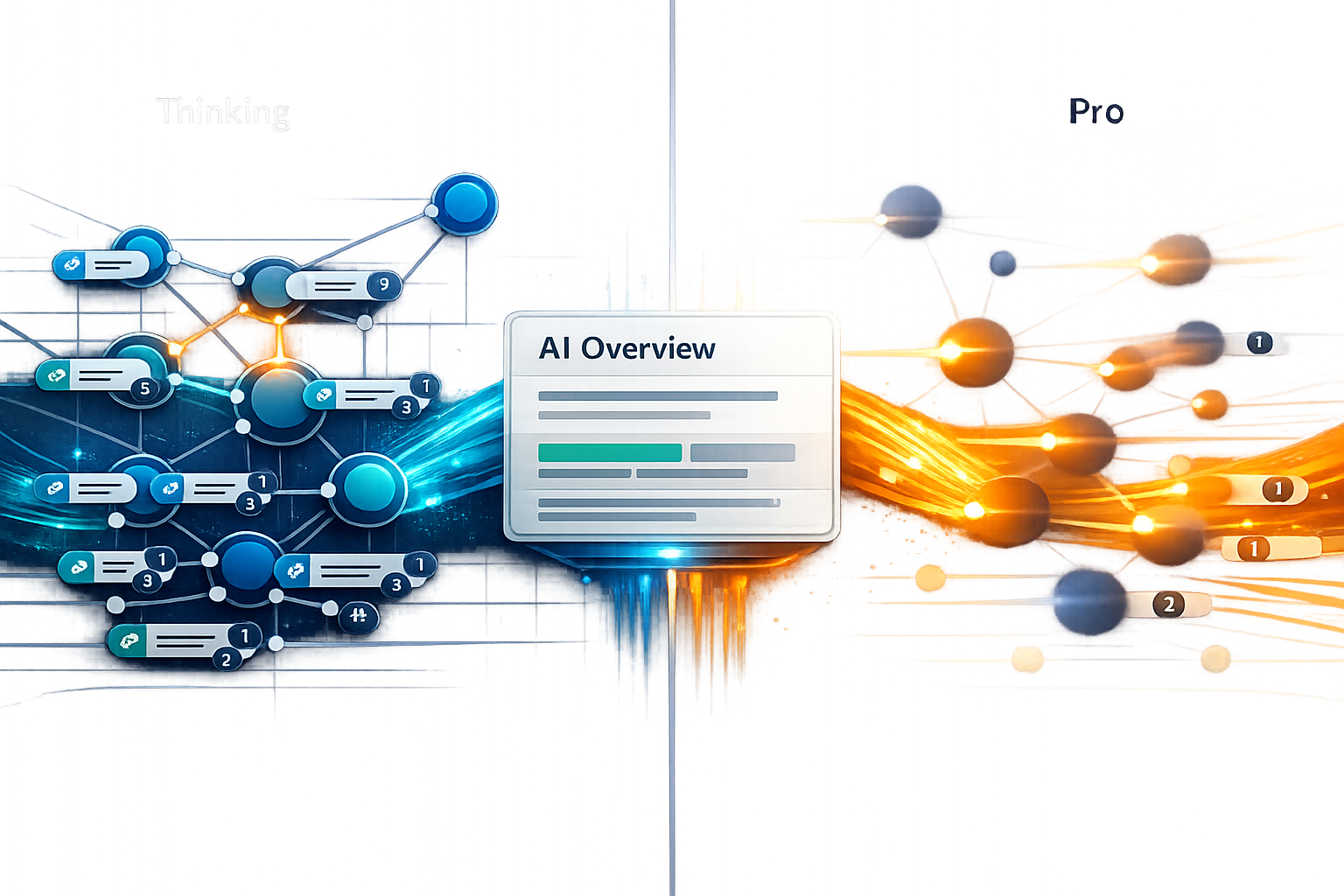
GPT-5.4 Thinking vs GPT-5.4 Pro: What the Release Signals for Knowledge Graph Grounding in Google AI Overviews
GPT-5.4’s split into a deliberative “Thinking” variant and a throughput-optimized “Pro” variant is more than a product packaging decision—it’s a signal about how answer engines will balance depth (multi-step reasoning, entity disambiguation) with scale (latency and cost). For Google AI Overviews specifically, that balance determines whether summaries are grounded in stable entities and verifiable attributes (Knowledge Graph-friendly) or drift into generic, weakly-cited synthesis. In practice, the release raises the bar for publishers: if your entities aren’t unambiguous, consistently identified, and easy to cite, faster and smarter models won’t help you—they’ll route around you.
This analysis focuses on how model behavior changes incentives for structured data, entity consistency, and retrieval pipelines that feed AI Overviews-style experiences—so you can improve knowledge graph grounding and citation likelihood, not just rankings.
As models get better at reasoning and cheaper to run, AI Overviews-style systems can synthesize more aggressively. That increases the value of pages that are easy to map into entities, attributes, and relationships—and decreases the value of pages that are only “keyword relevant” but entity-ambiguous.
Key takeaways
GPT-5.4 Thinking pushes answer quality toward deeper reconciliation across evidence—raising the premium on clean entity IDs, explicit relationships, and verifiable claims.
GPT-5.4 Pro likely makes large-scale, low-latency synthesis cheaper—so retrieval breadth can increase, but systematic entity mistakes can also scale faster.
For publishers, “being cited” becomes an entity/provenance problem: consistent naming, sameAs identifiers, author/organization markup, and claim-level support.
Monitor AI Overviews with entity-heavy queries: citation domains, attribute coverage, and whether the system abstains when evidence is thin.
What OpenAI just shipped: GPT-5.4 Thinking and GPT-5.4 Pro (and why it matters for Knowledge Graph grounding)
OpenAI announced GPT-5.4 on March 5, 2026, with two variants designed for different operating constraints: GPT-5.4 Thinking (deliberative, higher-reasoning) and GPT-5.4 Pro (production-oriented, optimized for speed and professional workloads). The important takeaway for AI search is not “which model is smarter,” but how these modes encourage different grounding behaviors—especially when an answer must reconcile multiple sources, entities, and attributes. Source: OpenAI release notes.
Release snapshot: dates, availability, and positioning
OpenAI’s packaging is a clue about downstream product requirements. “Thinking” is optimized for deliberation and reconciliation; “Pro” is optimized for predictable performance under production constraints. Search-like experiences (including AI Overviews) care about both: they need correctness and grounding, but they also need to respond within strict latency and cost budgets.
| Dimension | GPT-5.4 Thinking | GPT-5.4 Pro |
|---|---|---|
| Release / rollout | Announced Mar 5, 2026; positioned for deeper reasoning and complex tasks (per release notes). | Announced Mar 5, 2026; positioned for pro-tier performance and production throughput (per release notes). |
| Primary optimization target | Deliberation quality: multi-step reasoning, better reconciliation across evidence. | Latency/throughput: faster answers under tight budgets; scalable deployment. |
| Tooling and integration (as disclosed) | Rolled out across ChatGPT/Codex/API with emphasis on reasoning and integrated coding workflows (see release notes for specifics). | Rolled out across ChatGPT/Codex/API with emphasis on pro-tier performance for complex professional tasks (see release notes for specifics). |
| Implication for grounding | More capacity to reconcile entities/attributes—if retrieval evidence is strong and constraints are enforced. | More capacity to scale synthesis—so consistent entity mapping and deduplication become operational necessities. |
The key distinction: reasoning mode vs production mode
From a Knowledge Graph perspective, “Thinking” is the mode you’d expect to do better at: (1) selecting the correct entity for an ambiguous mention, (2) resolving attribute conflicts across sources, and (3) maintaining consistency across a multi-claim summary. “Pro” is the mode you’d expect to win on: (1) predictable latency, (2) lower cost per answer, and (3) higher throughput—requirements that matter when an overview is generated for millions of queries per day.
Better reasoning can also produce more plausible-sounding but incorrect relationships if the model isn’t tightly anchored to retrieved evidence and entity constraints. This is why citation validity research keeps resurfacing as a core risk area for LLM outputs.
The GhostCite study highlights how fabricated or misaligned citations can appear in LLM-generated content, reinforcing the need for claim-to-source alignment checks in any overview-style system. Source: GhostCite (arXiv).
Why this is a Google AI Overviews story (not just a model story)
Google’s direction of travel is toward more “reasoning-forward” search experiences. Coverage of Google’s experimental AI Mode frames it as advanced reasoning and multimodal capability layered into search behavior—exactly the environment where entity grounding and citation mechanics become product-critical rather than academic. Source: PYMNTS on Google AI Mode.
In other words: GPT-5.4’s split is a market signal. If major model providers are explicitly separating “deliberation” from “production,” then AI Overviews-like systems will increasingly be engineered as hybrid pipelines—fast default synthesis with selective deeper reasoning, plus constraints from retrieval and Knowledge Graphs to keep answers stable.
How “Thinking” changes the Knowledge Graph layer: entity resolution, relationship inference, and confidence
Entity resolution: fewer merges, fewer splits (in theory)
Entity resolution is where overview systems quietly win or lose. If the model merges two entities that should be separate (e.g., a parent company and a similarly named product), the resulting summary can be “fluent” but structurally wrong. A deliberative mode should improve disambiguation by spending more compute on: comparing attributes, checking co-reference across passages, and rejecting near-matches that don’t share stable identifiers (official site, legal name, sameAs links, or consistent bios).
- Fewer incorrect merges: “Acme (company)” vs “Acme (software)” stay distinct when attributes conflict.
- Fewer incorrect splits: the same entity referenced by acronym + full name is unified when identifiers match.
- Cleaner attribute selection: the model is more likely to choose the right HQ/founder/date when sources disagree.
Relationship inference: typed edges vs loose associations
A Knowledge Graph is only as useful as its edges. “Thinking” can help infer relationships across multiple hops (A acquired B; B owns product C; therefore A owns product C). That’s valuable for overview answers—but dangerous if the system infers edges that aren’t explicitly supported by evidence. The practical shift is toward typed relationships (acquiredBy, foundedBy, headquarteredIn) rather than vague “is related to” associations.
If you want AI Overviews to pick up the right relationships, state them explicitly in copy and reinforce them in Schema.org (e.g., parentOrganization, founder, brand, manufacturer, sameAs). Don’t rely on implication.
Confidence and abstention: when the model should say “unknown”
The most underrated grounding improvement is abstention: refusing to fill in an attribute when evidence is missing or contradictory. Deliberative reasoning can improve calibration (knowing when it doesn’t know), but only if the product layer rewards abstention instead of always demanding a complete answer. Citation-validity work like GhostCite underscores why: if an overview must cite, then the system needs mechanisms to avoid “citation-shaped hallucinations” where a source is attached to an unsupported claim.
Benchmark design for entity disambiguation and citation alignment (example template)
Illustrative structure for a benchmark you can run internally. Values are placeholders to show what to measure.
Why GPT-5.4 Pro likely shifts the economics of AI Overviews: speed, cost, and scaling structured understanding
Throughput and latency: what “Pro” implies for real-time synthesis
AI Overviews live inside a latency budget. A “Pro” variant signals that the provider expects heavy production use where milliseconds matter. In search UX, faster inference doesn’t just mean “same answer, quicker”—it changes architecture: you can afford more retrieval calls, more reranking, and more structured post-processing (like entity constraint checks) while still meeting p95 latency targets.
Cost curves: cheaper tokens can mean more retrieval, not less
When per-answer cost drops, product teams often reinvest savings into better grounding rather than minimalism: retrieving more documents, extracting more candidate passages, and running additional verification steps. Developer-facing search tooling illustrates this direction: APIs that provide raw, ranked web results make it easier to build retrieval-first systems where generation is the final step, not the first. Source: InfoQ on Perplexity Search API.
Operational tradeoffs: shallow vs deep grounding at scale
Scaling tradeoff for AI Overviews-style systems
- Faster model enables more queries to receive overviews within latency budgets
- Lower cost can fund broader retrieval and verification steps
- More consistent UX (fewer timeouts, fewer partial answers)
- Systematic entity mapping errors can scale to more users faster
- Broad retrieval increases deduplication and contradiction-handling complexity
- Without constraints, speed can incentivize “good enough” synthesis over careful abstention
Illustrative cost vs retrieval depth under a fixed latency budget
Example curves showing how end-to-end cost can rise with retrieval depth, even as model inference gets cheaper. Values are illustrative for planning.
Implications for publishers: how to make your entities “stick” in AI Overviews via Knowledge Graph-friendly signals
Structured Data that reinforces entities and relationships (Schema.org)
If AI Overviews are increasingly built on retrieval + entity constraints + synthesis, then Schema.org becomes less about “rich results” and more about reducing ambiguity during entity mapping. Your goal is to make it easy for the system to answer: Who/what is this page about? Which identifiers confirm it? What relationships does the page assert, and are they consistent with other sources?
- Use the right top-level entity type: Organization, Person, Product, SoftwareApplication, MedicalEntity, etc.
- Add sameAs links to authoritative profiles (official site, Wikidata, Crunchbase, LinkedIn, app stores—where appropriate).
- Mark relationships explicitly: parentOrganization/subOrganization, founder, brand, manufacturer, owns, memberOf.
- Strengthen provenance: author, editor, reviewedBy (where relevant), and dateModified with visible on-page corroboration.
On-page entity consistency: naming, identifiers, and disambiguation cues
Models can reason better, but they still ingest messy web text. Help them: keep the canonical name consistent across title/H1/intro, include a short disambiguation line (“Acme Analytics (the B2B SaaS company)”), and repeat stable identifiers (legal name, domain, app bundle ID, ISBN, NPI, etc.) where applicable. This reduces the chance that your page is retrieved but mapped to the wrong entity node.
Freshness and provenance: making citations more likely
Citation is a product decision, but you can make yourself the easiest source to cite. Put key claims near the top, support them with primary evidence, and make “who said this and when” unmissable. If the system is trying to avoid GhostCite-style failures, it will prefer sources where claims are clearly stated and attributable.
Structured data + provenance audit scorecard (example)
Use this as a rubric to compare pages in a niche. Values are illustrative.
What happens next: predictions for Knowledge Graph-driven retrieval and AI Overviews behavior over the next 90 days
Short-term: more entity-aware summaries and fewer generic answers
Expect more summaries that read like lightweight Knowledge Graph views: explicit attributes (founder, HQ, pricing tier, compatibility, release date) and fewer vague “best options” statements—when sources support those attributes. Where evidence is thin, watch for more qualifying language or abstention rather than confident filler.
Medium-term: tighter coupling between retrieval, Knowledge Graph constraints, and citations
The likely pipeline direction is hybrid: retrieve broadly, map candidates into entities, apply constraints (dedupe, resolve conflicts, reject unsupported edges), then synthesize. This is consistent with the industry trend toward reasoning-forward search modes and retrieval APIs that expose ranked results for grounding.
What to watch: signals that Google AI Overviews is adapting to model shifts
Track overview presence and volatility
For 30–100 entity-heavy queries, record whether an AI Overview appears and how often it changes week to week.
Measure citations and domain diversity
Count citations per overview, unique domains, and whether the same “authority set” repeats or expands.
Score entity attribute coverage
Create an attribute checklist per entity type (e.g., founder/HQ/pricing for SaaS; dosage/contraindications for medical) and count how many attributes are mentioned.
Check claim-to-citation alignment
Spot-check whether each key claim is actually supported by the cited page(s). Log mismatches as “citation drift.”
SERP monitoring template: overview presence and citations over time (example)
Illustrative time series for weekly monitoring. Values are placeholders.
Recommended internal reading (Geol.ai)
- Google AI Overviews: complete guide to how it works, citations, and optimization
- Knowledge Graph fundamentals: entities, relationships, and semantic search
- Generative Engine Optimization (GEO): strategies for AI search visibility
- Structured Data (Schema.org) implementation checklist for publishers
- AI Retrieval & Content Discovery: how retrieval pipelines influence AI answers
FAQ

Founder of Geol.ai
Senior builder at the intersection of AI, search, and blockchain. I design and ship agentic systems that automate complex business workflows. On the search side, I’m at the forefront of GEO/AEO (AI SEO), where retrieval, structured data, and entity authority map directly to AI answers and revenue. I’ve authored a whitepaper on this space and road-test ideas currently in production. On the infrastructure side, I integrate LLM pipelines (RAG, vector search, tool calling), data connectors (CRM/ERP/Ads), and observability so teams can trust automation at scale. In crypto, I implement alternative payment rails (on-chain + off-ramp orchestration, stable-value flows, compliance gating) to reduce fees and settlement times versus traditional processors and legacy financial institutions. A true Bitcoin treasury advocate. 18+ years of web dev, SEO, and PPC give me the full stack—from growth strategy to code. I’m hands-on (Vibe coding on Replit/Codex/Cursor) and pragmatic: ship fast, measure impact, iterate. Focus areas: AI workflow automation • GEO/AEO strategy • AI content/retrieval architecture • Data pipelines • On-chain payments • Product-led growth for AI systems Let’s talk if you want: to automate a revenue workflow, make your site/brand “answer-ready” for AI, or stand up crypto payments without breaking compliance or UX.
Related Articles
What a GEO Platform Actually Costs in 2026: The Pricing Guide Vendors Won't Write
Real published prices for the Generative Engine Optimization tool market in 2026: self-serve entry tiers, enterprise quote walls, metering math, and honest tool-versus-consultant economics.
ChatGPT Optimization in 2026: A Working Checklist for Getting Your Brand Cited, Not Just Ranked
How ChatGPT retrieves and cites sources in July 2026, with a sourced Generative Engine Optimization checklist covering crawler access, extractable answers, entity signals, and measurement.