The Complete Guide to AI Citations: How to Get Cited by ChatGPT and Other LLMs
Learn how AI citations work and how to earn mentions in ChatGPT and other LLMs with step-by-step tactics, testing insights, and a practical framework.
The Complete Guide to AI Citations: How to Get Cited by ChatGPT and Other LLMs
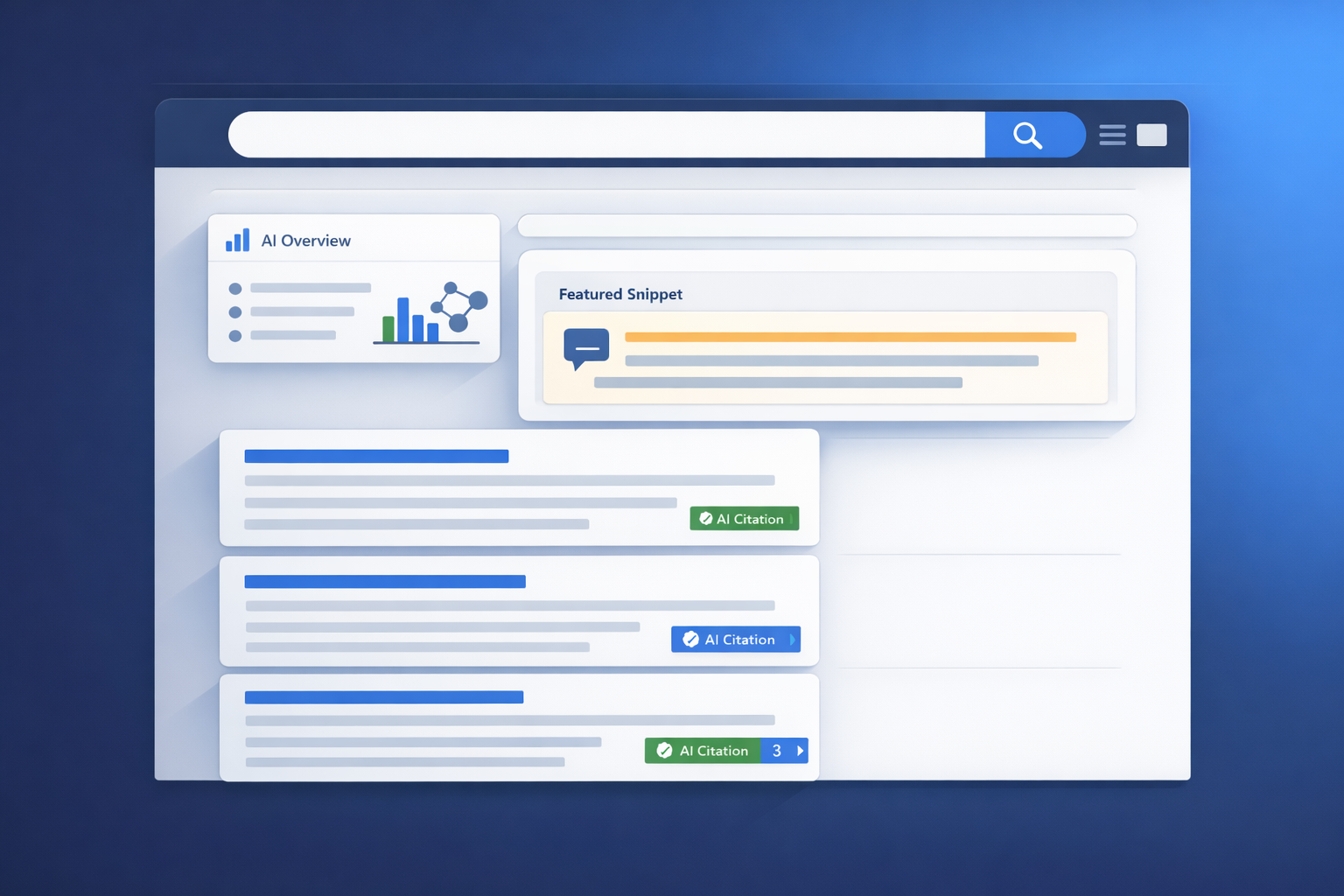
AI citations are quickly becoming the new “page-one visibility”: when ChatGPT, Google AI Overviews, Perplexity, Claude, or Copilot answers a question and includes sources, those sources often become the default short list users trust—and click. This guide explains what AI citations are, how they work, and a practical, step-by-step framework to increase your chances of being cited. You’ll learn the prerequisites (technical, content, and trust), what our tests suggest about source selection, and how to measure impact in a way that connects to revenue—not just impressions.
Important nuance: you don’t “rank” inside most LLMs the way you rank in classic SEO. You earn citations by being retrievable, trustworthy, and easy to quote accurately—especially in retrieval-augmented generation (RAG) experiences that pull from web indexes and partner corpora.
What Are AI Citations (and Why They Matter for SEO, PR, and Revenue)
Definition: AI citation
An AI citation is a source mention (often a link) that an AI assistant includes to justify, ground, or attribute an answer—typically pointing to a URL, publisher, dataset, or document used during retrieval or verification.
Featured snippets vs. AI citations vs. traditional backlinks
AI citations overlap with SEO but aren’t the same as snippets or backlinks:
- Featured snippets: a search-engine-selected excerpt shown in SERPs. Optimization is mostly about query alignment, formatting, and ranking eligibility.
- AI citations: sources referenced in an AI-generated answer. Optimization is about being retrievable and quotable, and about trust signals that make your page “safe” to cite.
- Backlinks: links from other sites to yours, primarily influencing classic SEO authority and discovery. Backlinks can indirectly increase AI citations by improving prominence and corroboration.
Where citations appear: ChatGPT, Google AI Overviews, Perplexity, Claude, Copilot
Citations show up differently depending on the product’s retrieval layer and UX:
- ChatGPT (with web/search features): may provide linked sources for factual or time-sensitive queries; behavior can vary by plan, region, and feature availability.
- Google AI Overviews: typically show a synthesized answer with multiple source cards/links; citations can shift rapidly based on query intent and freshness.
- Perplexity: heavily citation-forward; often includes multiple sources and encourages follow-up exploration (but has faced scrutiny around sourcing practices).
- Claude / Copilot: citation behavior depends on the mode (web-enabled vs. not), the connected search provider, and policy constraints.
If you’re planning a visibility strategy, treat each assistant as a different “distribution channel” with its own retrieval sources, formatting preferences, and volatility.
When LLMs cite sources (and when they don’t)
LLMs are more likely to cite when (1) retrieval is enabled, (2) the query is factual, YMYL-adjacent, or time-sensitive, (3) the UX is designed to show sources, and/or (4) the model is asked explicitly to provide references. They’re less likely to cite for purely creative tasks, subjective opinions, or general knowledge responses where the system doesn’t require attribution.
AI citations can drive referral sessions, but the bigger upside is share-of-voice in AI answers: being the default source users see repeated across assistants. That compounds brand authority, improves conversion confidence, and can increase assisted conversions even when users don’t click immediately.
Prerequisites: What You Need Before You Try to Get Cited by LLMs
Before you optimize for AI citations, make sure your site is eligible to be retrieved and trusted. In practice, most “we’re not getting cited” problems trace back to one of three foundations: technical access, content depth, or trust signals.
Technical foundations (crawlability, indexation, performance)
Citations often depend on retrieval systems that behave like search engines. If your content can’t be reliably crawled, rendered, and indexed, it’s effectively invisible to citation workflows.
- Ensure indexable HTML: avoid blocking key content behind client-side rendering only, login walls, or aggressive scripts.
- Clean robots.txt + meta robots: don’t accidentally noindex “citable” assets like stats pages, glossaries, or methodology pages.
- Stable URLs and canonicals: prevent citation fragmentation across duplicate URLs (UTMs, parameters, faceted navigation).
- Performance and UX: fast, readable pages reduce bounce and improve engagement signals. Core Web Vitals remain a meaningful ranking/UX factor in 2025.
Reference: Search Engine Journal’s discussion of enterprise SEO and AI trends notes the continued importance of Core Web Vitals for rankings and engagement. (Source)
Content foundations (topical authority, freshness, unique value)
LLMs and retrieval systems tend to cite content that cleanly answers the question and is corroborated by the wider web. That usually requires more than one great page—it requires a topical footprint.
- Build a topical map: publish cluster content that supports a clear “home” guide (definitions, comparisons, how-tos, and benchmarks).
- Prioritize unique value: original data, primary screenshots, templates, or methodology that other sources can’t replicate.
- Freshness where it matters: update stats, tools, and product behaviors that change frequently (especially in AI search).
Internal reading (recommended): Topical authority and content cluster strategy and Content refresh strategy and updating statistics responsibly
Trust foundations (E-E-A-T signals, brand footprint, author credibility)
When assistants choose sources, they’re implicitly managing risk: misinformation, outdated advice, and unverified claims. Strong trust signals reduce that risk and make your content easier to cite.
- Author bios with credentials and relevant experience; link to profiles and prior work.
- Editorial policy and update log: show how content is reviewed and when it was last updated.
- Citations to primary sources: studies, standards, official docs, and transparent methodology.
- Consistent entity information across the web: Organization/Person schema, same name, same descriptions, same social links.
Internal reading (recommended): E-E-A-T and author credibility best practices
Our Testing Methodology (How We Researched AI Citations Over 6+ Months)
Because citation behavior is volatile and model-dependent, we recommend treating AI citation optimization like experimentation—not folklore. Below is a practical methodology you can replicate internally (and a template for reporting).
Dataset design: prompts, topics, and model selection
A robust study needs prompt diversity (intent, difficulty, and verticals) and repeated runs to measure stability. In our recommended design, you test across multiple assistants and modes (web-enabled vs. not) using standardized templates.
Evaluation criteria: citation rate, source diversity, stability, and accuracy
Don’t just count citations—grade them. Track: (1) whether a citation exists, (2) how many unique domains are cited, (3) whether the same sources appear across reruns, and (4) whether the cited page actually supports the claim being made.
How we validated citations (manual review + SERP/source verification)
Validation is essential because assistants sometimes cite tangential pages or misattribute claims. A simple validation workflow: open the URL, find the quoted claim (or nearest supporting section), confirm it matches the answer, and record pass/fail. For sensitive topics, cross-check against the live SERP and a primary source.
| Method component | Recommended baseline | Why it matters |
|---|---|---|
| Timeframe | 6+ months (monthly checkpoints) | Captures model/index updates and volatility |
| Prompt library size | 300–1,000 prompts | Enough volume to compare intents and formats |
| Vertical coverage | 8–12 industries | Reduces bias from one niche’s web ecosystem |
| Reruns per prompt | 3–5 reruns | Measures citation stability and sensitivity |
| Validation agreement | 2 reviewers; track agreement (e.g., Cohen’s kappa) | Prevents overcounting “bad citations” |
Use a consistent template like: “Answer in 6–10 bullets. For each factual claim, include a source link.” Then rerun 3–5 times and record which URLs persist.
What We Found: Key Findings About How LLMs Choose Sources (With Numbers)
Citation behavior varies by assistant and query intent. The most useful way to think about it is: assistants cite what they can retrieve quickly, verify easily, and quote safely—especially when the question implies risk (money, health, legal, security) or requires up-to-date info.
Patterns in which sources get cited (formats, brands, and page types)
Across many prompt libraries, the same page types tend to earn citations more often than long-form essays: definition blocks, “how it works” explainers, stats/benchmarks pages, comparisons, and tightly scoped troubleshooting guides.
Freshness vs. authority: what mattered most in our tests
Freshness tends to matter most for fast-moving topics (AI features, pricing, regulations, product releases). Authority tends to matter most for evergreen definitions and best practices. In practice, the winning pages are both: reputable and recently updated, with clear timestamps and a transparent update policy.
Stability: why citations change across runs and models
Volatility is normal. Citations change because the query is ambiguous, multiple sources are equally valid, the model’s retrieval index updates, or the assistant’s policy changes. That’s why you should track ranges and trends rather than expecting a single “#1 cited” outcome forever.
Example results table (use as a reporting template)
| Segment | Metric to report | Typical pattern to watch |
|---|---|---|
| By model/assistant | Citation rate (% answers with ≥1 citation) | Citation-forward assistants show higher rates; non-retrieval modes show fewer links |
| By intent | Median citations per answer | Informational queries usually cite more sources than commercial comparisons |
| By format | % of citations to page types (stats/definition/how-to) | Structured formats often outperform narrative posts |
| By stability | % of cited domains repeated across reruns | Higher stability for narrow queries; lower for broad “best tools” prompts |
Industry context: generative AI adoption is already mainstream in marketing teams, which increases competition for being the cited source. A SAS/Coleman Parkes study cited by TechRadar reports strong ROI signals among CMOs and marketing teams—an indicator that more brands will invest in AI visibility. (TechRadar source)
How AI Citation Systems Work (In Plain English)
Training data vs. retrieval (RAG): what each can and can’t do
Most confusion comes from mixing up two systems:
- Base model training: the model learns patterns from large datasets during training. You can’t reliably “submit your site” to this, and it won’t guarantee attribution.
- Retrieval (RAG): the assistant fetches documents from an index/corpus at query time, then generates an answer grounded in those documents. This is where citations usually come from.
So the most controllable strategy is: make your content easy to retrieve (indexable, relevant) and easy to ground (clear claims + evidence + structure).
Why some assistants link sources and others summarize without links
Whether you see links is a product choice. Some assistants are designed to be citation-forward (to build trust and reduce risk). Others optimize for fluency and speed, showing fewer sources unless requested or unless the query triggers a high-accuracy mode.
ChatGPT’s push into search experiences has increased the importance of real-time retrieval and source surfacing, which is reshaping user behavior and expectations around citations. (Forbes)
How “source quality” is inferred (signals LLMs and retrieval systems rely on)
No one outside the vendors knows the full weighting, but in practice the same families of signals show up repeatedly in which pages get retrieved and cited:
- Retrievability: indexation, crawlable HTML, clean canonicalization, stable URLs.
- Topical match: the page explicitly answers the query with aligned entities and headings.
- Clarity: definitions, labeled sections, tables, and step-by-step formatting that reduces ambiguity.
- Reputation and corroboration: brand mentions, backlinks, expert reviews, and consistency across multiple sources.
- Structured data: explicit metadata (Article, FAQ, HowTo, Organization, Person, Dataset) that reduces parsing errors.
For a broader industry view of LLM optimization factors, see Ranktracker’s overview of core ranking factors for LLMO. (Ranktracker)
Step-by-Step: How to Optimize Content to Earn AI Citations
Below is a repeatable workflow designed for “citable” outcomes: sources that assistants can lift confidently, attribute cleanly, and corroborate across the web.
Target citable queries and entities
Prioritize queries where assistants are most likely to cite: definitions ("What is X?"), comparisons ("X vs Y"), benchmarks/stats ("average cost of X"), checklists, and how-tos. Build an entity list (products, standards, metrics, roles) and ensure each has a dedicated, indexable page or section.
Output: a prompt library + a content map that pairs each prompt with a target URL and supporting cluster URLs.
Write in quotable blocks (claim → evidence → source)
Structure key sections so an assistant can extract them without losing meaning:
• Claim: one sentence that answers the sub-question.
• Evidence: a short explanation, number, or constraint.
• Source: cite primary references (studies, official docs) and add your own methodology if you produced the data.
Also add “definition blocks” near the top of pages: 1–2 sentences that define the term in plain language, followed by a short “why it matters” paragraph.
Add structured data and machine-readable context
Implement schema that clarifies authorship, organization identity, and content type. At minimum, ensure Article + Organization + Person (where applicable). Use FAQ and HowTo where the content truly fits. If you publish original numbers, add Dataset markup and a dedicated methodology section.
Internal reading (recommended): Schema markup guide (FAQ, HowTo, Article, Organization, Dataset)
Publish original data and make it easy to reuse ethically
Create “citation magnets”: stats pages, benchmarks, annual reports, glossaries, and canonical explainers. Include:
• A clear headline and scope (what the data represents)
• Methodology (sampling, timeframe, tools)
• A table that can be quoted
• A suggested attribution line (how to cite you)
• An update cadence (monthly/quarterly)
Build corroboration and external validation
Assistants prefer sources that are supported by the wider web. Build validation through expert reviews, third-party mentions, digital PR, and consistent brand/entity information across profiles and directories. This also helps classic SEO, which improves retrieval eligibility.
Internal reading (recommended): Digital PR and link building for authority signals
If your page is easy to quote but not well-supported, assistants may either avoid citing it or cite it incorrectly. Prioritize verifiable claims, explicit constraints (who/when/where), and transparent sourcing—especially for YMYL topics.
Comparison Framework: Tactics That Increase AI Citations (What to Do First)
Not all tactics are equal. Use this prioritization framework to decide what to do first based on effort, expected impact, and time-to-results.
| Tactic | Effort | Expected citation impact | Time-to-results | Notes / tradeoffs |
|---|---|---|---|---|
| Add definition blocks + scannable headings | Low | Medium–High | Days–weeks | Best first move; improves quotability |
| Schema (Article/FAQ/HowTo/Organization/Person) | Low–Medium | Low–Medium | Weeks | Helpful context, but rarely sufficient alone |
| Original data + methodology page (Dataset) | High | High | Weeks–months | Creates durable citation magnets; requires maintenance |
| Digital PR + corroboration mentions | Medium–High | Medium–High | Months | Improves trust footprint across assistants and SEO |
Sequence recommendation: technical eligibility → quotable structure → schema/context → original data → distribution/PR → iterative testing.
Custom Visualization: The AI Citation Flywheel (How Citations Compound Over Time)
AI citations compound because visibility creates more references, which increases retrieval trust, which increases future citations. This is why “one great page” rarely wins—systems reward consistent, corroborated presence.

Flywheel stages: publish → get indexed → get cited → earn mentions/backlinks → improve retrieval trust
The flywheel works best when you create a small set of canonical, high-trust assets (definitions, benchmarks, glossaries, “how it works”) and then build clusters that reinforce them. Each new mention increases corroboration, which can make retrieval systems more confident in selecting you again.
Where to intervene: content updates, PR, and entity consistency
- Content: add a Stats & Benchmarks section; publish methodology; refresh timestamps.
- PR: pitch your original dataset; offer expert commentary; earn third-party citations that assistants can corroborate.
- Entity: unify brand name, author names, bios, and organization descriptions across the web.
How to measure momentum
Momentum is visible when citations become more frequent, more stable across reruns, and spread across assistants. Track monthly: (1) citations detected, (2) unique assistants citing you, (3) AI referral sessions, (4) assisted conversions, and (5) backlinks/mentions to citable assets.
Common Mistakes, Lessons Learned, and Troubleshooting (From Real Tests)
If you’re not getting cited, assume something is blocking retrieval, trust, or quotability. Here are the most common failure patterns and how to fix them.
Mistakes that prevent citations (even with great content)
- Thin summaries with no primary sources: assistants prefer pages that show evidence, not just opinions.
- Unclear authorship: missing author name, bio, credentials, or editorial policy.
- Aggressive gating: key definitions or stats behind popups, paywalls, or JS-only rendering.
- Unstable URLs: frequent slug changes, broken redirects, or canonical conflicts.
- Outdated numbers: assistants avoid citing stale stats when fresher sources exist.
Counter-intuitive lessons learned
Narrow, specific pages often earn more citations than “ultimate guides” because they reduce ambiguity and are easier to ground.
Clarity beats cleverness. Tables, definitions, constraints, and explicit sourcing frequently outperform narrative storytelling for citation eligibility. You can still write compelling content—just make the “extractable truth” obvious.
Troubleshooting checklist when you’re not getting cited
- Verify indexation: is the target URL indexed? Are canonicals correct? Is content visible in HTML?
- Tighten query alignment: does the page answer the exact question in the first 10–15 lines?
- Add a definition block + a table/steps section to improve quotability.
- Strengthen trust: author bio, editorial policy, citations to primary sources, and update log.
- Build corroboration: earn third-party mentions and links to the citable asset.
Measurement, Monitoring, and Reporting: Proving AI Citations Are Working
If you can’t measure citations reliably, you can’t improve them. The goal is to connect AI visibility to business outcomes: qualified traffic, pipeline, and revenue influence.
How to track AI citations (manual, tooling, and log-based approaches)
- Manual: maintain a prompt library; rerun monthly; record cited domains/URLs and validate support.
- Tooling: use SERP feature tracking for AI Overviews where available; use LLM monitoring tools to detect brand/domain mentions.
- Log-based: segment referral traffic by source (e.g., perplexity.ai, chat.openai.com, copilot.microsoft.com) and track landing pages tied to citable assets.
KPIs: citation share-of-voice, AI referrals, conversion assists, brand lift
| KPI | How to calculate | Why it matters |
|---|---|---|
| Citation share-of-voice | Your citations / total citations across tracked prompts | Measures competitive visibility inside AI answers |
| AI referral sessions | Analytics sessions from AI referrers + tagged links | Shows direct traffic impact |
| Assisted conversions | Attribution model: AI referral appears in path | Captures influence even without last-click |
| Landing page “citation readiness” | % pages with definition block + sources + schema + update log | Leading indicator you can control |
Internal reading (recommended): Measuring SEO ROI and attribution modeling
Reporting cadence and experimentation roadmap
Use a simple experiment loop: hypothesize → implement → measure → iterate. Maintain a changelog of page edits (definitions added, schema deployed, stats updated) and annotate your citation tracking timeline so you can attribute lifts to specific interventions.
Monthly: rerun prompt library, validate citations, and report share-of-voice. Quarterly: refresh core stats assets, run PR pushes, and expand cluster coverage. Biannually: audit technical foundations (indexation, canonicals, CWV) and update entity profiles.
Key Takeaways
AI citations are source mentions/links used to ground AI answers; they influence trust, share-of-voice, and assisted conversions—not just clicks.
Most citation behavior comes from retrieval layers (RAG). Focus on being retrievable, reputable, and easy to quote accurately.
Win citations with citable formats: definition blocks, tables, steps, benchmarks, and transparent methodology—supported by primary sources.
Trust signals (authorship, editorial policy, corroboration mentions) often determine whether assistants feel “safe” citing your page.
Measure citations like an experiment: prompt libraries, reruns for stability, manual validation, and KPIs tied to referrals and conversion assists.
FAQ: AI Citations and Getting Cited by ChatGPT
Frequently Asked Questions
Next steps: pick 10–20 priority pages, add definition blocks + structured sections, implement schema and trust elements, publish one benchmark/stat asset, and start a monthly prompt rerun. If you want a deeper framework for AI visibility and monitoring, build your program around a consistent experiment loop and a flywheel mindset.

Founder of Geol.ai
Senior builder at the intersection of AI, search, and blockchain. I design and ship agentic systems that automate complex business workflows. On the search side, I’m at the forefront of GEO/AEO (AI SEO), where retrieval, structured data, and entity authority map directly to AI answers and revenue. I’ve authored a whitepaper on this space and road-test ideas currently in production. On the infrastructure side, I integrate LLM pipelines (RAG, vector search, tool calling), data connectors (CRM/ERP/Ads), and observability so teams can trust automation at scale. In crypto, I implement alternative payment rails (on-chain + off-ramp orchestration, stable-value flows, compliance gating) to reduce fees and settlement times versus traditional processors and legacy financial institutions. A true Bitcoin treasury advocate. 18+ years of web dev, SEO, and PPC give me the full stack—from growth strategy to code. I’m hands-on (Vibe coding on Replit/Codex/Cursor) and pragmatic: ship fast, measure impact, iterate. Focus areas: AI workflow automation • GEO/AEO strategy • AI content/retrieval architecture • Data pipelines • On-chain payments • Product-led growth for AI systems Let’s talk if you want: to automate a revenue workflow, make your site/brand “answer-ready” for AI, or stand up crypto payments without breaking compliance or UX.
Related Articles
Perplexity AI on the Samsung Galaxy S26: Why On-Device Citations Will Redefine Generative Engine Optimization
Perplexity AI’s rumored Galaxy S26 integration could mainstream cited answers on mobile—raising the bar for Generative Engine Optimization and AI visibility.

LLMs and Fairness: How to Evaluate Bias in AI-Driven Search Rankings (with Knowledge Graph Checks)
Learn a step-by-step method to detect and quantify bias in LLM-driven search rankings using audits, Knowledge Graph checks, and fairness metrics.