The Impact of Content Structure on LLM Citations: Insights from Recent Studies
Comparison review of content structures that increase LLM citations, with study-backed criteria, examples, and recommendations for Answer Engine Optimization.

The Impact of Content Structure on LLM Citations: Insights from Recent Studies
Content structure is one of the few on-page levers you can reliably control to influence whether large language models (LLMs) cite your page. Recent industry analyses suggest that answer engines tend to cite sources that are easy to retrieve at the passage level, easy to attribute (clear, self-contained claims), and semantically consistent (clean entity definitions and relationships). This spoke article translates those findings into practical criteria, a side-by-side pattern review, and a repeatable “citation-ready” template you can apply to new or existing pages.
Authority signals (brand, backlinks, domain age) still matter, but they’re slower to change. Structure is the fastest way to make your content more “retrievable” and “citable” by systems that do passage ranking and grounded synthesis.
What “LLM citation” means—and why structure is the controllable variable
Featured snippet-style definition (for quick capture)
Definition: LLM citation
An LLM citation is when an answer engine explicitly attributes a claim to a source (often via a link, footnote, or “Sources” panel) during response generation—commonly seen in AI-assisted search experiences and browsing modes.
In practice, citations appear when the system can (1) retrieve your page for the query, (2) extract a relevant passage, and (3) confidently ground a statement in that passage. Structure influences all three steps because it changes how your content is chunked, indexed, and ranked at the passage level.
How LLMs retrieve and select sources (AI Retrieval & Content Discovery)
Most citation-producing answer engines use some form of retrieval: they locate candidate documents, then rank smaller passages or sections before synthesizing an answer. Well-structured pages make this pipeline easier by providing “clean” boundaries (descriptive headings, short sections, scannable lists) that map to retrievable units. Industry guidance on citation-earning formats emphasizes that content types like definitions, lists, comparisons, and modular explanations are easier to reuse in grounded answers than long narrative blocks. Source: Onely analysis of content types that earn LLM mentions; and practical structuring guidance from Surfer (external reference).
Where Knowledge Graph alignment fits into citation likelihood
Even when the system isn’t explicitly “using a Knowledge Graph” in the classic sense, citation likelihood improves when your content is semantically unambiguous: entities have canonical names, definitions are explicit, and relationships are stated (e.g., “X enables Y,” “X is a type of Y,” “X depends on Y”). This reduces synthesis ambiguity and makes it easier for a model to quote or paraphrase a passage without misattribution.
If a reader has to infer what “it/this/that” refers to, an LLM may avoid citing the passage. Replace pronouns with named entities in key definitional lines (especially in the first 150–250 words).
| Quick reality check | What to do with it |
|---|---|
| Many popular answer engines now show sources/links in at least some modes (e.g., AI search experiences, browsing, “sources” panels). | Assume your content may be consumed as passages. Optimize for extractable sections, not just “readability.” |
| Product behavior is evolving quickly (new browsers and AI navigation experiences are emerging). | Treat structure as a durable tactic: even as UIs change, passage retrieval and grounding remain core. |
| Background context on emerging AI browsing/search products: | See product overviews for context (not as “ranking factors”): Perplexity AI and ChatGPT Atlas. |
With the basics defined, the next step is to turn “structure” into something measurable—so you can audit existing pages and design new ones with citation outcomes in mind.
Comparison criteria: the structural signals studies associate with higher citation rates
A reusable rubric helps you avoid vague advice like “make it scannable.” Below is a practical scoring model built around how retrieval layers work and what industry studies highlight as citation-friendly formats (definitions, lists, comparisons, and modular sections).
- Clarity (0–5): How quickly a passage answers a question without extra context.
- Retrievability (0–5): How well headings and section boundaries support passage ranking and chunk selection.
- Attribution readiness (0–5): Whether claims are packaged as quotable units (lists, tables, crisp sentences) with minimal ambiguity.
- Semantic consistency (0–5): Entity clarity and stable terminology that maps cleanly to a Knowledge Graph-like representation.
Criterion 1: Answer-first formatting (definition, TL;DR, direct response blocks)
Answer engines reward pages that make the “best passage” obvious. Put a definitional or direct-answer paragraph near the top, then expand. This mirrors the way systems extract a short, citable span before reading deeper context.
Criterion 2: Chunk integrity (one idea per section + descriptive headings)
Chunk integrity means each section stands on its own: one primary claim, minimal cross-references, and a heading that describes the question it answers. Question-mirroring headings (e.g., “What is X?” “How does X work?”) reduce ambiguity in retrieval and synthesis.
Criterion 3: Entity clarity (Knowledge Graph-friendly naming and relationships)
Entity clarity is the bridge between “good writing” and “machine-usable meaning.” Use consistent canonical names, disambiguate overloaded terms, and type relationships explicitly (e.g., “A Knowledge Graph represents entities and relationships,” “Schema.org is a vocabulary for structured data markup”). These patterns reduce the risk that a model misquotes or declines to cite due to uncertainty.
Criterion 4: Evidence packaging (tables, bullets, and cited claims)
Tables and bullets compress facts into extractable units. They also signal “this is a list of attributes” or “this is a comparison,” which can increase attribution behavior because the model can point to a specific, bounded block. Where possible, attach sources to non-obvious claims (benchmarks, thresholds, “X increases Y”).
Criterion 5: Markup and metadata (Schema.org, TOC, and scannability)
Separate two concepts: structured writing (headings, bullets, modular sections) and Structured Data (Schema.org markup). Both can help: structured writing improves passage selection, while markup can clarify page type and enable rich extraction (e.g., FAQPage, HowTo) in some ecosystems. Markup is not strictly required for citations, but it can reduce ambiguity and improve machine parsing.
Over-fragmenting content can create thin, repetitive sections that don’t contain enough substance to cite. The goal is self-contained passages with a complete thought—not just shorter text.
Side-by-side review: 4 content structure patterns and their citation performance
Different page structures create different “citable units.” Below is a practical review of four common patterns. The performance notes reflect how well each pattern tends to support passage-level retrieval, attribution, and semantic clarity—consistent with industry observations that definitions, lists, comparisons, and modular content are more likely to be referenced than purely narrative formats.
Pattern A: Q&A / FAQ-first pages
- Question-mirroring headings align with retrieval prompts
- High chunk integrity (one question → one answer)
- Easy for answer engines to cite a specific Q/A block
- Can become shallow if answers are too short or repetitive
- May underperform for complex queries that need comparisons, constraints, or procedures
Pattern B: Definition + comparison table + short sections (review format)
- Strong answer-first capture (definition/TL;DR)
- Tables and bullets produce quotable, bounded units
- Works well for “best X,” “X vs Y,” and criteria-driven queries
- Needs careful entity naming to avoid vague categories
- Tables require maintenance to remain trustworthy
Pattern C: Long narrative essay (minimal headings)
- Can build authority and nuance for human readers
- Good for thought leadership and storytelling
- Buries answers; weak passage boundaries
- Higher ambiguity (pronouns, implied context) reduces citation confidence
- Harder for retrieval systems to isolate a single attributable claim
Pattern D: Documentation-style (modular, task-based, with examples)
- Excellent chunk integrity and low ambiguity
- Procedures, constraints, and examples are easy to ground and cite
- Strong for technical and “how-to” queries
- Can feel dry; may need a summary layer for non-technical queries
- Requires disciplined information architecture
Illustrative benchmark: citation incidence by structure pattern (sampled queries)
An example mini-benchmark to show how structure can change citation likelihood. Values are illustrative for planning and should be validated with your own query set and target answer engines.
Use the chart as a testing model: pick 10–20 representative queries, produce (or refactor) equivalent pages into each pattern, and measure citation incidence across the answer engines that matter to your audience. The goal isn’t a universal winner—it’s matching structure to query intent while preserving citable passages.
What recent studies imply about “citable units”: chunk size, heading style, and evidence density
Chunk size and passage ranking: when smaller beats longer
A “citable unit” is typically a passage that is specific, self-contained, and minimally referential. In practice, that means shorter sections often outperform long blocks—up to the point where the passage loses completeness. As a working guideline for citation-friendly pages: aim for sections that can be quoted as a standalone explanation (definition → 2–4 supporting sentences → optional list/table). Industry writeups on LLM citations repeatedly emphasize that formats like definitions, bullets, and comparisons improve extractability and reuse. References: Onely; Surfer guidance.
Heading syntax that matches retrieval prompts (question vs statement)
Headings function like labels for passage retrieval. When headings mirror how users ask questions, they can improve matching in retrieval pipelines and reduce the model’s need to infer what a section is “about.” A practical pattern is to use question-style H2/H3s for user intents (“What is…”, “How does…”, “X vs Y”), then use statement subheads for supporting details (“Key limitations”, “Implementation checklist”).
Evidence density: how tables and bullet lists change attribution behavior
Evidence density is the ratio of verifiable, specific claims to narrative filler. Tables and bullets increase evidence density by compressing facts into extractable units, which can lower hallucination risk and make attribution easier (“this list came from that page”). Pair lists with brief context so the extracted unit still makes sense when isolated.
Conceptual relationship: structure improvements vs. citation likelihood
A conceptual model showing how citation likelihood tends to rise as pages become more chunked and evidence-dense, then plateaus if over-fragmented. Use this as a hypothesis to test with your own content experiments.
The practical takeaway: optimize for “extractable completeness.” Each chunk should be small enough to rank as a passage, but complete enough to stand alone as a cited explanation.
Recommendation: the “Citation-Ready Structure” template for Answer Engine Optimization
Template: section order and required blocks
Answer-first block (top of page)
Start with a 1–3 sentence direct answer/definition. Include the primary entity name and a typed relationship (e.g., “X is a … that enables …”).
Criteria section (your rubric)
List 4–6 evaluation criteria in bullets. Define each criterion in one sentence so it can be cited independently.
Comparison table (evidence packaging)
Add a table that summarizes options/patterns and scores. This often becomes the most “quotable” unit.
Short evaluations (one pattern/option per section)
Use descriptive H2/H3s. Keep each section focused on a single idea with minimal pronouns and clear entity names.
Sources & evidence section
Where you make non-obvious claims, cite authoritative sources. Link out to primary research or credible industry analyses.
FAQ (question-mirroring headings)
Add 3–5 FAQs that match real prompts. Each answer should be self-contained and specific enough to cite.
Implementation checklist (including Structured Data and Knowledge Graph alignment)
- Answer-first paragraph exists within the first ~150–250 words.
- Headings are descriptive and mirror user intents (use question syntax where appropriate).
- One primary claim per paragraph; avoid heavy cross-references (“as mentioned above”).
- At least one comparison table or structured list that summarizes key differences.
- Explicit entity definitions and relationships (Knowledge Graph-friendly statements).
- Structured Data added where it matches content (e.g., FAQPage for FAQs, HowTo for procedural steps, Article for general pages).
Comparison table: scoring the 4 patterns across citation criteria
| Pattern | Clarity (0–5) | Retrievability (0–5) | Attribution readiness (0–5) | Semantic consistency (0–5) | Overall (0–20) |
|---|---|---|---|---|---|
| A) FAQ-first | 4 | 5 | 4 | 4 | 17 |
| B) Definition + table + short sections | 5 | 4 | 5 | 4 | 18 |
| C) Narrative essay | 2 | 1 | 2 | 2 | 7 |
| D) Documentation-style | 4 | 5 | 4 | 5 | 18 |
Expert quote opportunities to strengthen credibility
- Information retrieval researcher: comment on passage ranking, chunking, and why question-style headings help matching.
- Technical SEO: explain how structured writing + Schema.org reduce ambiguity for machine parsing in AI search experiences.
- Knowledge graph/ontology practitioner: describe how canonical naming and typed relationships improve extractability and reduce mis-citation.
Key Takeaways
LLM citations tend to follow passage retrieval: structure that creates clean, self-contained chunks increases the odds of being selected and attributed.
Answer-first formatting plus descriptive, question-mirroring headings make it easier for answer engines to match queries to the right passage.
Tables, bullets, and explicitly sourced claims improve “attribution readiness” by packaging facts into quotable units.
Knowledge Graph alignment is a writing discipline: consistent entity names + explicit relationships reduce ambiguity and make passages safer to cite.
FAQ: Content structure and LLM citations

Founder of Geol.ai
Senior builder at the intersection of AI, search, and blockchain. I design and ship agentic systems that automate complex business workflows. On the search side, I’m at the forefront of GEO/AEO (AI SEO), where retrieval, structured data, and entity authority map directly to AI answers and revenue. I’ve authored a whitepaper on this space and road-test ideas currently in production. On the infrastructure side, I integrate LLM pipelines (RAG, vector search, tool calling), data connectors (CRM/ERP/Ads), and observability so teams can trust automation at scale. In crypto, I implement alternative payment rails (on-chain + off-ramp orchestration, stable-value flows, compliance gating) to reduce fees and settlement times versus traditional processors and legacy financial institutions. A true Bitcoin treasury advocate. 18+ years of web dev, SEO, and PPC give me the full stack—from growth strategy to code. I’m hands-on (Vibe coding on Replit/Codex/Cursor) and pragmatic: ship fast, measure impact, iterate. Focus areas: AI workflow automation • GEO/AEO strategy • AI content/retrieval architecture • Data pipelines • On-chain payments • Product-led growth for AI systems Let’s talk if you want: to automate a revenue workflow, make your site/brand “answer-ready” for AI, or stand up crypto payments without breaking compliance or UX.
Related Articles

What a GEO Platform Actually Costs in 2026: The Pricing Guide Vendors Won't Write
Real published prices for the Generative Engine Optimization tool market in 2026: self-serve entry tiers, enterprise quote walls, metering math, and honest tool-versus-consultant economics.
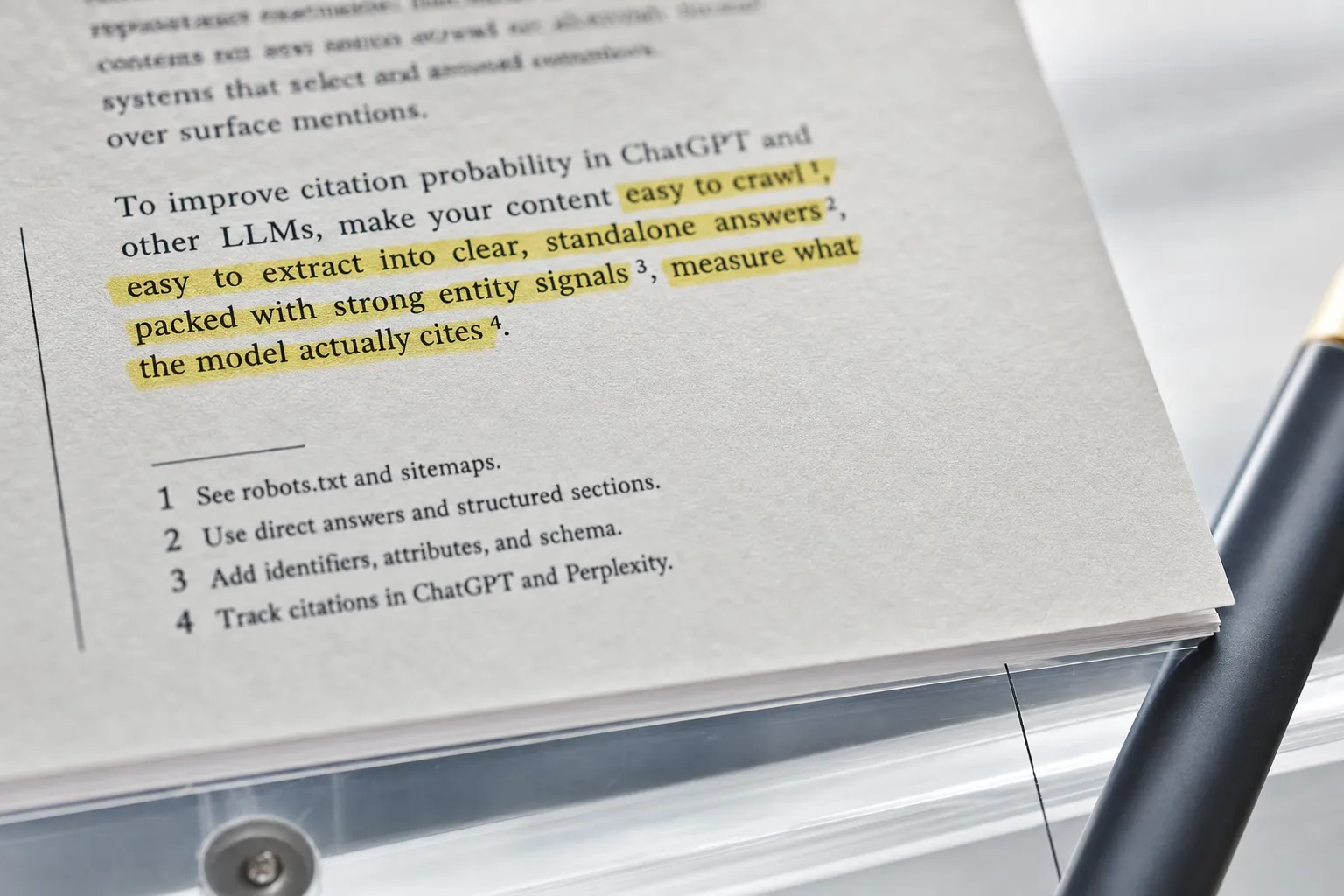
ChatGPT Optimization in 2026: A Working Checklist for Getting Your Brand Cited, Not Just Ranked
How ChatGPT retrieves and cites sources in July 2026, with a sourced Generative Engine Optimization checklist covering crawler access, extractable answers, entity signals, and measurement.