Google adds Read more links best practices
Google published new guidance for Read more links. Here's what publishers need to do to stay eligible and why these previews matter for AI-era content surfacing.
Google adds Read more links best practices
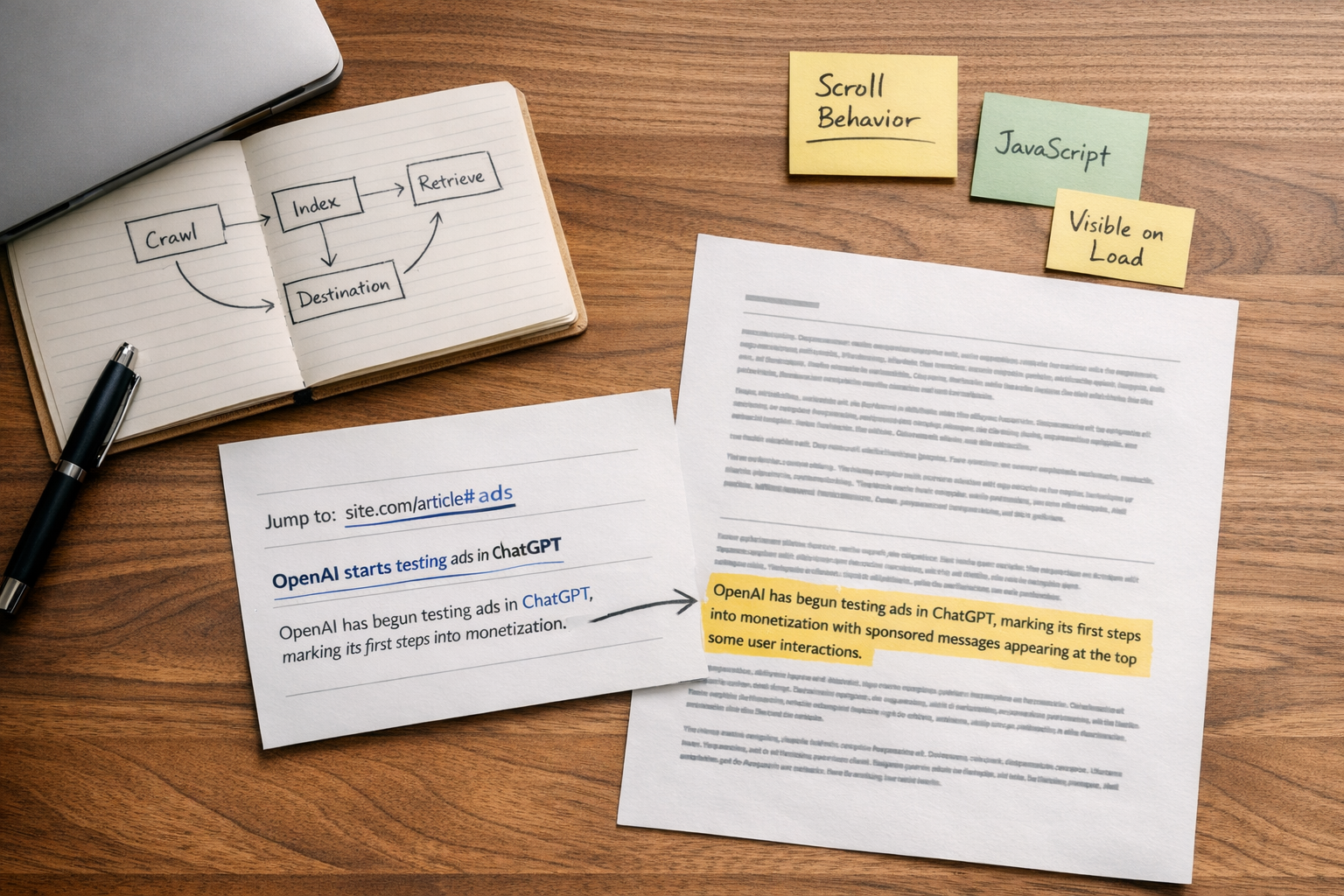
Google’s new best practices for ‘Read more’ links boil down to one idea: if Search sends a user to a deeper passage on your page, that destination should load cleanly, stay addressable, and be visible right away. As Search Engine Land reported, the guidance covers fragment URLs, scroll behavior, and JavaScript patterns that can prevent snippet deep links from working as intended.
This matters beyond classic SEO. AI-powered search systems increasingly cite, summarize, and navigate to specific passages rather than generic pages. If your site breaks deep links, hides the cited section, or rewrites the URL on load, you lower the odds that both users and answer engines will trust the landing experience.
For content teams, this is also a reminder that small UX details now affect discoverability. A strong passage is not enough if the destination experience breaks the handoff between result and page. The same principle shows up across passage ranking, citations, and answer inclusion in broader GEO programs, which we cover in our GEO guide.
Treat a Read more URL as a promise: the exact section Google surfaced should be the section the visitor sees without extra clicks, tab changes, or scroll resets.
What Google actually changed
The guidance centers on three practical behaviors. First, content referenced by a Read more link should be immediately visible when the page opens. Second, page scripts should not override the browser’s attempt to scroll to the fragment target. Third, sites should preserve the URL fragment instead of stripping or replacing it during redirects, hydration, or client-side routing.
- Make the targeted section immediately visible on load.
- Avoid on-load JavaScript that changes the user’s scroll position.
- Preserve hash fragments such as
#section-2across redirects and routing. - Test deep links on mobile and desktop, especially on JS-heavy templates.
These may sound like small implementation details, but they shape snippet quality, click satisfaction, and crawler confidence. A deep link that lands badly creates a mismatch between what Google previewed and what the user actually reaches.
In practice, this affects more templates than many publishers expect. Tabs that open to the wrong pane, accordions that keep the target collapsed, sticky headers that cover anchored text, and client-side routers that re-render the page after load can all make a valid fragment behave like a broken one. Google is essentially telling site owners to remove those avoidable points of friction.
If a page lands at the right URL but the user still has to expand a section or scroll again, the deep-link experience is weak even if the content itself is relevant.
Why Read more links matter beyond traditional snippets
That mismatch is becoming more expensive as discovery shifts from page-level ranking to passage-level retrieval. Google’s latest AI Mode updates emphasize more personal and agentic experiences, which means systems are trying to match not just queries but intent, context, and task completion. Pages that expose the right passage cleanly are easier for those systems to trust.
Other platforms point in the same direction. The Perplexity changelog shows citations, filters, and structured outputs becoming product features, while OpenAI’s newest agents tooling points toward search systems that do more than retrieve pages: they decide, navigate, and act. In that environment, a clean passage target becomes part of the product surface, not just a technical afterthought.
There is also growing evidence that generative systems reward precise, well-structured content. The recent e-commerce GEO benchmark suggests that selection and citation behavior are becoming measurable at the passage and attribute level. That is why teams should pair deep-link QA with ongoing AI search monitoring rather than treating snippet links as a one-off SEO task.
How Read more readiness affects discovery
| Scenario | What good looks like | What creates risk |
|---|---|---|
| FAQ answer linked from search | Anchor opens directly to visible answer text | Page loads at top or answer stays collapsed |
| Long-form guide section | Fragment persists after redirects and tracking parameters | Client-side routing strips the hash |
| Mobile landing experience | Sticky UI leaves heading and paragraph readable | Banner or header covers the target |
| AI citation handoff | Cited passage matches the visible destination | Summary references text the user cannot immediately find |
Strategic implementation
The safest rollout is to treat Read more support as a cross-functional checklist. SEO can identify important templates, editorial can standardize headings and anchor targets, and engineering can verify that frameworks, experiments, and analytics scripts do not break the browser’s default fragment behavior.
Audit high-value templates
Review article, help-center, documentation, and product-detail templates where Google is most likely to surface passage-level links. Start with pages that already earn rich snippets, featured results, or frequent long-tail traffic.
Standardize anchor targets
Use stable IDs on headings or container elements, keep section names predictable, and avoid changing anchors during redesigns unless redirects and fragment handling are tested together.
Test with and without JavaScript
Check whether the target remains visible during hydration, lazy loading, consent prompts, and A/B tests. If a script moves the viewport after the browser reaches the fragment, fix that behavior before rollout.
Monitor live results
Track which passages appear in search and assistant answers, and compare them with the actual landing experience. Tools such as Prompt Explorer can help teams understand how prompts, passages, and citations surface across engines.
This process is especially important on publisher, ecommerce, docs, and help-center pages where search engines often surface passage-level destinations. The more your business depends on answer discovery, the more expensive a broken anchor becomes.
When the right passage appears instantly, users bounce less, trust increases, and both search engines and AI assistants get a stronger signal that the page fulfilled the promise of the snippet.
Common challenges and solutions
Most failures are not caused by missing content; they are caused by page behavior layered on top of the content. Modern front ends often introduce enough motion, personalization, or delayed rendering to interrupt deep links without anyone noticing during normal QA.
- Collapsed accordions: open the targeted panel when a matching fragment is present.
- Infinite or lazy-loaded sections: ensure the target exists in the initial render or is restored before scroll position is recalculated.
- Redirect chains: keep the fragment intact from old URLs to new ones.
- Overlay UI: test banners, consent modals, and sticky elements so they do not cover the destination.
A useful rule is to test the worst-case path, not the ideal one. Open the page on mobile, with cookies cleared, on a slower connection, and after a redirect. If the target is still visible immediately, your implementation is far more likely to survive real search traffic and preserve user confidence.
Future outlook
The broader trend is clear: search is moving from ranked lists toward assisted navigation and task completion. Reporting on Perplexity Computer highlights how quickly search products are expanding into agentic workflows, and Google’s AI Mode shows the same ambition from a larger platform. These systems need dependable destinations they can cite and send users to with confidence.
That means optimization will increasingly blend relevance, structure, and execution. Brands will still need strong topical coverage, but they will also need stable anchors, scannable sections, preserved state, and pages that respect user intent on arrival. Preference matching may matter more in AI experiences, yet query matching still fails if the landing experience is broken.
Think of deep-link readiness as foundational GEO hygiene. It helps Google snippets today and improves the odds that AI systems can cite, route, and trust your content tomorrow.
Conclusion and key takeaways
Google’s Read more guidance is easy to underestimate because it sounds mechanical. In reality, it sets a practical standard for passage-level trust. If the exact section promised in Search loads visibly, keeps its fragment, and resists scroll-breaking scripts, your content is better positioned for classic snippets, AI citations, and agentic discovery alike.
Key Takeaways
Read more links work best when the cited passage is visible immediately on load.
JavaScript, hydration, and client-side routing are common causes of broken deep links.
Preserving URL fragments is now part of both SEO quality and AI citation readiness.
Cross-functional testing across templates, devices, and redirect paths is essential.
Passage-level trust will matter more as search becomes more agentic and personalized.
Frequently asked questions

Founder of Geol.ai
Senior builder at the intersection of AI, search, and blockchain. I design and ship agentic systems that automate complex business workflows. On the search side, I’m at the forefront of GEO/AEO (AI SEO), where retrieval, structured data, and entity authority map directly to AI answers and revenue. I’ve authored a whitepaper on this space and road-test ideas currently in production. On the infrastructure side, I integrate LLM pipelines (RAG, vector search, tool calling), data connectors (CRM/ERP/Ads), and observability so teams can trust automation at scale. In crypto, I implement alternative payment rails (on-chain + off-ramp orchestration, stable-value flows, compliance gating) to reduce fees and settlement times versus traditional processors and legacy financial institutions. A true Bitcoin treasury advocate. 18+ years of web dev, SEO, and PPC give me the full stack—from growth strategy to code. I’m hands-on (Vibe coding on Replit/Codex/Cursor) and pragmatic: ship fast, measure impact, iterate. Focus areas: AI workflow automation • GEO/AEO strategy • AI content/retrieval architecture • Data pipelines • On-chain payments • Product-led growth for AI systems Let’s talk if you want: to automate a revenue workflow, make your site/brand “answer-ready” for AI, or stand up crypto payments without breaking compliance or UX.
Related Articles
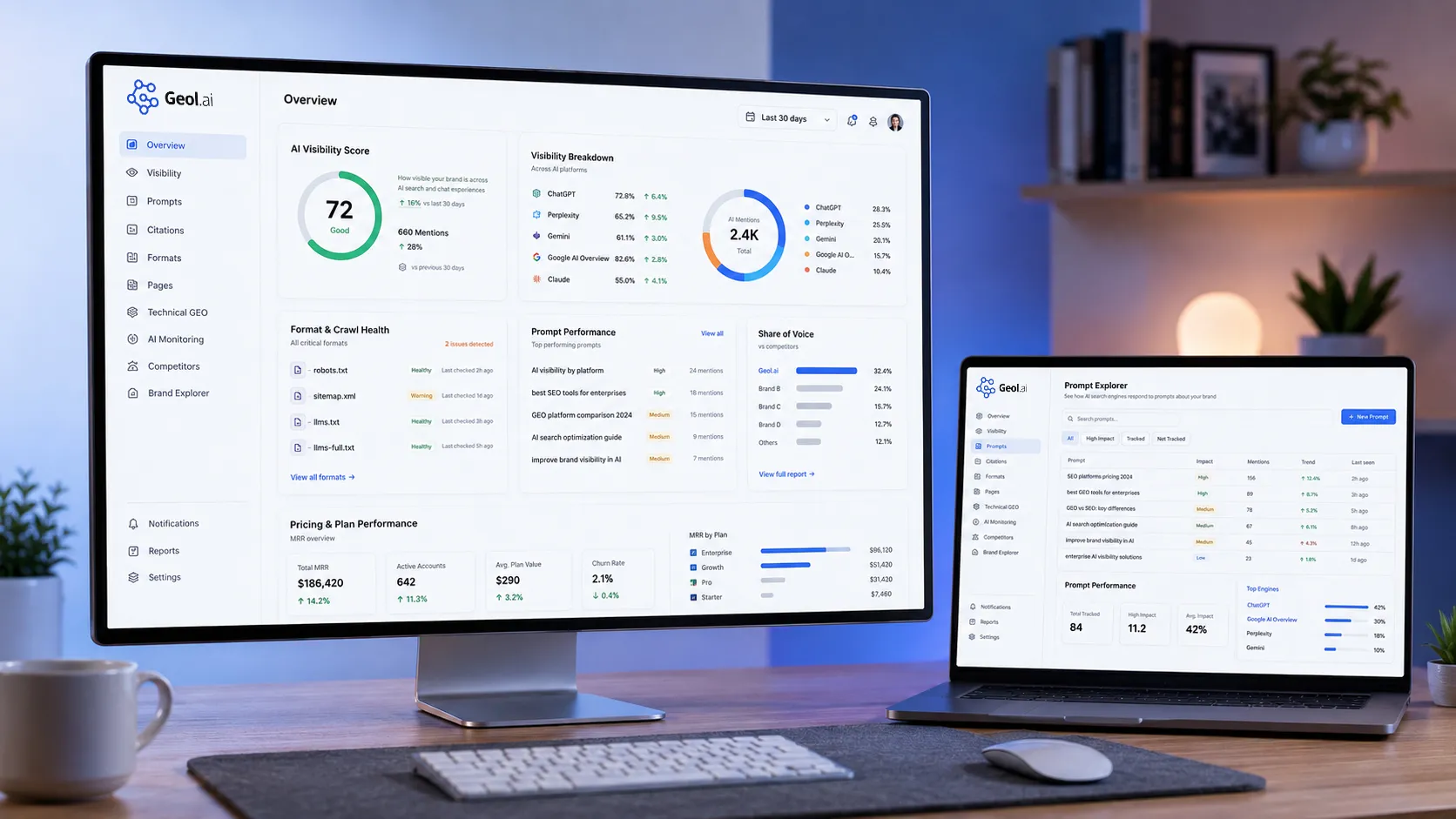
What a GEO Platform Actually Costs in 2026: The Pricing Guide Vendors Won't Write
Real published prices for the Generative Engine Optimization tool market in 2026: self-serve entry tiers, enterprise quote walls, metering math, and honest tool-versus-consultant economics.
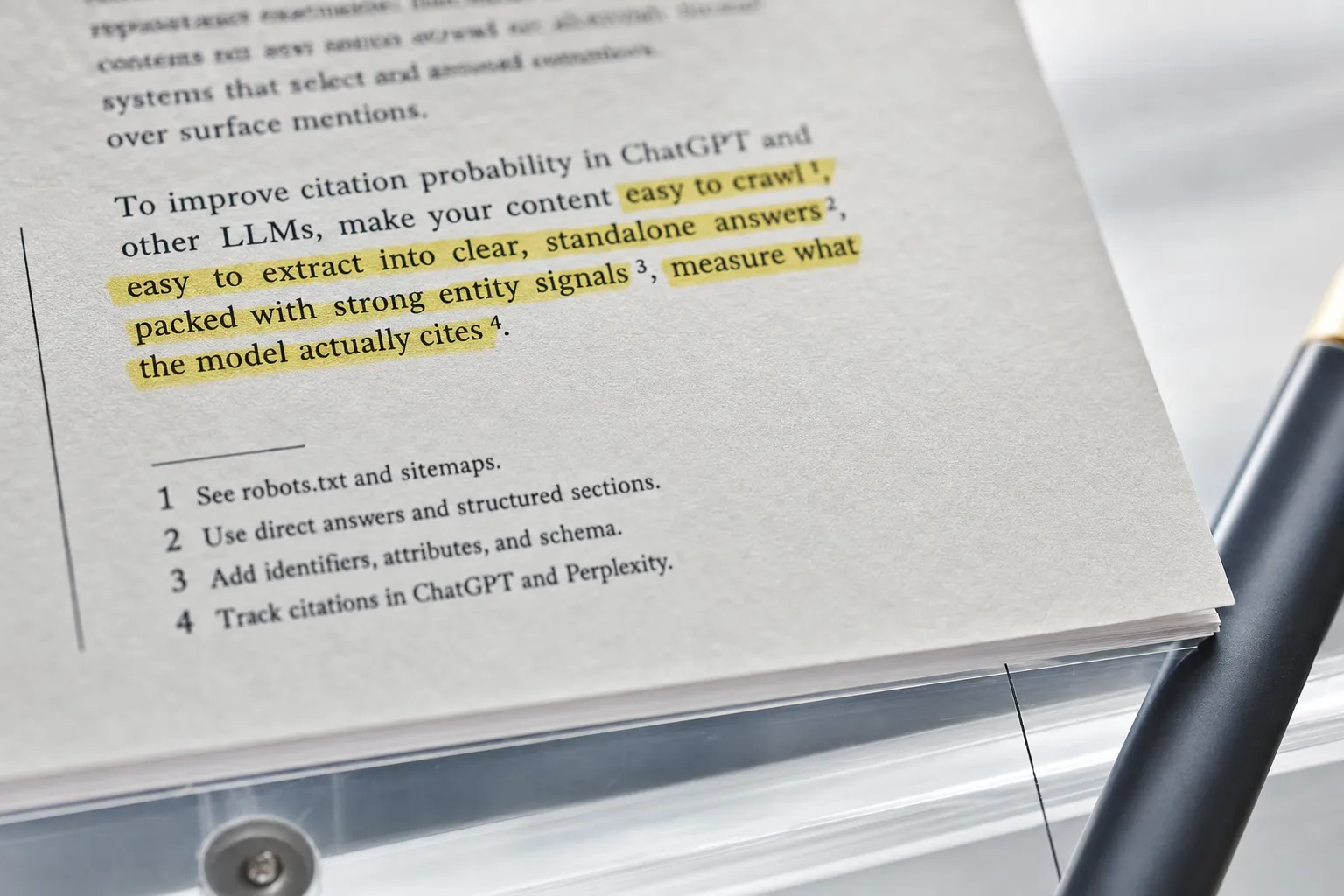
ChatGPT Optimization in 2026: A Working Checklist for Getting Your Brand Cited, Not Just Ranked
How ChatGPT retrieves and cites sources in July 2026, with a sourced Generative Engine Optimization checklist covering crawler access, extractable answers, entity signals, and measurement.