Industry Debates: The Ethics and Future of AI in Search—Why Knowledge Graph Transparency Must Be Non‑Negotiable
Opinionated analysis on AI search ethics: why transparent Knowledge Graphs, provenance, and citation rules are essential for trust, traffic, and GEO.

Industry Debates: The Ethics and Future of AI in Search—Why Knowledge Graph Transparency Must Be Non‑Negotiable
AI-powered search is rapidly shifting from “ten blue links” to synthesized answers. The central ethical risk isn’t that models generate text—it’s that an opaque Knowledge Graph (and the retrieval rules wrapped around it) silently decides which entities, attributes, and sources are eligible to be retrieved, grounded, and cited. If those eligibility rules are invisible, bias becomes institutional: not a one-off hallucination, but a repeatable, scalable exclusion mechanism. That’s why Knowledge Graph transparency must be non-negotiable—for ethics, for user trust, and for Generative Engine Optimization (GEO) where visibility and attribution increasingly depend on being “graph-legible.”
If a search provider can synthesize claims, it must also be able to show: what claim was made, which sources support it, how confident the system is, and how to correct it. Otherwise, AI search becomes unaccountable infrastructure.
Thesis: AI search needs transparent Knowledge Graph governance—or it will institutionalize invisible bias
The hidden layer: how Knowledge Graphs shape what AI can “know”
In AI search, a Knowledge Graph is not just a “database of facts.” It’s a governance layer that defines: which entities exist (people, brands, products, places), which attributes matter (founder, pricing, side effects, location), which relationships are allowed (competitor-of, located-in, treats), and which sources are considered valid enough to support those claims. When that layer is opaque, the system can appear neutral while encoding decisions about inclusion, legitimacy, and authority.
This is especially relevant as models increasingly rely on retrieval and grounding. For deeper coverage on why grounding and representation choices matter in AI Overviews, explore GPT-5.4 Thinking vs GPT-5.4 Pro: What the Release Signals for Knowledge Graph Grounding in Google AI Overviews.
Why this is a GEO problem, not just an AI ethics debate
GEO is about earning visibility and attribution inside answer engines. But if the graph and retrieval rules are hidden, optimization becomes guesswork: you can publish accurate content and still be excluded from eligibility. Worse, entity-level errors (wrong category, missing relationships, low confidence) can suppress an entire brand or topic across thousands of queries. That’s not “ranking volatility”—it’s systemic discoverability failure.
- Opaque entity inclusion/exclusion changes visibility (can you appear at all?), attribution (are you cited?), and demand capture (do users click through?).
- Errors and bias become systemic: the same wrong attribute can be repeated across many answers because it’s embedded as a reusable claim.
Operational definition: “Knowledge Graph transparency”
Transparency does not require publishing the entire graph. It requires publishing the rules of the graph: (1) entity definitions and schema, (2) relationship types, (3) provenance fields and citation policy, (4) confidence scoring and thresholds, (5) update cadence and change logs, and (6) appeal/correction mechanisms with measurable SLAs.
Illustrative impact of AI-synthesized answers on organic click-through (CTR)
A conceptual model (not a measurement) showing typical CTR decline as more query classes trigger synthesized answers. Use this as a planning heuristic and replace with your Search Console + SERP feature tracking data.
The direction of travel is clear: as more queries are “answered” on the SERP, the marginal value of being merely indexed falls—and the value of being eligible for retrieval and citation rises. That eligibility is governed by the graph layer.
The core ethical fault line: provenance and consent in Knowledge Graph construction
Provenance: who said what, when, and under what license?
AI search should treat Knowledge Graph inputs like regulated supply chains. Every entity-attribute claim (e.g., “Drug X causes side effect Y,” “Company A acquired Company B,” “Restaurant C is wheelchair accessible”) should carry machine-readable provenance: source URL, extraction timestamp, publisher name, and usage rights/terms. Without it, users can’t evaluate trust, publishers can’t challenge misattribution, and auditors can’t reproduce decisions.
Citation behavior is already a contested design choice. See analysis of how models choose citations and why that matters for creators: https://www.tomkelly.com/how-llms-choose-citations/ and https://beomniscient.com/blog/how-llms-source-brand-information/.
Consent and compensation: are publishers funding the graph that replaces them?
“It’s on the public web” is not the same as “ethical to extract and persist as structured claims.” There’s a meaningful difference between (a) linking to a page and (b) extracting facts into a durable Knowledge Graph that can power answers without sending traffic back. The latter can compete directly with the original work, especially when the graph becomes the default interface for information.
Citing pages vs. extracting persistent claims
- Page citation preserves context and encourages click-through
- Errors can be corrected at the source page
- Licensing and attribution are clearer
- Claim extraction can outlive the source and propagate stale info
- Publishers may lose traffic while still supplying the underlying facts
- Attribution can degrade into “generic citations” that don’t map to claims
The market is already pricing consent through licensing deals and, in parallel, testing boundaries through litigation and public disputes. For background context on major AI search players and controversies, see: https://en.wikipedia.org/wiki/OpenAI and https://en.wikipedia.org/wiki/Perplexity_AI.
Why consent is becoming a priced input (illustrative market signals)
Conceptual comparison of two forces: (1) growth in licensing/partnership announcements and (2) growth in legal disputes. Replace with your maintained tracker of announcements and filings for a current view.
Adopt machine-readable provenance for graph claims: source URL, timestamp, license/rights, and extraction method (human-curated, model-extracted, partner feed). Pair it with opt-out/opt-in signals for entity extraction and reuse.
Bias, authority, and “entity gatekeeping”: when Knowledge Graphs decide whose reality is searchable
Authority signals: how structured data and citations become power
Entity gatekeeping is simple: if a person, brand, product, or concept is missing, mis-typed, or poorly connected in a Knowledge Graph, AI systems struggle to retrieve and ground information about it. In practice, that means fewer citations, fewer “included in the answer” moments, and higher risk that competitors become the default entity for the category.
Structured data (e.g., Schema.org) can help reduce ambiguity—but it can also advantage well-resourced organizations that can implement it correctly, maintain it, and secure high-authority citations. If governance is opaque, “authority” becomes a black box that tends to reward incumbency.
Feedback loops: popularity → inclusion → visibility → more popularity
Knowledge Graphs can inadvertently create reinforcing cycles: popular entities get more mentions, which increases their perceived authority, which increases their retrieval likelihood, which increases their visibility, which generates more mentions. Meanwhile, underrepresented demographics, geographies, and languages can be systematically under-modeled. “Notability” thresholds often mirror platform incentives—not public interest.
- Bias modes to watch: demographic underrepresentation, geographic skew, language bias, and category/ontology bias (what types exist, which attributes “count”).
- The counterpoint: Knowledge Graphs can reduce hallucinations and improve consistency—if governance is explicit, auditable, and contestable.
Mini-audit template: entity coverage and citation diversity across verticals (example values)
Example scores (0–100) for three verticals to illustrate how to audit: coverage (how many known entities exist), attribute accuracy, and citation diversity (higher is better). Replace with your own measurement from sampled queries + extracted citations.
When a Knowledge Graph is wrong, it’s not just misinformation—it’s an eligibility bug. And eligibility bugs are distribution bugs.
What the future should look like: auditable Knowledge Graphs and citation-first AI search
Minimum viable transparency: provenance, confidence, and change logs
Search providers should publish a “Knowledge Graph transparency spec” that makes governance legible without exposing proprietary data. At minimum, it should document: schema/ontology, relationship types, provenance fields, confidence scoring, update frequency, and a public change-log format for material entity edits (merges/splits/type changes).
| Transparency element | What must be disclosed | Why it matters (ethics + GEO) |
|---|---|---|
| Provenance fields | Source URL, publisher, timestamp, license/rights, extraction method | Enables claim-level traceability, contestability, and fair attribution |
| Confidence scoring | Score definition, thresholds for display/citation, decay rules | Prevents low-quality claims from becoming “default truth” |
| Change logs | Entity merges/splits, type changes, major attribute edits, effective dates | Lets brands/publishers detect drift and respond before damage spreads |
| Appeals process | Submission requirements, verification rules, SLA, outcomes reporting | Makes correction practical; reduces long-lived reputational harm |
Accountability mechanisms: appeals, corrections, and third-party audits
Citation-first UX should be the default: every synthesized claim should be traceable to one or more sources, and citations should be claim-level—not a generic list of “related links.” In sensitive domains (health, finance, elections), independent audits should validate: coverage, demographic fairness, citation concentration, and correction latency. Providers should publish aggregate metrics on dispute outcomes and time-to-fix.
Track correction latency (median days to fix verified entity errors) and publish it by category. If a system can update answers in minutes but fixes entity truth in weeks, it’s optimizing optics—not accuracy.
Call to action: how brands and publishers should respond (without waiting for regulation)
Build your entity footprint: structured data + linked references
Even if platforms lag on transparency, you can reduce the chance of being mis-modeled by becoming easier to identify, disambiguate, and cite. Treat Knowledge Graph readiness like a distribution channel: define your entities cleanly, keep naming consistent across properties, and publish machine-readable facts with references.
Establish canonical entity IDs
Choose canonical URLs for your Organization/Product/Person pages, and align references across your site, press pages, and profiles. Where appropriate, connect to stable external IDs (e.g., Wikidata) to reduce ambiguity.
Implement Schema.org for core entities
Use structured data for Organization, Product, Person, FAQ, and HowTo where it truthfully applies. Validate markup and keep it synchronized with on-page content.
Publish provenance-ready claims
When you state a fact that will likely be extracted (pricing, availability, clinical claims, certifications), include references, dates, and update history on the page. Make it easy for systems—and humans—to verify.
Harden your citation surface area
Earn citations from diverse, reputable sources (industry associations, standards bodies, peer-reviewed publications where relevant). Citation diversity reduces single-source gatekeeping.
Monitor and defend: entity change detection and citation share-of-voice
The winners in AI search will be those who can prove what’s true about them—machine-readably—and defend it when the graph gets it wrong. That means monitoring: entity presence (do you exist?), attribute drift (did facts change?), retrieval eligibility (are you being pulled into answers?), and citation share-of-voice (who gets credited?).
Before/after: structured data + entity consolidation (illustrative uplift)
Example of how consolidating entity signals can increase inclusion in AI answers and citations. Replace with your measured results from AI SERP tracking and citation logs.
If you’re a publisher, the same logic applies: make your claims extractable with consent and enforceable provenance. If you’re a brand, assume the graph is already being built about you—so you either supply clean, verifiable signals, or you inherit whatever the ecosystem infers.
Key Takeaways
The biggest ethical risk in AI search is opaque Knowledge Graph governance: it determines eligibility, authority, and who gets cited.
Provenance and consent must be treated like a supply chain: claim-level sources, timestamps, and usage rights should be standard.
Entity gatekeeping creates feedback loops that can institutionalize bias—unless the schema, confidence rules, and appeals process are auditable.
Brands and publishers should act now: build canonical entities, implement structured data, and monitor citation share-of-voice and entity drift as core GEO work.
FAQ: Knowledge Graph transparency in AI search

Founder of Geol.ai
Senior builder at the intersection of AI, search, and blockchain. I design and ship agentic systems that automate complex business workflows. On the search side, I’m at the forefront of GEO/AEO (AI SEO), where retrieval, structured data, and entity authority map directly to AI answers and revenue. I’ve authored a whitepaper on this space and road-test ideas currently in production. On the infrastructure side, I integrate LLM pipelines (RAG, vector search, tool calling), data connectors (CRM/ERP/Ads), and observability so teams can trust automation at scale. In crypto, I implement alternative payment rails (on-chain + off-ramp orchestration, stable-value flows, compliance gating) to reduce fees and settlement times versus traditional processors and legacy financial institutions. A true Bitcoin treasury advocate. 18+ years of web dev, SEO, and PPC give me the full stack—from growth strategy to code. I’m hands-on (Vibe coding on Replit/Codex/Cursor) and pragmatic: ship fast, measure impact, iterate. Focus areas: AI workflow automation • GEO/AEO strategy • AI content/retrieval architecture • Data pipelines • On-chain payments • Product-led growth for AI systems Let’s talk if you want: to automate a revenue workflow, make your site/brand “answer-ready” for AI, or stand up crypto payments without breaking compliance or UX.
Related Articles
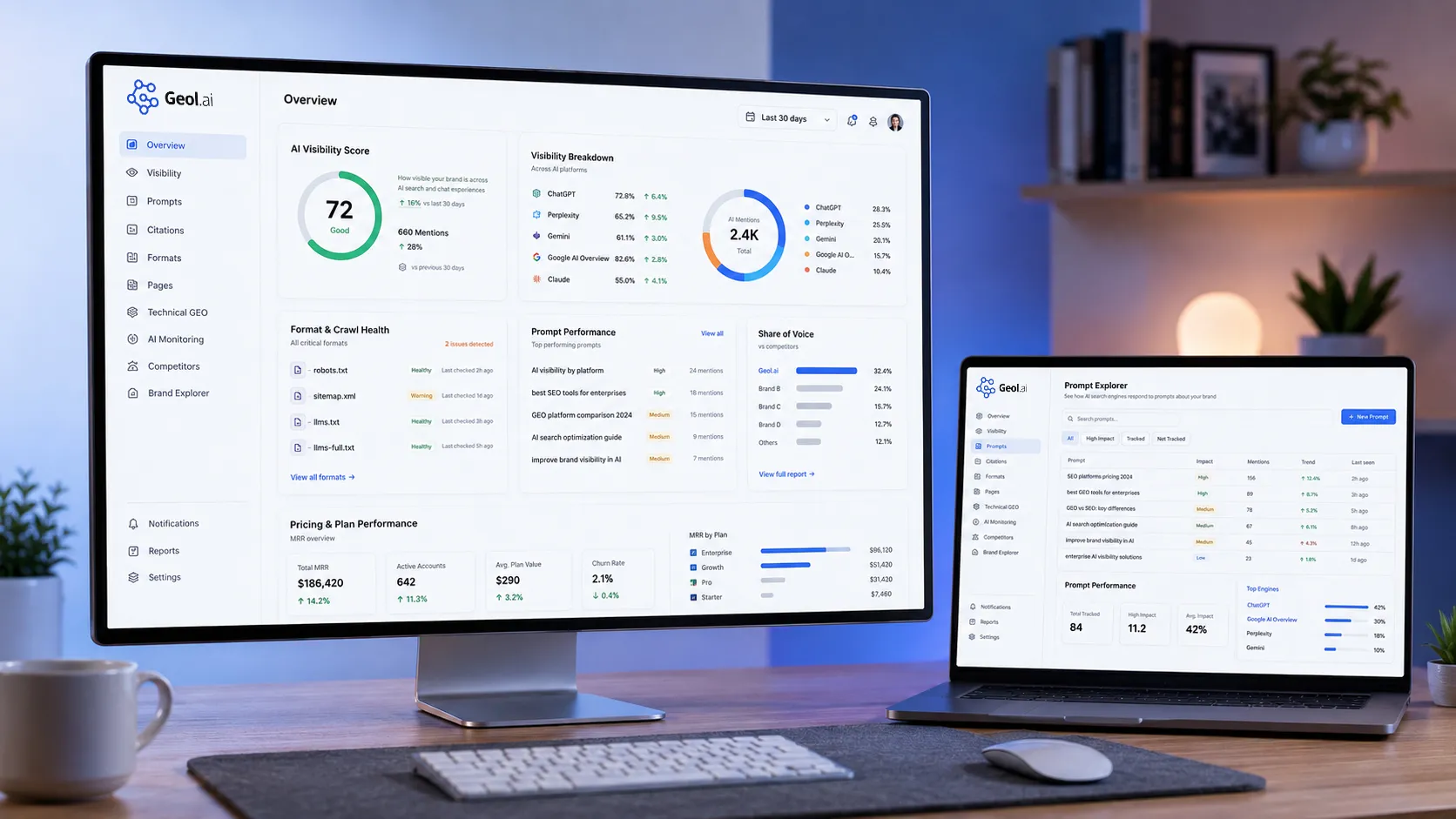
What a GEO Platform Actually Costs in 2026: The Pricing Guide Vendors Won't Write
Real published prices for the Generative Engine Optimization tool market in 2026: self-serve entry tiers, enterprise quote walls, metering math, and honest tool-versus-consultant economics.
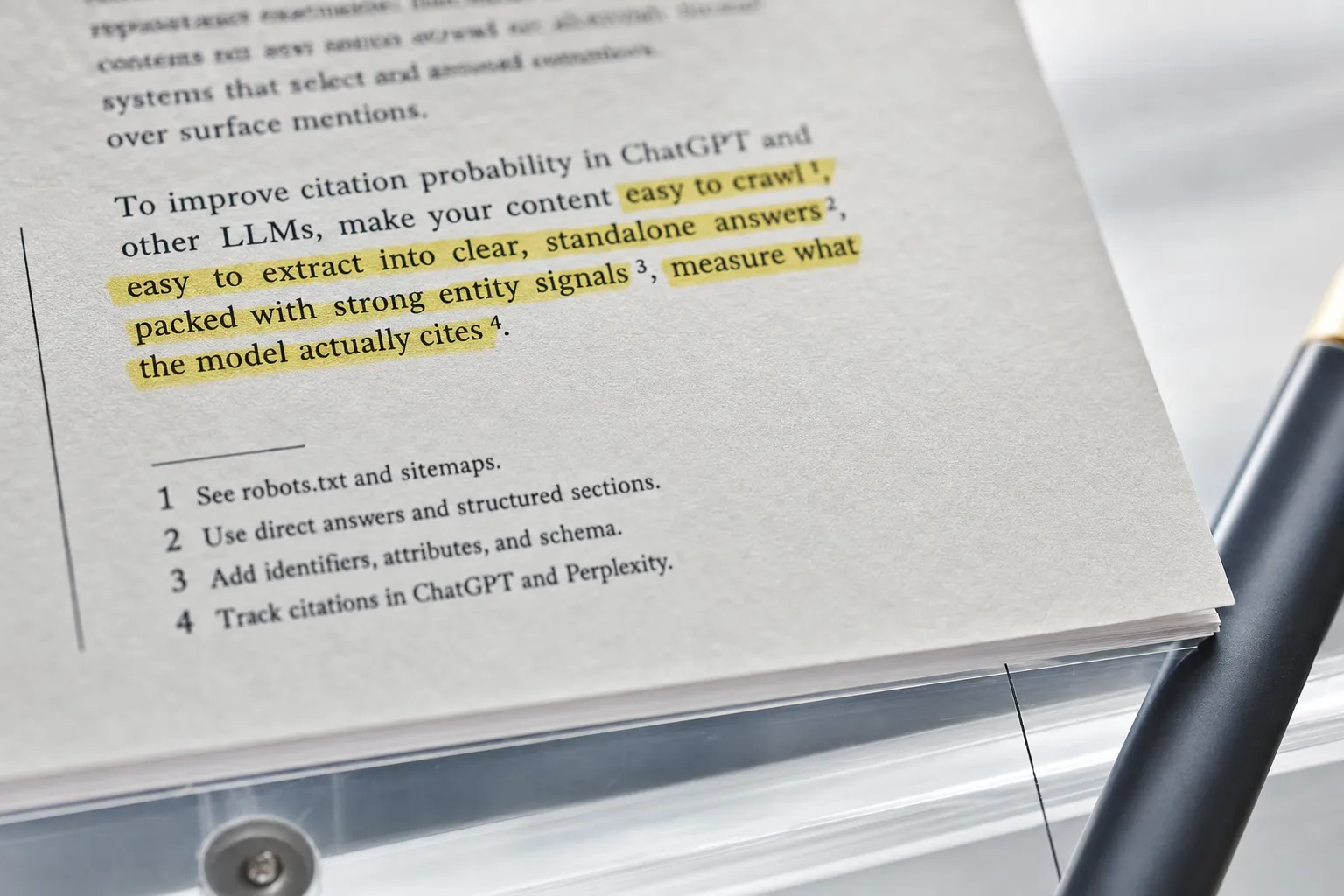
ChatGPT Optimization in 2026: A Working Checklist for Getting Your Brand Cited, Not Just Ranked
How ChatGPT retrieves and cites sources in July 2026, with a sourced Generative Engine Optimization checklist covering crawler access, extractable answers, entity signals, and measurement.