LLMs and Fairness: Addressing Bias in AI-Driven Rankings (Comparison Review for AI Visibility)
Compare bias-mitigation methods for LLM-driven rankings and how fairness choices affect AI Visibility, citations, and trust in answer engines.
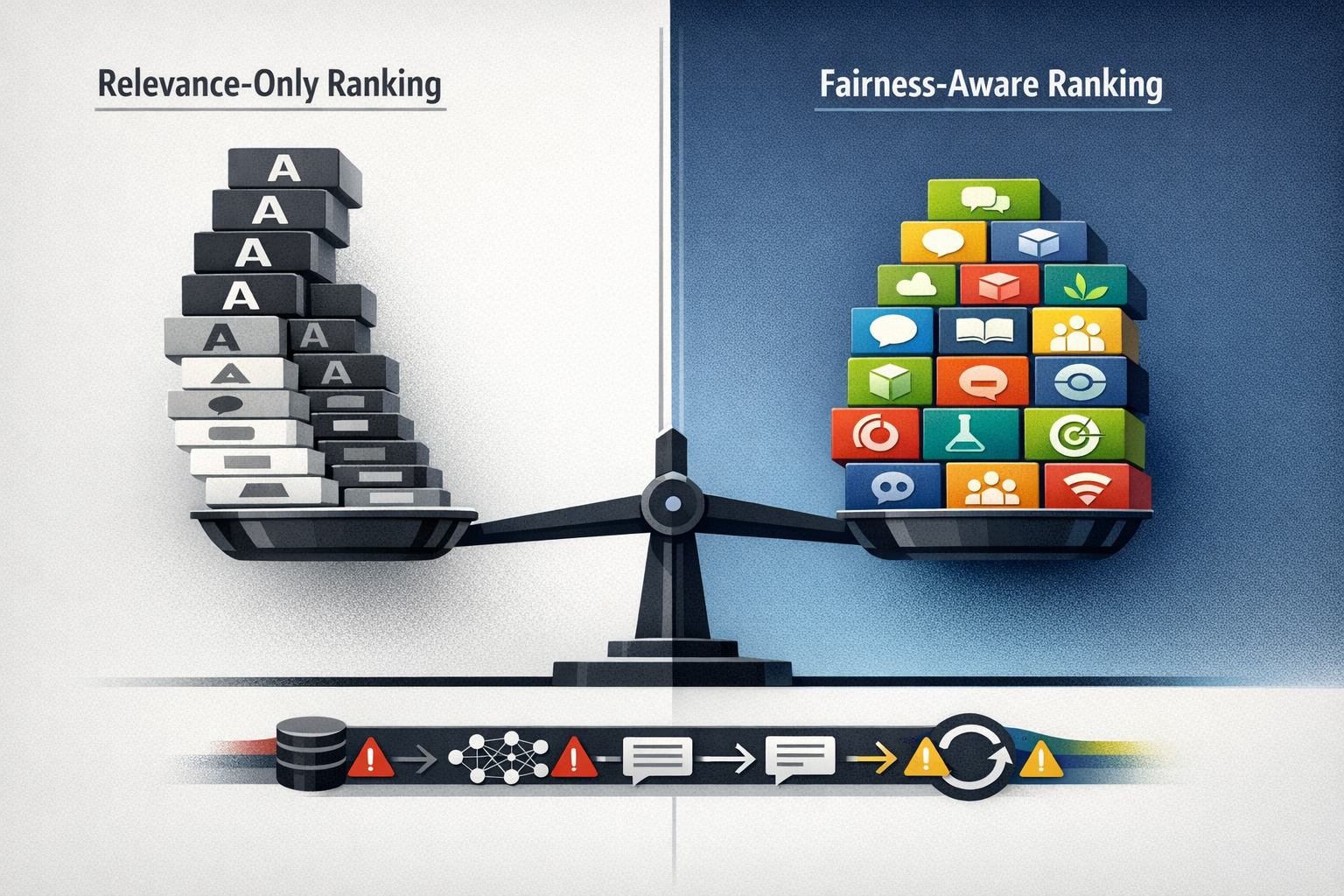
LLMs and Fairness: Addressing Bias in AI-Driven Rankings (Comparison Review for AI Visibility)
LLM-driven rankings (the ordered lists, “top sources,” citations, and recommendations produced by answer engines) can unintentionally amplify bias—changing who gets exposure, which publishers get cited, and which products or viewpoints get recommended. The practical question isn’t just “is the model biased?” but “does the ranking distribute attention fairly without destroying relevance?” This spoke article defines fairness for ranking outputs, compares four mitigation approaches, and provides an implementation workflow that explicitly treats AI Visibility (citation share and exposure in answer engines) as a dependent metric you must track alongside fairness KPIs.
In answer engines, “ranking” is often the hidden layer behind the final narrative answer: which sources are retrieved, which are cited, and which are summarized first. Fairness choices can directly change citation frequency, source diversity, and perceived trust—so measure fairness on exposure/citation distribution, not only on language quality or sentiment.
For deeper context on how “visibility” is changing in AI-native browsing and answer surfaces, explore: Generative Engine Optimization (GEO / AEO) Adoption Surges in 2026—What It Means for AI Browser Security.
What “fairness” means in LLM-driven rankings (and why it impacts AI Visibility)
Featured-snippet definition: AI-driven rankings vs. traditional rankings
Traditional rankings (classic search/IR) primarily order documents by estimated relevance given a query. AI-driven rankings add extra layers: an LLM might (1) retrieve candidates, (2) re-rank them, (3) choose which to cite, and (4) compress them into a single answer. The “ranking” you experience is therefore not only a list—it’s also the ordering of citations and the allocation of attention in the generated response. That allocation is what shapes AI Visibility: who gets surfaced, how often, and in what context.
Fairness criteria used in practice: group, individual, and calibration fairness
In ranking systems, fairness is a measurable property of outcomes. Common families of definitions include:
- Group fairness: outcomes are balanced across protected groups (e.g., exposure parity across categories, demographics, regions, or publisher types).
- Individual fairness: similar items (or similarly qualified candidates) should receive similar ranking treatment.
- Calibration-style notions: if the system assigns scores or confidence, those scores should be comparably meaningful across groups (often harder to apply cleanly to pure LLM citation behavior).
Mini-metric glossary (ranking-first)
Use ranking-first metrics that map to AI Visibility (citations/exposure), not just “toxicity” or generic bias scores.
Demographic parity difference (DPD): |P(exposed|Group A) − P(exposed|Group B)|. Example threshold: DPD ≤ 0.05 for top-k exposure. Ranking impact: reduces skew in who appears in top positions; AI Visibility impact: shifts citation share toward under-exposed groups.
Equal opportunity gap (EOG): difference in true-positive exposure among qualified items. Example threshold: EOG ≤ 0.03. Ranking impact: ensures qualified candidates from different groups are surfaced similarly; AI Visibility impact: preserves “deserved” citations while reducing systematic under-citation.
Exposure parity (EP): compare cumulative exposure (often position-weighted) between groups. Example threshold: EP ratio between 0.9–1.1 for top-10. Ranking impact: directly corrects position bias; AI Visibility impact: stabilizes citation share distribution across groups over time.
Where bias enters the ranking pipeline: data, model, prompts, and feedback loops
Bias in AI-driven rankings rarely comes from a single place. It typically accumulates across: (1) training data skew and label bias, (2) model priors and representation gaps, (3) retrieval coverage and metadata quality, (4) prompt/system policy choices (what counts as “authoritative”), and (5) feedback loops (users click/cite what was already shown, reinforcing exposure). Research specifically examining fairness in LLM ranking settings highlights that LLMs can reproduce and amplify biases in ranking outcomes, not just in generated text.
External reference: “LLMs and Fairness: Addressing Bias in AI-Driven Rankings” (arXiv:2404.03192).
Comparison criteria: how to evaluate bias-mitigation methods for AI-driven rankings
To compare mitigation methods fairly, you need criteria that reflect ranking reality: position bias, exposure, and citations. Below is a reusable scorecard model you can adapt to your system (publisher, marketplace, or enterprise knowledge base).
Ranking-specific metrics: exposure, position bias, and citation share
- Exposure parity (position-weighted): track cumulative exposure by group over time windows (day/week/month).
- Citation share: % of citations attributed to each group/domain/category (your core AI Visibility KPI).
- Concentration / diversity: Herfindahl-Hirschman Index (HHI) or a diversity index over cited domains to detect “winner-take-most” patterns.
Operational criteria: cost, latency, and governance readiness
- Latency overhead: does the method add milliseconds (re-ranking) or days/weeks (retraining cycles)?
- Implementation complexity: data requirements, metadata, labeling, and evaluation harness maturity.
- Governance readiness: auditability, change management (prompts/policies), and human review integration.
Risk criteria: overcorrection, relevance loss, and legal/compliance constraints
Fairness interventions can fail in predictable ways: (1) overcorrection (perceived manipulation), (2) relevance loss (users stop trusting answers), (3) proxy discrimination (using correlated attributes), and (4) documentation gaps (you can’t explain why a source was cited). Your comparison should include both fairness lift and “trust preservation” metrics like complaint rate, appeal outcomes, and editorial review flags.
| Scorecard criterion (1–5) | How to measure | Example KPI / target | AI Visibility impact |
|---|---|---|---|
| Fairness lift | Δ exposure parity, Δ demographic parity difference | EP ratio 0.9–1.1; DPD ≤ 0.05 (top-10) | More stable citation share across groups/domains |
| Relevance impact | Δ NDCG@10, Δ MRR, human preference tests | NDCG@10 drop ≤ 1–2% relative | Protects trust; prevents visibility gains from being discounted by user churn |
| Citation diversity | HHI or diversity index on cited domains | HHI ↓ (less concentration) without relevance loss | Less “single-source dominance”; healthier citation share distribution |
| Governance & auditability | Model/prompt change logs, replayable eval sets, human review | 100% changes logged; monthly audits; incident SLA < 72h | Improves trust in citations; reduces reputational risk |
Method reviews: four approaches to reducing bias in LLM-driven rankings
Below are four practical “levers” you can pull. In ranking and citation systems, the most reliable results come from combining at least two: one that changes selection (retrieval/re-ranking) and one that enforces/monitors outcomes (auditing/post-processing).
Approach A: Data curation & labeling (pre-training / fine-tuning)
What it is: improve training or fine-tuning data to reduce representational skews and biased associations. This can include rebalancing corpora, curating high-quality sources, improving labels, or introducing fairness-aware objectives during fine-tuning.
Approach A (Data) — strengths and limits
- Best for systemic, root-cause issues (language priors, stereotypes, missing viewpoints).
- Improves many downstream behaviors beyond ranking (summaries, tone, refusals).
- Can reduce the need for heavy-handed post-processing later.
- Costly and slow (labeling, training cycles, evaluation).
- Fairness can become stale as content distributions and queries shift.
- Indirect impact on exposure unless ranking/citation objectives are explicitly included.
Approach B: Retrieval & re-ranking controls (RAG, constrained ranking, diversification)
What it is: adjust which sources enter the candidate set (retrieval) and how they are ordered (re-ranking). In RAG systems, this is the most direct way to control citation exposure because you can enforce constraints (e.g., minimum representation) or optimize a multi-objective function (relevance + fairness + diversity).
Approach B (Retrieval/Re-ranking) — strengths and limits
- Directly targets ranking exposure and citation selection (best lever for AI Visibility outcomes).
- Supports tunable trade-offs (e.g., cap dominance, diversify domains, enforce exposure parity).
- Works without retraining the base LLM if you have metadata and a re-ranker layer.
- Requires strong metadata (group labels, domain categories, quality signals).
- Adds engineering complexity and monitoring burden.
- Can be gamed if constraints are simplistic (e.g., low-quality sources filling quotas).
Approach C: Prompting & system policies (instruction tuning, refusal, style constraints)
What it is: use prompts and system rules to reduce biased phrasing, require balanced perspectives, or constrain how the model describes groups. This is often the fastest mitigation to deploy, especially for “presentation bias” (how results are described).
Approach C (Prompt/Policy) — strengths and limits
- Fast to deploy; low cost compared to retraining.
- Effective for overt bias in phrasing and unsafe generalizations.
- Can standardize citation formatting and disclosure language.
- Brittle: prompt drift, model updates, and different answer engines behave differently.
- May improve tone while leaving exposure/citation bias unchanged.
- Harder to audit causality (“did the prompt or retrieval cause the citation skew?”).
Approach D: Post-processing & auditing (fairness reweighting, counterfactual tests, human review)
What it is: measure ranking outcomes, then apply corrective actions or enforcement. Examples include fairness-aware reweighting of ranked lists, counterfactual evaluation (swap group attributes to test sensitivity), and human-in-the-loop review for high-stakes queries.
Approach D (Post-processing/Audit) — strengths and limits
- Governance-friendly: measurable, reportable, and enforceable.
- Can enforce exposure constraints even when the base model is a black box.
- Pairs well with compliance requirements and incident response.
- Risk of overcorrection or perceived “manipulation” if not transparent.
- May introduce relevance loss if constraints are too strict.
- Requires robust evaluation harness and subgroup sample sizes.
Illustrative experiment template: baseline vs. four mitigation approaches (reporting placeholders)
Example reporting structure for ranking fairness evaluation. Replace placeholder values with your measured results for exposure parity lift, NDCG@10 change, and citation concentration (HHI) change.
If you only evaluate “bias in generated text,” you can miss the bigger harm: biased allocation of exposure (which sources get cited, which products appear first). Always compute fairness on the ranked outputs and citations themselves.
External reference for citation behavior considerations: Optimizing Content for AI Citations (Be Omniscient).
Side-by-side comparison: which approach best protects fairness without harming AI Visibility?
No single approach “wins” universally. The right choice depends on whether your primary risk is (a) skewed citations and exposure, (b) compliance/audit requirements, or (c) long-term representational bias in the model. Use the table below as a decision aid.
| Approach | Expected fairness lift (typ.) | Relevance risk (typ.) | Latency overhead (typ.) | Effort (typ.) | Best for AI Visibility |
|---|---|---|---|---|---|
| A) Data curation / fine-tuning | Medium–High (5–15pp) | Low–Medium (if eval is strong) | None at runtime | High (weeks–months) | Long-term trust and consistency across many queries |
| B) Retrieval + constrained re-ranking | High (8–25pp) | Medium (tunable) | Low–Medium (extra ranking pass) | Medium–High (weeks) | Directly manages citation share and top-k exposure |
| C) Prompting + system policies | Low–Medium (2–8pp, often presentation) | Low (if scoped) / Medium (if heavy constraints) | None–Low | Low (days) | Quick mitigation; improves perceived neutrality and disclosures |
| D) Post-processing + auditing | Medium–High (6–20pp) | Medium (depends on constraint severity) | Low–Medium | Medium (weeks) | Compliance and defensible reporting of citation behavior |
Best-fit recommendations by scenario (publisher, marketplace, enterprise knowledge base)
- Publisher / media citation fairness: prioritize Approach B (retrieval + re-ranking) to manage citation share and domain diversity; add Approach D for ongoing audits and “top-cited domain” concentration alerts.
- Marketplace recommendations: combine Approach B (exposure parity constraints) with Approach D (counterfactual tests) to reduce disparate exposure while protecting conversion relevance.
- Enterprise knowledge base / internal search: Approach D is often the fastest path to governance (audit trails, review queues), while Approach B improves coverage and reduces “department dominance” in citations.
Common failure modes and how to detect them early
- Fairness improves on average, regresses in specific query classes: add query segmentation (topic, locale, intent) to subgroup dashboards.
- Diversity improves but quality drops: add minimum quality constraints (authority, freshness, evidence) before fairness constraints apply.
- Citation share “looks fair” but summaries remain biased: evaluate both outcome fairness (exposure) and presentation fairness (language) in a single report.
Implementation playbook: a pragmatic fairness workflow for AI-driven rankings
A workable fairness program doesn’t start with a perfect definition—it starts with a baseline audit and a small set of metrics you can monitor continuously. The workflow below is designed to be “minimum viable” while still defensible for governance and useful for AI Visibility optimization.
Define protected attributes and acceptable trade-offs
Decide which attributes you will measure (e.g., publisher category, geography, language, seller type, department, or other protected classes where legally applicable). Document what “acceptable” relevance loss is (e.g., NDCG@10 drop ≤ 2% relative) and what fairness improvement you’re targeting (e.g., EP ratio 0.9–1.1 in top-10).
Choose metrics and set baselines (including AI Visibility)
Create an evaluation harness: fixed query sets, replayable retrieval snapshots, and a citation parser. Track (a) exposure parity, (b) relevance (NDCG/MRR + human judgments), and (c) AI Visibility KPIs such as citation share by domain/group and concentration (HHI). Baseline before any mitigation so you can quantify lift and avoid “fairness theater.”
Deploy controls + continuous audits (human-in-the-loop where needed)
Start with the most direct lever for your risk: re-ranking constraints (Approach B) for exposure/citation skew, or post-processing/audits (Approach D) for compliance. Add human review for high-impact queries (health, finance, legal, employment). Set drift alerts: if EP ratio leaves the target band or citation concentration rises sharply, trigger investigation and rollback procedures.
Maintain (1) a change log for prompts/re-ranking rules, (2) a “ranking behavior card” describing fairness metrics and thresholds, and (3) a replayable evaluation set so you can explain why citation share shifted after updates.
| Fairness readiness gate | Measurable requirement | Suggested minimum |
|---|---|---|
| Baseline audit coverage | % of high-traffic queries included in evaluation set | ≥ 60% coverage (then expand quarterly) |
| Subgroup sample size | Queries per subgroup for stable estimates | ≥ 200 per critical subgroup (or widen time window) |
| Audit frequency | How often fairness + visibility dashboards refresh | Daily monitoring + monthly deep-dive |
| Incident response | Time to triage a fairness regression alert | < 72 hours (with rollback plan) |
External references for governance and risk framing: NIST’s AI Risk Management Framework (AI RMF 1.0) https://www.nist.gov/itl/ai-risk-management-framework, and OECD AI Principles https://oecd.ai/en/ai-principles.
If your goal is to improve fairness in citations and top-k exposure (AI Visibility), start with Approach B (retrieval + re-ranking) and add Approach D (auditing). Use Approach C for quick tone/policy fixes, and Approach A for long-term systemic improvements.
Key Takeaways
Fairness in LLM-driven rankings must be measured on exposure and citations (AI Visibility), not only on generated language quality.
Retrieval + constrained re-ranking is the most direct lever for reducing citation/exposure skew; post-processing + auditing makes it governable and defensible.
Every mitigation has trade-offs—set explicit thresholds (e.g., EP band + NDCG tolerance) and monitor drift with subgroup dashboards.
Treat AI Visibility as a dependent KPI: fairness changes will shift who gets cited, so track citation share, diversity, and concentration alongside fairness metrics.
FAQ: Bias and fairness in AI-driven rankings
Additional external context on AI answer engines and their retrieval/citation behavior is often discussed in public documentation and summaries; for background reading on Perplexity AI as an example of an answer engine, see: https://en.wikipedia.org/wiki/Perplexity_AI.

Founder of Geol.ai
Senior builder at the intersection of AI, search, and blockchain. I design and ship agentic systems that automate complex business workflows. On the search side, I’m at the forefront of GEO/AEO (AI SEO), where retrieval, structured data, and entity authority map directly to AI answers and revenue. I’ve authored a whitepaper on this space and road-test ideas currently in production. On the infrastructure side, I integrate LLM pipelines (RAG, vector search, tool calling), data connectors (CRM/ERP/Ads), and observability so teams can trust automation at scale. In crypto, I implement alternative payment rails (on-chain + off-ramp orchestration, stable-value flows, compliance gating) to reduce fees and settlement times versus traditional processors and legacy financial institutions. A true Bitcoin treasury advocate. 18+ years of web dev, SEO, and PPC give me the full stack—from growth strategy to code. I’m hands-on (Vibe coding on Replit/Codex/Cursor) and pragmatic: ship fast, measure impact, iterate. Focus areas: AI workflow automation • GEO/AEO strategy • AI content/retrieval architecture • Data pipelines • On-chain payments • Product-led growth for AI systems Let’s talk if you want: to automate a revenue workflow, make your site/brand “answer-ready” for AI, or stand up crypto payments without breaking compliance or UX.
Related Articles
What a GEO Platform Actually Costs in 2026: The Pricing Guide Vendors Won't Write
Real published prices for the Generative Engine Optimization tool market in 2026: self-serve entry tiers, enterprise quote walls, metering math, and honest tool-versus-consultant economics.

ChatGPT Optimization in 2026: A Working Checklist for Getting Your Brand Cited, Not Just Ranked
How ChatGPT retrieves and cites sources in July 2026, with a sourced Generative Engine Optimization checklist covering crawler access, extractable answers, entity signals, and measurement.