The Fairness Dilemma: Biases in LLM-Based Ranking Systems
LLM ranking shapes what gets seen and cited. Explore where bias enters AI Retrieval & Content Discovery—and how structured data can reduce unfair outcomes.
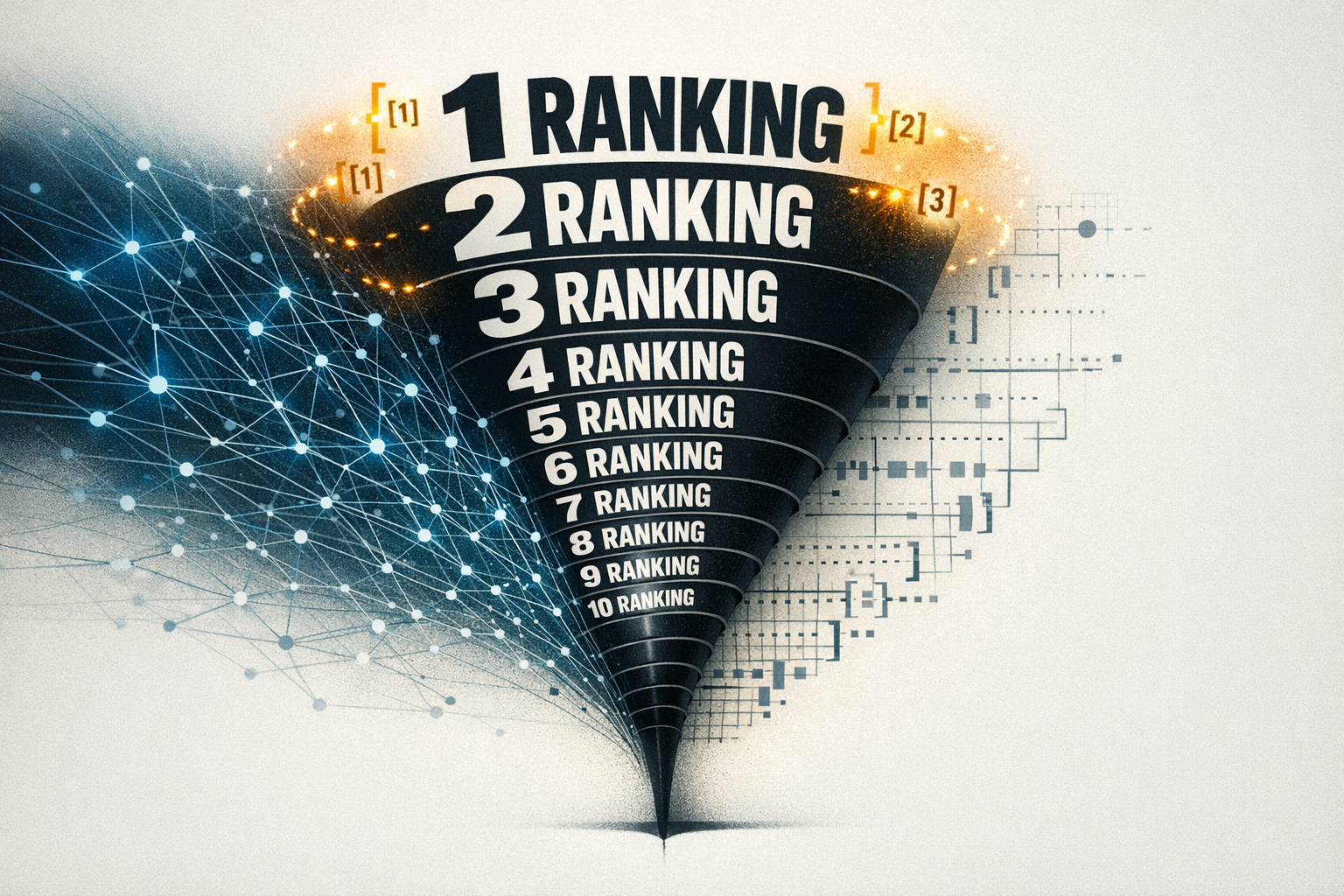
The Fairness Dilemma: Biases in LLM-Based Ranking Systems
Bias in LLM-based ranking systems is the systematic skew in which sources, products, or viewpoints get surfaced, cited, and trusted when an AI system generates a ranked list or an “answer with citations.” It’s not limited to overt demographic bias: in AI Retrieval & Content Discovery, bias often shows up as visibility bias (who gets seen), credibility bias (who gets believed), and citation bias (who gets referenced). The dilemma is that improving perceived “quality” and “helpfulness” can unintentionally increase concentration—creating winner-take-most dynamics that disadvantage smaller publishers, non-English sources, and emerging expertise.
If your content isn’t retrieved, ranked, or cited, it effectively doesn’t exist inside answer engines. For deeper coverage of how citation failures happen (even when content is correct), explore: Generative Engine Optimization (GEO): Agentic citation-failure diagnostics in AI Retrieval & Content Discovery (Case Study).
Bias in LLM ranking is not a bug—it’s a product decision
Featured snippet target: What is bias in LLM-based ranking systems?
Definition
Bias in LLM-based ranking systems is any consistent, measurable skew in how an AI system orders, selects, or cites items (documents, domains, products, entities, viewpoints) that cannot be explained solely by user intent satisfaction—and that disproportionately advantages or disadvantages certain groups of sources (e.g., large publishers vs. small sites, English vs. non-English, incumbents vs. newcomers).
Thesis: Ranking is governance, not just relevance
When an LLM ranks “best X,” chooses which sources to cite in a RAG answer, or decides which passages to quote, it is allocating scarce attention. Those decisions encode values—often implicitly—about what counts as authoritative (prestige), safe (risk), current (recency), and useful (readability). The result is a governance layer over the information ecosystem: some publishers gain compounding credibility, while others become effectively invisible.
This is the core fairness dilemma documented in recent work on LLM ranking: even if the model is “accurate,” its ranking behavior can still be unfair because it amplifies pre-existing imbalances in what gets written, crawled, linked, and learned.
Illustrative concentration in ranked attention and citations
A stylized example showing how attention and citations can concentrate in top positions/domains. Use as a diagnostic baseline to compare with your own query logs and citation samples.
If your system optimizes only for perceived answer quality, you may get a “cleaner” experience while silently reducing publisher diversity. Treat concentration as a first-class metric (not an accidental side effect).
Where bias enters the AI Retrieval & Content Discovery ranking pipeline
Most LLM-based ranking in answer engines is a pipeline: (1) candidate generation (crawl/index coverage), (2) retrieval (keyword + vector), and (3) re-ranking/synthesis (LLM chooses what to quote, cite, and order). Bias can enter at each stage—and compound across stages.
Training priors: popularity, language, and publisher prestige baked into representations
LLMs and embedding models learn from corpora that already reflect unequal production and distribution of content. If a language, region, or publisher type is underrepresented in training data, the model may encode weaker semantic representations for it—making those sources harder to retrieve and less likely to be judged as “high quality.” This can manifest as the model preferring familiar outlets, mainstream phrasing, or majority viewpoints even when niche sources are more correct for a query’s context.
Retrieval-stage bias: indexing coverage, freshness, and crawl inequality
Retrieval is bounded by what you have. If content is not crawled, licensed, accessible (paywalls), or parsable, it cannot be retrieved—so it cannot be ranked. This creates structural underrepresentation for smaller sites, local publishers, non-English sources, and formats that are harder to ingest (PDFs, tables, interactive pages). Even within indexed content, freshness skew matters: frequently crawled domains get “newer truth” and therefore win recency-sensitive queries.
Re-ranking bias: proxies for “authority” and “quality” that correlate with power
Re-rankers and LLM judges frequently rely on proxies: backlink profiles, brand familiarity, engagement, “well-cited” patterns, and domain reputation. These correlate with incumbency and marketing reach, not just expertise. In practice, this can suppress emerging research, independent analysts, and minority perspectives—especially on contested topics where “consensus” is partly a function of who had the loudest distribution.
How bias compounds across the ranking pipeline (conceptual)
Candidate coverage, retrieval recall, and final citation share can each skew toward large/English/incumbent sources; compounding yields outsized final concentration.
A useful mental model: if each stage is “only a little biased,” the end-to-end system can still become highly biased because later stages operate on a pre-filtered set.
Related industry observations suggest that some answer engines and LLM experiences disproportionately cite community and UGC sources (e.g., forums) for certain intents—useful for lived experience, but risky for technical or YMYL topics when not cross-validated.
External reading: arXiv: The Fairness Dilemma: Biases in LLM-Based Ranking Systems; Quoleady: AI Search Engines' Preference for Reddit.
The hidden trade-off: ‘helpfulness’ metrics can intensify unfair exposure
Why optimizing for user satisfaction can reduce viewpoint diversity
Ranking objectives like CTR, dwell time, “thumbs up,” and rater-based helpfulness tend to reward sources that are familiar, confidently written, and easy to summarize. That often correlates with mainstream outlets, well-funded publishers, and content that matches dominant linguistic norms. Meanwhile, high-signal but “harder” content (technical, local, nuanced, multilingual) can lose—despite being more appropriate for parts of the audience.
Feedback loops: clicks, citations, and “answer acceptance” as bias accelerants
Answer engines create new feedback loops. More exposure leads to more downstream mentions, more links, more brand search, and more “authority” signals—then the ranker learns that these sources are “safe bets.” LLM citations can become an authority signal themselves: if a domain is repeatedly cited, it looks reputable to both users and models, reinforcing its selection in future retrieval and re-ranking.
Conceptual feedback loop: citation concentration increases over time without constraints
Illustrative trend showing how the share of citations from top domains can rise as feedback loops reinforce incumbents.
Counterpoint: fairness constraints can reduce perceived relevance—when is that acceptable?
A common objection is that fairness constraints may surface lower-quality sources. That can happen if you implement fairness as a blunt quota. A pragmatic middle path is fairness-aware ranking with explicit thresholds: require minimum evidence quality (e.g., primary sources, clear methodology, recent updates) and then optimize for diversity within that high-quality set. This treats fairness as “diversify among qualified candidates,” not “promote anything to satisfy a target.”
Pick 200–500 stable queries across categories (head/tail, YMYL/non-YMYL, multilingual). Re-run daily for 4–6 weeks and track: domain concentration (HHI), citation diversity (Shannon entropy), and rank volatility. Then introduce one change (e.g., freshness weighting, structured data boost, or diversity-aware re-ranking) and compare deltas.
Why structured data is a fairness lever (and where it can backfire)
Structured signals reduce guesswork in ranking and grounding
When systems lack reliable metadata, they fall back to popularity proxies (links, mentions, brand familiarity). Structured data can reduce that reliance by making provenance and comparability explicit—who wrote it, when it was updated, what geography it applies to, what methodology was used, and what sources it cites. In RAG, this can improve grounding and citation quality because the model can select passages with clearer scope and evidence.
Industry SEO/LLMO commentary also emphasizes structured data as a visibility factor in AI-driven search experiences (treat these as directional, not definitive): Ranktracker: Optimizing Content for AI (LLM-specific ranking factors).
Schema choices that influence who gets recognized as ‘authoritative’
- Authorship & credentials: make author identity, role, and relevant expertise machine-readable (and consistent across pages).
- Dates & maintenance: include publication and last-updated timestamps to reduce stale dominance.
- Geographic applicability: specify the region/jurisdiction a claim applies to (critical for local and regulatory topics).
- Methodology & evidence: structure “how we know” (data sources, references, citations) so models can compare like-with-like.
- Content type: distinguish editorial, reference, product, and opinion to avoid flattening everything into a single “authority” scale.
Failure modes: schema gaming, uneven adoption, and metadata bias
Structured data can also introduce new inequities. Larger publishers adopt schema faster and more completely, which can widen visibility gaps. Bad actors can fabricate metadata (fake authors, fake citations). And if your ranker over-weights schema presence, you may create a “metadata tax” that penalizes small teams—even when their content is high quality.
Use structured data as a signal, then validate it: cross-check author entities, verify citations resolve, compare timestamps to on-page content, and down-rank inconsistent metadata. Calibrate weighting so “has schema” never dominates “is correct.”
With vs. without structured data: expected directional impact on fairness-related outcomes
Illustrative comparison showing how structured data can improve citation accuracy and freshness alignment while modestly increasing diversity—if validated and not over-weighted.
A practical fairness audit checklist for LLM ranking teams
Treat fairness like reliability: define service-level objectives (SLOs), measure continuously, and investigate regressions. The goal isn’t perfect parity; it’s to prevent systematic, compounding disadvantage—especially for query classes where diversity and local context matter.
Define slices and “protected” source categories
Create evaluation slices: head vs. tail queries; YMYL vs. non-YMYL; multilingual; local intent; and underrepresented publisher cohorts (small sites, local media, niche research groups). Decide which dimensions you will monitor for exposure and error rates.
Measure exposure, representation, and concentration
Track exposure share by category (impressions, rank-weighted exposure), plus concentration metrics like HHI and top-N domain share. Add viewpoint diversity proxies (entropy across domains/entities) for queries where plural perspectives are appropriate.
Measure citation and grounding errors
Audit citation precision/recall (does the citation support the claim?), hallucinated attribution rate, “unknown source” frequency, and mismatch between cited date and claim freshness. These errors often correlate with over-reliance on a narrow set of sources.
Stress-test with red-team scenarios
Use ambiguous prompts, controversial topics, and region-specific questions to test whether the system defaults to dominant viewpoints. Include adversarial cases where high-authority sources are outdated, and low-authority sources are correct and current.
Publish minimal transparency notes and correction paths
Document what signals matter (at a high level), how structured data is used, and how publishers/users can request corrections. Even lightweight transparency reduces the “black box” harm where disadvantaged sources cannot diagnose why they’re excluded.
| Metric | What it detects | Suggested cadence | Example threshold (starting point) |
|---|---|---|---|
| Top-N domain share | Over-concentration / winner-take-most | Daily / weekly | Cap at 60–75% for top-5 in diversity-sensitive query classes |
| HHI (domain concentration) | Market-like dominance across sources | Weekly / release-gated | No sustained increases > X% week-over-week without review |
| Citation precision (supportiveness) | Misattribution / misleading citations | Weekly / release-gated | ≥ 0.90 on sampled queries; higher for YMYL |
| Time-to-update / freshness drift | Stale dominance; crawl inequality effects | Weekly / monthly | Set per query class (e.g., news vs evergreen); alert on regressions |
Key Takeaways
LLM ranking bias is often visibility and citation bias: it governs who gets attention and credibility, not just what is “relevant.”
Bias compounds across pipeline stages (coverage → retrieval → re-ranking). Small skews early can become large inequities at the citation layer.
Helpfulness optimization can reduce diversity via feedback loops; monitor concentration (top-N share, HHI) alongside satisfaction metrics.
Structured data is a fairness lever when validated and calibrated—otherwise it can become a new bias that rewards big publishers and metadata gaming.
FAQ: Fairness in LLM-Based Ranking
Primary research reference: The Fairness Dilemma: Biases in LLM-Based Ranking Systems (arXiv). Additional context on AI visibility factors: Ranktracker (LLMO ranking factors & structured data).

Founder of Geol.ai
Senior builder at the intersection of AI, search, and blockchain. I design and ship agentic systems that automate complex business workflows. On the search side, I’m at the forefront of GEO/AEO (AI SEO), where retrieval, structured data, and entity authority map directly to AI answers and revenue. I’ve authored a whitepaper on this space and road-test ideas currently in production. On the infrastructure side, I integrate LLM pipelines (RAG, vector search, tool calling), data connectors (CRM/ERP/Ads), and observability so teams can trust automation at scale. In crypto, I implement alternative payment rails (on-chain + off-ramp orchestration, stable-value flows, compliance gating) to reduce fees and settlement times versus traditional processors and legacy financial institutions. A true Bitcoin treasury advocate. 18+ years of web dev, SEO, and PPC give me the full stack—from growth strategy to code. I’m hands-on (Vibe coding on Replit/Codex/Cursor) and pragmatic: ship fast, measure impact, iterate. Focus areas: AI workflow automation • GEO/AEO strategy • AI content/retrieval architecture • Data pipelines • On-chain payments • Product-led growth for AI systems Let’s talk if you want: to automate a revenue workflow, make your site/brand “answer-ready” for AI, or stand up crypto payments without breaking compliance or UX.
Related Articles

What a GEO Platform Actually Costs in 2026: The Pricing Guide Vendors Won't Write
Real published prices for the Generative Engine Optimization tool market in 2026: self-serve entry tiers, enterprise quote walls, metering math, and honest tool-versus-consultant economics.

ChatGPT Optimization in 2026: A Working Checklist for Getting Your Brand Cited, Not Just Ranked
How ChatGPT retrieves and cites sources in July 2026, with a sourced Generative Engine Optimization checklist covering crawler access, extractable answers, entity signals, and measurement.