Generative Engine Optimization (GEO): Agentic citation-failure diagnostics in AI Retrieval & Content Discovery (Case Study)
Case study on agentic diagnostics to fix AI citation failures in AI Retrieval & Content Discovery—root causes, workflow, metrics, and lessons learned.
Generative Engine Optimization (GEO): Agentic citation-failure diagnostics in AI Retrieval & Content Discovery (Case Study)
When a GEO content refresh “works” in classic analytics (more impressions, more crawl activity, more long-tail coverage) but answer engines start citing the wrong URLs—or stop citing you at all—you’re not looking at a copy problem. You’re looking at an AI Retrieval & Content Discovery problem across fetchability, indexing, retrieval ranking, grounding, and citation selection. This case study shows a repeatable, agentic diagnostic pipeline that isolates citation failures quickly, produces evidence per stage, and guides targeted fixes that measurably improve citation accuracy—without rewriting everything.
Operationally, we labeled a prompt as a citation failure when: (1) the model’s answer is mostly correct but cites the wrong URL, (2) the model answers incorrectly while citing our page, or (3) the model refuses to cite despite our site containing a relevant, fetchable source.
To see how retrieval partnerships and product surfaces change what “discoverable” means at scale, apply these diagnostics in the context of social and browser distribution too—study Perplexity’s Snapchat-scale retrieval dynamics before you assume “Google indexing” is the whole story.
Situation: Citation failures surfaced after a GEO content refresh
Symptoms observed in answer engines (missing, wrong, or stale citations)
A B2B knowledge site (documentation + explainers + comparison pages) shipped a major GEO refresh: updated templates, consolidated legacy URLs, and added new “definition-first” sections. Within two weeks, the team observed:
- More impressions and more crawl activity, but fewer answer-engine citations to the intended canonical pages.
- Wrong-page citations (e.g., citing a tag page or a parameterized URL instead of the refreshed article).
- Stale citations (answer engines citing pre-refresh content or cached snippets with outdated numbers).
Why this is an AI Retrieval & Content Discovery problem (not just SEO)
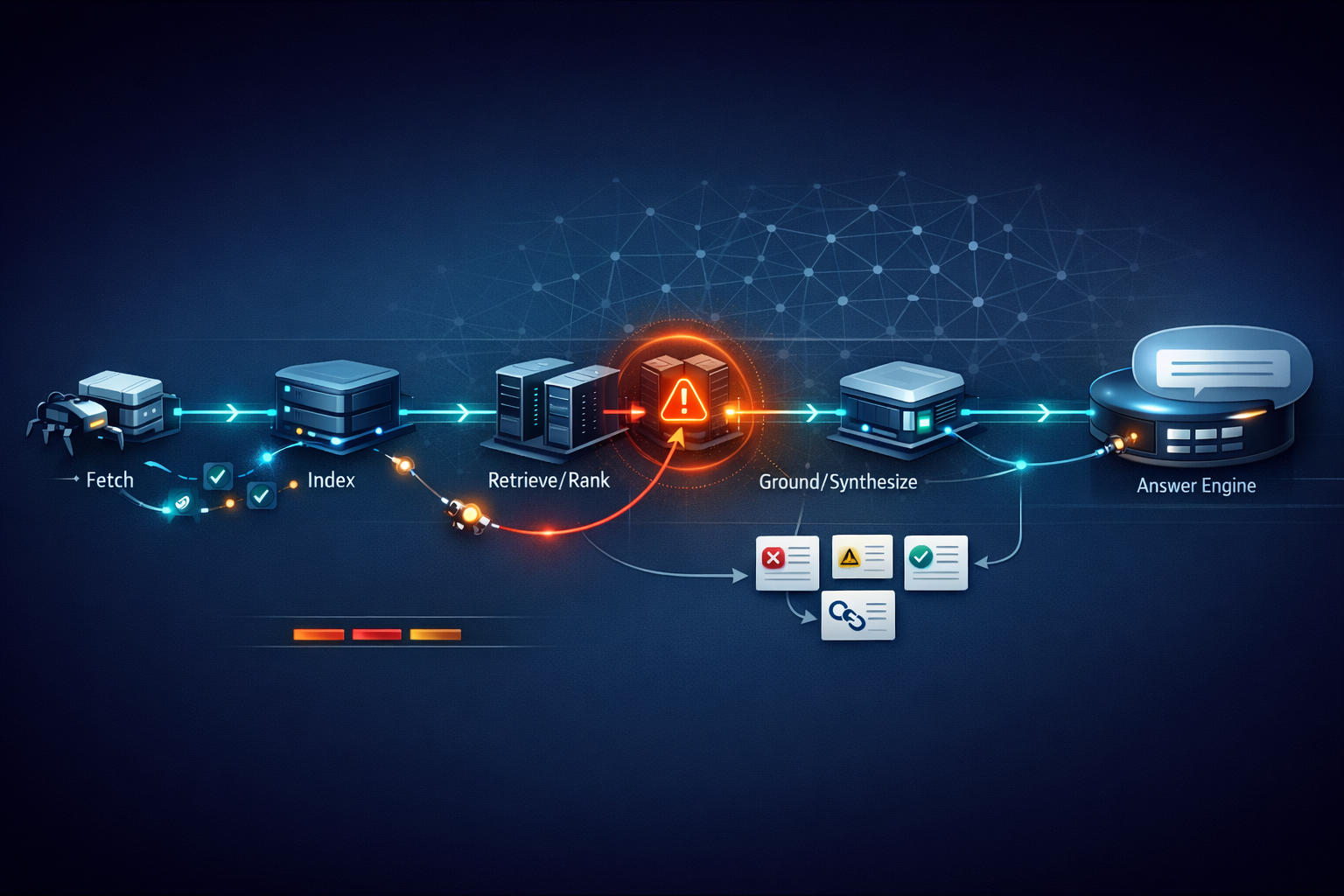
Answer engines don’t simply “rank a page.” They run a pipeline: fetch → index/cache → retrieve candidates → ground the response in passages → choose citations. A refresh can improve human readability while accidentally degrading one or more of these machine stages (e.g., JS-rendered tables, canonical inconsistencies, or weaker “quotable” passages).
Baseline snapshot: citation outcomes across monitored prompts (pre-diagnostics)
Share of prompts that returned (1) any citation, (2) a correct citation to the intended canonical URL, or (3) a stale citation to pre-refresh/incorrect URLs. Values represent the initial monitoring window after the refresh.
Scope note: this article focuses on diagnostics (how to find the failure stage fast), not a full GEO program. For citation reliability, you also need to understand how often AI systems can fabricate or mis-handle references—use this GhostCite briefing to pressure-test your citation confidence assumptions.
Approach: Build an agentic citation-failure diagnostic pipeline
Diagnostic taxonomy: fetch → index → retrieve → ground → cite
We used a stepwise taxonomy aligned to how answer engines actually work. Each stage has a small set of deterministic checks that can be automated and repeated:
| Stage | What breaks | Evidence to collect |
|---|---|---|
| Fetch | Robots blocks, auth walls, soft 403s, redirects, JS-only critical content | HTTP status/headers, response body, render vs raw diff, canonical/redirect chain |
| Index/cache | Stale caches, wrong canonical, conflicting freshness signals | Sitemap lastmod vs Last-Modified vs on-page timestamps, cache age estimates |
| Retrieve | Wrong candidate set, missing page coverage, de-ranked canonical | Top-k retrieved URLs, snippet/passage matches, rank positions |
| Ground | Thin/ambiguous passages, facts buried, no quotable claims, entity confusion | Passage-level coverage, claim detectability, entity disambiguation cues |
| Cite | Citation formatting/selection picks the wrong URL even when grounded | Citation-to-passage mapping, canonical resolution, duplicate URL clusters |
Agent roles and tools (crawler agent, retrieval probe agent, citation verifier agent)
An orchestrator agent routed each failing prompt to specialized agents that ran repeatable checks and attached evidence. This design mirrors emerging “agent team” patterns in production AI systems (see: TechCrunch on Anthropic’s agent teams). The minimum viable set:
- Crawler agent: requests with multiple user agents, records status codes, headers, redirect chains, robots outcomes, and canonical tags.
- Rendering agent: compares server HTML vs rendered DOM (headings, tables, key facts), flags “critical content missing without JS.”
- Retrieval probe agent: runs controlled queries, records top-k candidates, and checks whether the intended canonical appears and where.
- Citation verifier agent: maps cited URLs to the site’s canonical set; computes a source-of-truth match score (URL + passage overlap).
Test harness: prompt set, controls, and replayable runs
Build a prompt set (30–80 prompts)
Map each prompt to a target canonical URL and a “must-include” passage (the claim you expect to be cited). Include long-tail, ambiguous, and comparison variants.
Add controls to separate platform drift from site issues
Use (a) a known-citable reference page, (b) a deliberately blocked page, and (c) a stable evergreen page. If controls break, suspect engine/model drift rather than your refresh.
Run nightly with fixed parameters
Fix model/engine, temperature, region, and (if possible) retrieval mode. Store full outputs, cited URLs, and timestamps for diffs.
Emit artifacts per prompt
For each prompt: a citation trace (cited URLs + resolved canonicals), a match score, and a root-cause label with confidence.
Agentic diagnostic pipeline (fetch → index → retrieve → ground → cite)
A simplified flow showing how an orchestrator routes failing prompts to specialized agents and produces evidence-backed root-cause labels.
This approach is consistent with emerging research on agentic GEO diagnostics and targeted repair methods (arXiv: agentic citation-failure diagnostics). For broader context on how “deep research” product modes change retrieval and synthesis behaviors, compare against OpenAI’s description of research-style workflows (OpenAI Deep Research).
Diagnostics in action: What the agents found (root causes)
Failure mode 1: Fetch and rendering blockers (soft 403s, JS-only content, canonical traps)
Incident A (soft 403 by user agent): the crawler agent saw HTTP 200 responses, but the body contained an interstitial “verify you are human” variant for certain UAs. To a human, pages loaded; to a retrieval fetcher, the content was effectively blocked—leading to uncited answers or citations to third-party sources.
Incident B (JS-only critical table): the rendering agent diff showed that the “pricing comparison” table (the most citable artifact) only appeared after client-side JS. Raw HTML contained an empty shell, so retrieval systems that don’t fully render JS had nothing quotable to ground on—reducing citation selection.
Incident C (canonical trap): canonical tags sometimes pointed to parameterized URLs created during the refresh (e.g., UTM or filter params). Retrieval probe runs showed those variants outranking the intended canonical in some engines—so the model cited the “wrong” URL even when it used the right content.
Failure mode 2: Indexing and freshness gaps (stale caches, conflicting lastmod signals)
The index/freshness agent compared three freshness signals: sitemap lastmod, HTTP Last-Modified, and an on-page “Last updated” timestamp. For ~20% of refreshed pages, these conflicted (e.g., sitemap updated, but HTTP headers unchanged; or on-page date newer than sitemap). Several engines continued to surface pre-refresh cached snippets, producing stale citations even when the canonical was correct.
Failure mode 3: Retrieval/grounding mismatch (thin passages, entity ambiguity, missing anchors)
The retrieval probe agent repeatedly retrieved the right page—but the grounding checks flagged that the relevant claim was not easily extractable: key facts were buried in PDFs, lacked nearby headings, or were phrased as multi-paragraph narrative without crisp, quotable sentences. For ambiguous entities (e.g., a product name shared with a feature name), missing disambiguation cues increased wrong-page citations.
Root-cause breakdown of citation failures (agent-labeled)
Distribution of failures across stages. Use this to prioritize fixes that unblock the most prompts fastest.
If you don’t know whether you’re failing at fetch, index, retrieve, ground, or cite, you’ll ship changes that look plausible but don’t move citation correctness. Require each fix to be tied to an evidence artifact (headers, render diff, retrieval top-k, passage match).
Remediation: Targeted fixes that improved citation accuracy
Fix set A: Make sources fetchable and stable for AI content retrieval
- Remove soft blocks: eliminate bot challenges on doc paths; ensure consistent responses across user agents.
- Server-render critical content: ensure key tables/definitions exist in initial HTML (or provide a static fallback).
- Reduce redirect/duplicate paths: collapse parameter variants; keep a single, permanent canonical URL per concept.
Fix set B: Improve grounding surfaces (quotable passages, entity disambiguation, structured cues)
- Add a short definition block near the top (1–2 sentences) with the primary entity name + synonyms.
- Make claims quotable: convert “buried facts” into crisp statements under descriptive H2/H3 headings.
- Use labeled tables with stable anchors (e.g., “#pricing-table”, “#api-limits”) so citations can point to a semantically clear section.
Fix set C: Citation hygiene (canonical consistency, URL permanence, snippet-friendly formatting)
- Unify canonical logic across templates; ensure canonicals never point to parameterized variants.
- Standardize titles and H2/H3 structure to reduce duplicate-intent clustering.
- Align freshness signals: keep sitemap lastmod, HTTP headers, and on-page “Last updated” consistent.
Before/after trend: citation correctness and stale-citation rate
Illustrative 6-week trend after targeted fixes shipped behind feature flags and validated nightly via agentic replays.
These fixes also align with observed model citation behaviors: systems tend to cite sources that are unambiguous, extractable, and stable. For a practical overview of how LLMs choose what to cite (and why brands get misattributed), see LLM citation patterns and sourcing behaviors.
Results & lessons learned: A repeatable GEO diagnostic playbook
What moved the needle (and what didn’t)
The highest-leverage improvements came from making the site easier to fetch and easier to quote. Pure “wordsmithing” (rewriting paragraphs without changing structure, anchors, or renderability) produced little change in citation correctness. In practice, the agentic pipeline reduced time-to-diagnosis because each failure arrived with stage-specific evidence rather than a vague “AI didn’t cite us.”
“Citations fail when the system can’t reliably fetch or extract a clean, attributable passage. Agentic evaluation helps because it turns a fuzzy symptom into a staged, testable hypothesis with artifacts.”
How to capture featured snippets and answer-engine citations together
The same structure that helps featured snippets often helps answer-engine grounding: a compact definition block, a numbered diagnostic checklist, and a small “failure mode → test → fix” table. This improves extractability (for retrieval) and attribution clarity (for citations).
Governance: ongoing monitoring within AI Retrieval & Content Discovery
Treat AI Retrieval & Content Discovery as a product surface with SLAs: freshness, fetchability, and citation accuracy. Maintain a living prompt set, keep controls, and alert on drops in correctness (not just “any citation”). Also track distribution shifts as AI enters browsing contexts (e.g., Perplexity’s Comet browser), where retrieval and citation UX can differ from chat-only experiences.
| Playbook KPI | Definition | Why it matters |
|---|---|---|
| Correct-citation rate | % prompts where the cited URL resolves to the intended canonical and overlaps the target passage | Measures attribution accuracy, not just visibility |
| Uncited-answer rate | % prompts with no citation despite relevant content | Often indicates fetch, render, or grounding extractability issues |
| Median time-to-diagnosis | Time from alert to evidence-backed root-cause label | Directly reduces “guess-and-check” engineering cycles |
As GEO becomes a dedicated budget line, teams will be judged on measurable citation reliability (not just traffic). If you need a macro view of how quickly this space is professionalizing, see market coverage on GEO’s growth trajectory (marketresearch.com GEO visibility frontier).
Key takeaways
Diagnose citation failures by pipeline stage (fetch, index, retrieve, ground, cite) rather than “SEO vs content.”
Agentic diagnostics win because they attach evidence artifacts (headers, render diffs, top‑k retrieval, passage overlap) to each failure.
The most reliable lifts came from fetchability + quotability: SSR critical facts, stable canonicals, and crisp, anchored claims.
Treat AI Retrieval & Content Discovery as an ongoing surface: maintain a prompt set with controls and alert on correctness drops to catch drift.
FAQ: Agentic citation-failure diagnostics for GEO

Founder of Geol.ai
Senior builder at the intersection of AI, search, and blockchain. I design and ship agentic systems that automate complex business workflows. On the search side, I’m at the forefront of GEO/AEO (AI SEO), where retrieval, structured data, and entity authority map directly to AI answers and revenue. I’ve authored a whitepaper on this space and road-test ideas currently in production. On the infrastructure side, I integrate LLM pipelines (RAG, vector search, tool calling), data connectors (CRM/ERP/Ads), and observability so teams can trust automation at scale. In crypto, I implement alternative payment rails (on-chain + off-ramp orchestration, stable-value flows, compliance gating) to reduce fees and settlement times versus traditional processors and legacy financial institutions. A true Bitcoin treasury advocate. 18+ years of web dev, SEO, and PPC give me the full stack—from growth strategy to code. I’m hands-on (Vibe coding on Replit/Codex/Cursor) and pragmatic: ship fast, measure impact, iterate. Focus areas: AI workflow automation • GEO/AEO strategy • AI content/retrieval architecture • Data pipelines • On-chain payments • Product-led growth for AI systems Let’s talk if you want: to automate a revenue workflow, make your site/brand “answer-ready” for AI, or stand up crypto payments without breaking compliance or UX.
Related Articles
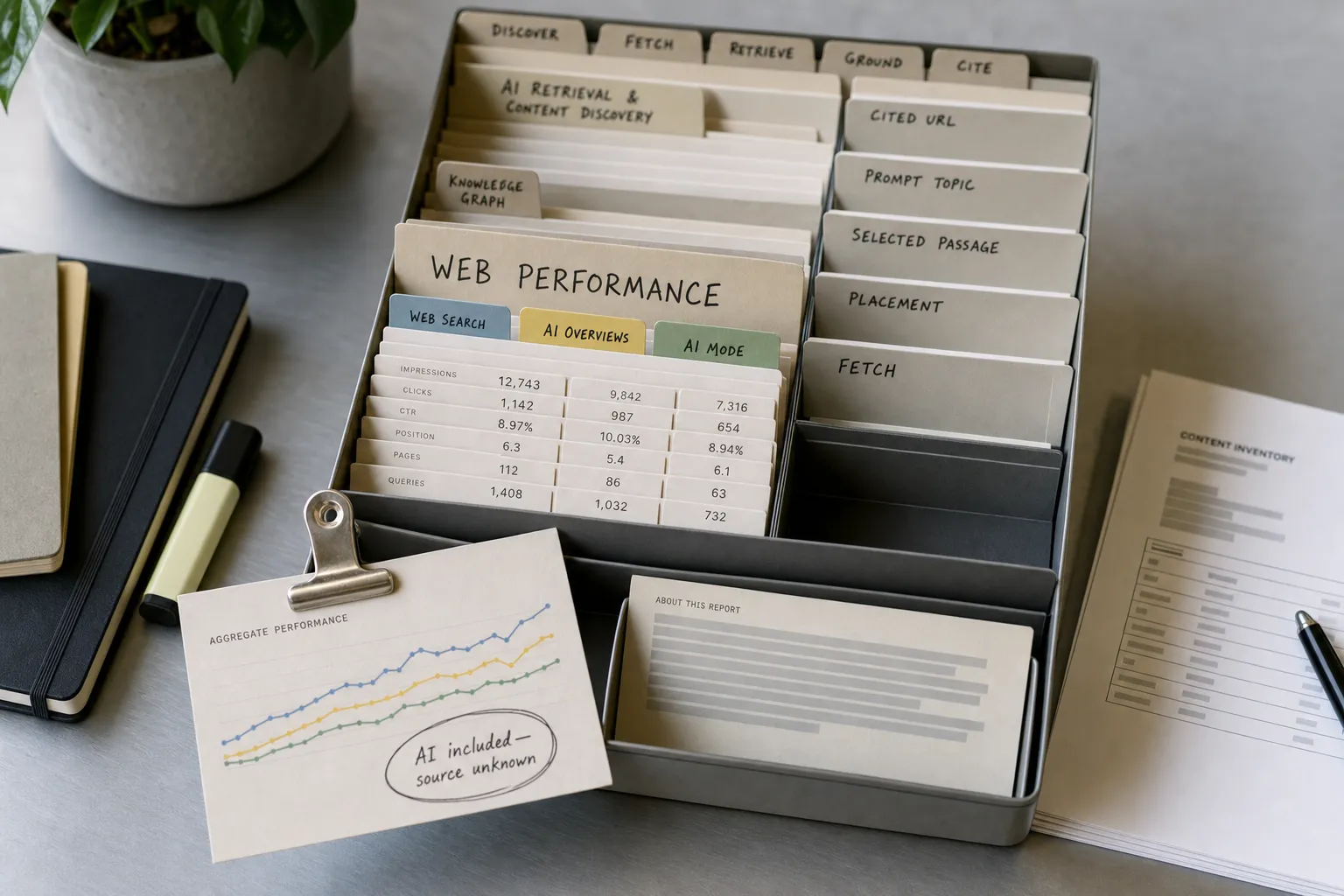
Google Finally Gives Publishers an AI-Visibility Dashboard—But Not the Data They Want
Google now counts AI search activity in Search Console, but blended reporting leaves publishers blind to citations, queries, and content-level performance.
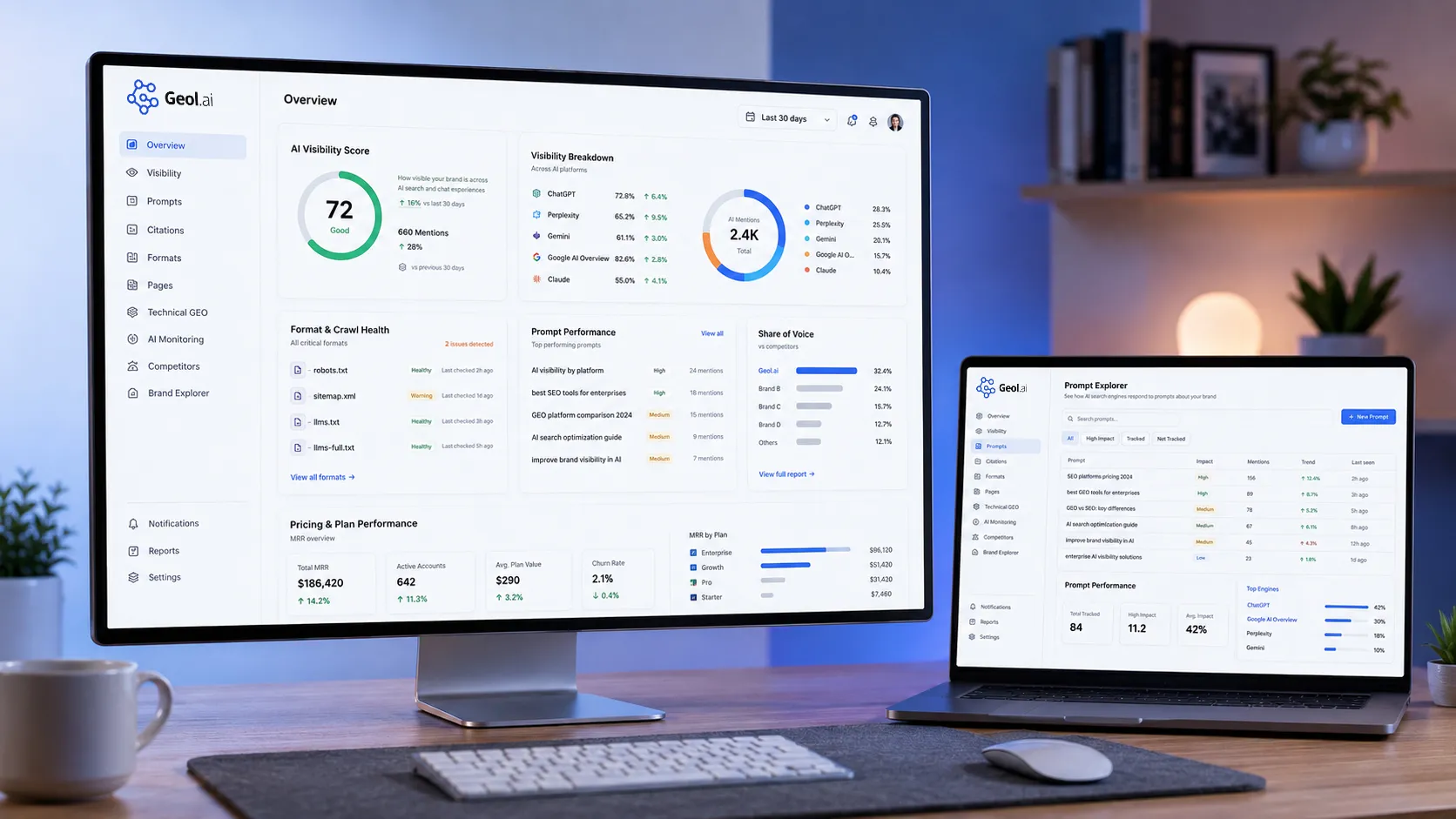
What a GEO Platform Actually Costs in 2026: The Pricing Guide Vendors Won't Write
Real published prices for the Generative Engine Optimization tool market in 2026: self-serve entry tiers, enterprise quote walls, metering math, and honest tool-versus-consultant economics.