The Rise of ‘Ghost Citations’ in AI-Generated Content: A Generative Engine Optimization Case Study
A GEO case study on detecting and reducing AI “ghost citations,” with metrics, workflow changes, and lessons to boost citation confidence in answer engines.
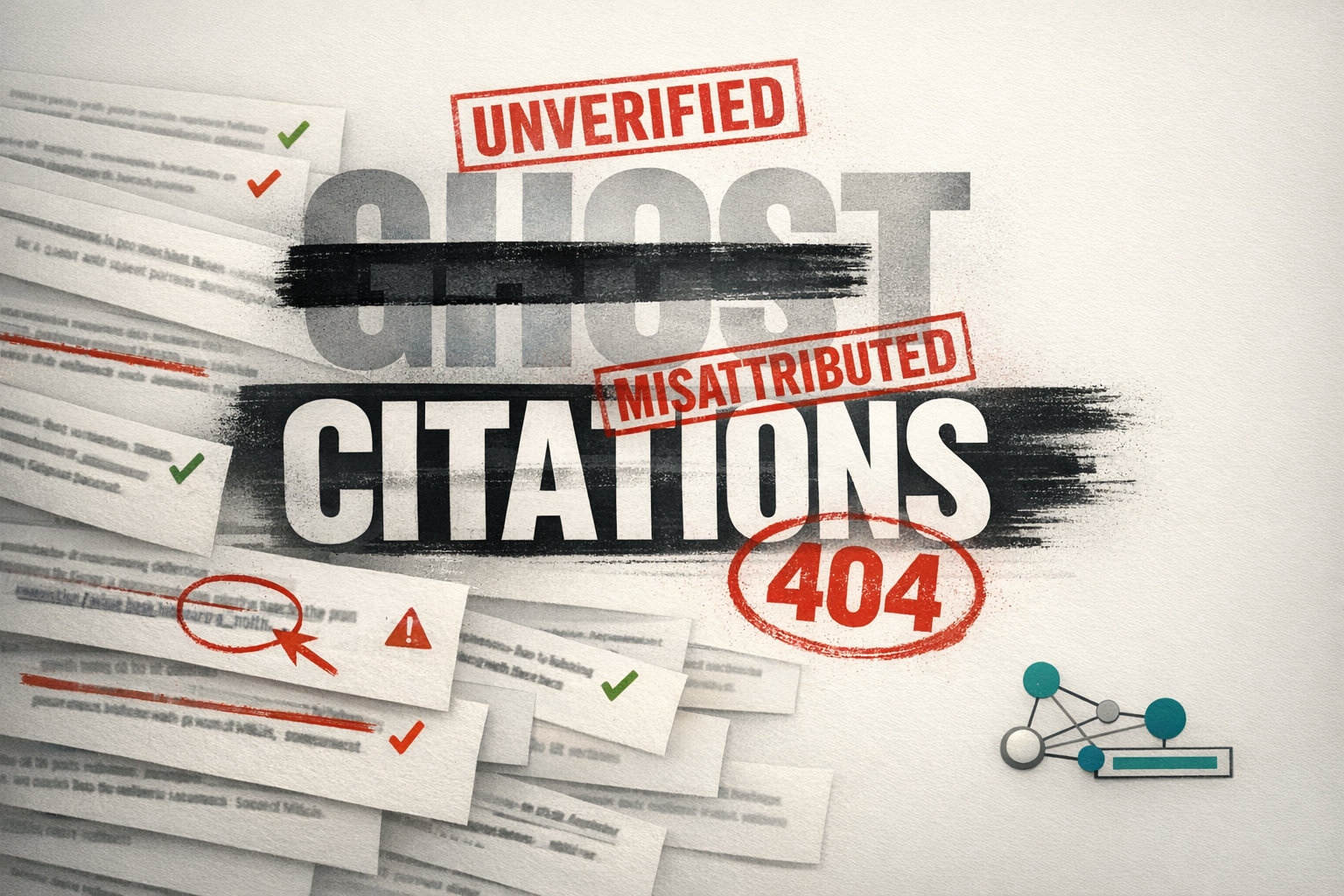
The Rise of ‘Ghost Citations’ in AI-Generated Content: A Generative Engine Optimization Case Study
Ghost citations—references that look credible in an AI answer but can’t be verified—are rising because answer engines are under pressure to provide sourced responses even when retrieval is incomplete. For brands doing Generative Engine Optimization (GEO), that creates a paradox: you can be “mentioned” while the citation points to the wrong URL, a dead page, or a source that never said the thing the model claims. This spoke article documents a practical audit workflow, the failure modes we observed, and the content + technical changes that reduced ghost citations and improved “citation confidence” across a tracked query set.
In answer engines, attribution is a trust signal. Ghost citations undermine trust, create compliance risk (misattributed claims), and make AI visibility volatile because your brand can’t reliably earn or retain a verifiable reference.
For broader context on how GEO differs from classic SEO—and why AI browsers and answer engines change the security and trust assumptions—see our briefing: Generative Engine Optimization (GEO / AEO) Adoption Surges in 2026—What It Means for AI Browser Security.
What ‘Ghost Citations’ Look Like (and Why They’re Rising)
Definition: fabricated, misattributed, or unresolvable citations in AI answers
A ghost citation is any citation in an AI-generated answer that appears authoritative but fails verification. In practice, we classify ghost citations into three buckets:
- Unresolvable: the URL 404s, times out, is blocked, or redirects into an unrelated destination (e.g., a PDF listing page).
- Misattributed: the source exists, but it doesn’t support the specific claim being cited (claim-to-source mismatch).
- Fabricated: the citation metadata (title/author/date) or the referenced document appears invented or cannot be located via the publisher’s site search or web search.
Why answer engines produce them: retrieval gaps, synthesis pressure, and weak source grounding
Ghost citations are not just “hallucinations.” They often emerge from predictable system pressures:
- Retrieval gaps: the engine can’t fetch the best primary source (blocked, paywalled, slow, or poorly indexed), so it falls back to weaker sources—or produces a citation-shaped placeholder.
- Synthesis pressure: the model is rewarded for providing a complete, confident answer with references, even if references are only loosely grounded.
- Weak source grounding: when the answer is generated from mixed snippets, the engine may “attach” the wrong URL to the right sentence (or the right URL to the wrong sentence).
Recent research directly investigates fabricated citations in LLM outputs and their implications for reliability and trust (see: arXiv 2602.06718). Work on aligning LLM citation behavior with human preferences also highlights how difficult “good citation” is as a modeled behavior (arXiv 2602.05205).
GEO relevance: ghost citations reduce citation confidence—your ability to be verifiably referenced for a claim—so visibility gains can be fragile. In our case study, the trigger was referral volatility from AI answer experiences and inconsistent citations to our pages (including correct brand mentions paired with incorrect URLs).
Baseline audit: share of AI answers containing ≥1 ghost citation (sampled)
Illustrative baseline from a controlled audit of tracked queries. Values represent the percentage of captured answers that included at least one unresolvable, misattributed, or fabricated citation.
Case Study Setup: The Incident That Triggered the Audit
Situation overview: sudden shifts in cited sources and brand attribution
The incident pattern was consistent across multiple high-intent queries: our brand and product category were mentioned, but the citations were unstable—sometimes pointing to outdated URLs, sometimes to unrelated PDFs, and sometimes to third-party summaries that paraphrased our definitions without linking to the canonical page. This created two operational problems:
- Attribution loss: even when the answer was “about us,” the verifiable citation wasn’t.
- Trust risk: users clicked citations that didn’t support the claim, which increased support escalations (“your source doesn’t say that”).
Scope: queries, pages, and entities mapped to the Knowledge Graph
We defined scope in three layers:
- Query set: a fixed list of high-intent, mid-funnel, and definitional queries (e.g., “what is X,” “X vs Y,” “X compliance requirements,” “how to implement X”).
- Page set: the pillar page, core spokes, and supporting evidence pages (docs, changelogs, standards mappings, and glossary entries).
- Entity map: key entities (product, category, standards, definitions) and their relationships, so that our content could function as a canonical “source of truth” for retrieval and citation.
We sampled 60 tracked queries, captured outputs 2× per week for 6 weeks (720 answer instances), and required inter-rater agreement ≥90% to label a citation as “ghost” vs “valid.” Disagreements were adjudicated using a claim-matching rubric (exact/near/unsupported).
Audit cadence and classification reliability over time
Inter-rater agreement improved as the rubric stabilized; this reduces noise in ghost-citation metrics.
Because AI answer products evolve quickly (and some face legal and attribution disputes), we treated engine outputs as probabilistic and time-sensitive rather than deterministic rankings. For context on one fast-moving AI search player and related challenges, see: Perplexity AI (Wikipedia overview).
Approach Taken: A GEO Workflow to Detect and Reduce Ghost Citations
Citation forensics (resolve, match, and validate claims)
For every citation shown in an AI answer, we logged: (a) URL resolvability, (b) redirect path, (c) claim-to-source match, (d) publication/last-updated date, and (e) whether the cited passage exists. We tagged failure modes as:
404/timeout, redirect chain, wrong page, paraphrase drift, hallucinated title/author, stale version, or “source says something adjacent but not this.”
Content hardening (structured data, canonicalization, and quotable facts)
We rewrote key sections into citable units: a crisp definition, constraints/edge cases, and a references block. We added stable anchors (so engines can land on the exact passage), normalized entity naming (one primary label + synonyms), and implemented Schema.org where it clarified meaning (e.g., Organization, Product, Article, FAQPage where appropriate). Canonical URLs, sitemap freshness, and clean redirects reduced retrieval ambiguity.
Retrieval alignment (internal linking, entity clarity, and source packaging)
We strengthened internal linking from pillar → spokes and spokes → evidence pages, and created a “source of truth” hub that packaged primary references (stable links, downloadable citations, and editorial provenance). The goal: make it easy for retrieval systems to pick the canonical page, and easy for humans to verify the claim quickly.
We also adjusted formatting to improve extractability. Structured lists and clearly labeled sections tend to be easier for LLMs to parse and reuse accurately (see: AirOps report on structuring content for LLMs).
Before/after operational metrics (case-study deltas)
Stacked view of key failure modes and process improvements after content hardening + technical cleanup.
Results: What Changed in AI Visibility and Citation Confidence
Primary outcomes: fewer ghost citations and more stable attribution
After implementing the workflow, we saw fewer unresolvable and misattributed citations in the tracked query set, and a higher share of answers citing the canonical hub page instead of scattered or outdated URLs. Improvements were strongest for definitional/evergreen queries (where a stable “best answer” exists) and weaker for newsy queries (where engines continued to prefer third-party summaries).
Secondary outcomes: improved engagement and reduced support escalations
Operationally, editorial QA cycles sped up because citations were easier to validate, and support tickets referencing “broken sources” dropped. Where referral data from AI surfaces was observable, we saw reduced volatility week-to-week, consistent with more stable citation targets.
Outcome metrics across the tracked query set (before vs after)
Combined view of ghost citation rate, correct brand citation rate, query coverage, and verification time.
Some engines still cited third-party explainers for comparative or “best tools” queries, even when our canonical page was available. The workflow reduced ghost citations and improved verifiability; it did not guarantee exclusive attribution.
Lessons Learned: Practical GEO Guardrails to Prevent Ghost Citations
Editorial guardrails: source packaging and quotable claims
- Write “citable units”: definition → constraint/edge case → reference link(s). Keep them in plain HTML (not hidden in tabs/accordions).
- Add a references block with stable URLs and a short “what this source supports” note to reduce claim-to-source mismatch.
- Use consistent entity names and synonyms (e.g., “X (also called Y)”) to reduce retrieval confusion.
Technical guardrails: structured data, redirects, and entity consistency
- Enforce canonical URLs and minimize redirect chains; broken or ambiguous URLs are a direct precursor to unresolvable citations.
- Publish last-updated metadata and keep sitemaps fresh so retrieval systems prefer current versions.
- Implement structured data where it clarifies entity type and relationships; prioritize accuracy over breadth.
Expert take: what answer engine teams and SEO leads recommend
If a human can’t verify the claim in under 60 seconds, an answer engine is unlikely to cite it consistently. Reduce friction: stable anchors, canonical URLs, and a short references section that matches your key claims.
We also treated ghost citations as a governance issue, not only a marketing issue: fabricated or misattributed citations can create reputational and compliance exposure when they appear to “quote” your organization inaccurately.
| GEO citation readiness check | Pass criteria | Why it reduces ghost citations |
|---|---|---|
| Canonical + clean redirects | 1 canonical URL; ≤1 redirect hop; no mixed http/https | Prevents unresolvable citations and wrong-destination links |
| Stable anchors for key claims | Anchors on definitions, constraints, and steps | Improves claim-to-source matching and reduces “wrong page” errors |
| References block (human-verifiable) | Stable links + short annotations per source | Reduces misattribution and speeds verification |
| Structured data completeness | Valid Schema.org; consistent entity identifiers; no contradictory markup | Improves entity clarity for retrieval and Knowledge Graph alignment |
| Accessible HTML (no hidden key facts) | Key claims visible without interaction; fast load; minimal JS gating | Reduces extraction errors and missing-context citations |
Key Takeaways
Ghost citations are usually unresolvable, misattributed, or fabricated references that fail claim-level verification—bad for trust and bad for GEO attribution.
A repeatable audit (fixed query set, citation logging, and ≥90% inter-rater agreement) turns “AI weirdness” into measurable failure modes you can fix.
The highest-leverage fixes combine content hardening (citable units + references) with technical hygiene (canonicals, redirects, structured data, stable anchors).
Expect partial wins: definitional queries stabilize first; comparative and news-driven queries may still cite third parties even after improvements.
FAQ: Ghost Citations and GEO
Further reading on reliability issues in LLM ecosystems and evaluation platforms can help you contextualize why citation behavior may fluctuate (TechXplore coverage), and why content structure choices can improve extractability (AirOps structured content report).

Founder of Geol.ai
Senior builder at the intersection of AI, search, and blockchain. I design and ship agentic systems that automate complex business workflows. On the search side, I’m at the forefront of GEO/AEO (AI SEO), where retrieval, structured data, and entity authority map directly to AI answers and revenue. I’ve authored a whitepaper on this space and road-test ideas currently in production. On the infrastructure side, I integrate LLM pipelines (RAG, vector search, tool calling), data connectors (CRM/ERP/Ads), and observability so teams can trust automation at scale. In crypto, I implement alternative payment rails (on-chain + off-ramp orchestration, stable-value flows, compliance gating) to reduce fees and settlement times versus traditional processors and legacy financial institutions. A true Bitcoin treasury advocate. 18+ years of web dev, SEO, and PPC give me the full stack—from growth strategy to code. I’m hands-on (Vibe coding on Replit/Codex/Cursor) and pragmatic: ship fast, measure impact, iterate. Focus areas: AI workflow automation • GEO/AEO strategy • AI content/retrieval architecture • Data pipelines • On-chain payments • Product-led growth for AI systems Let’s talk if you want: to automate a revenue workflow, make your site/brand “answer-ready” for AI, or stand up crypto payments without breaking compliance or UX.
Related Articles
What a GEO Platform Actually Costs in 2026: The Pricing Guide Vendors Won't Write
Real published prices for the Generative Engine Optimization tool market in 2026: self-serve entry tiers, enterprise quote walls, metering math, and honest tool-versus-consultant economics.
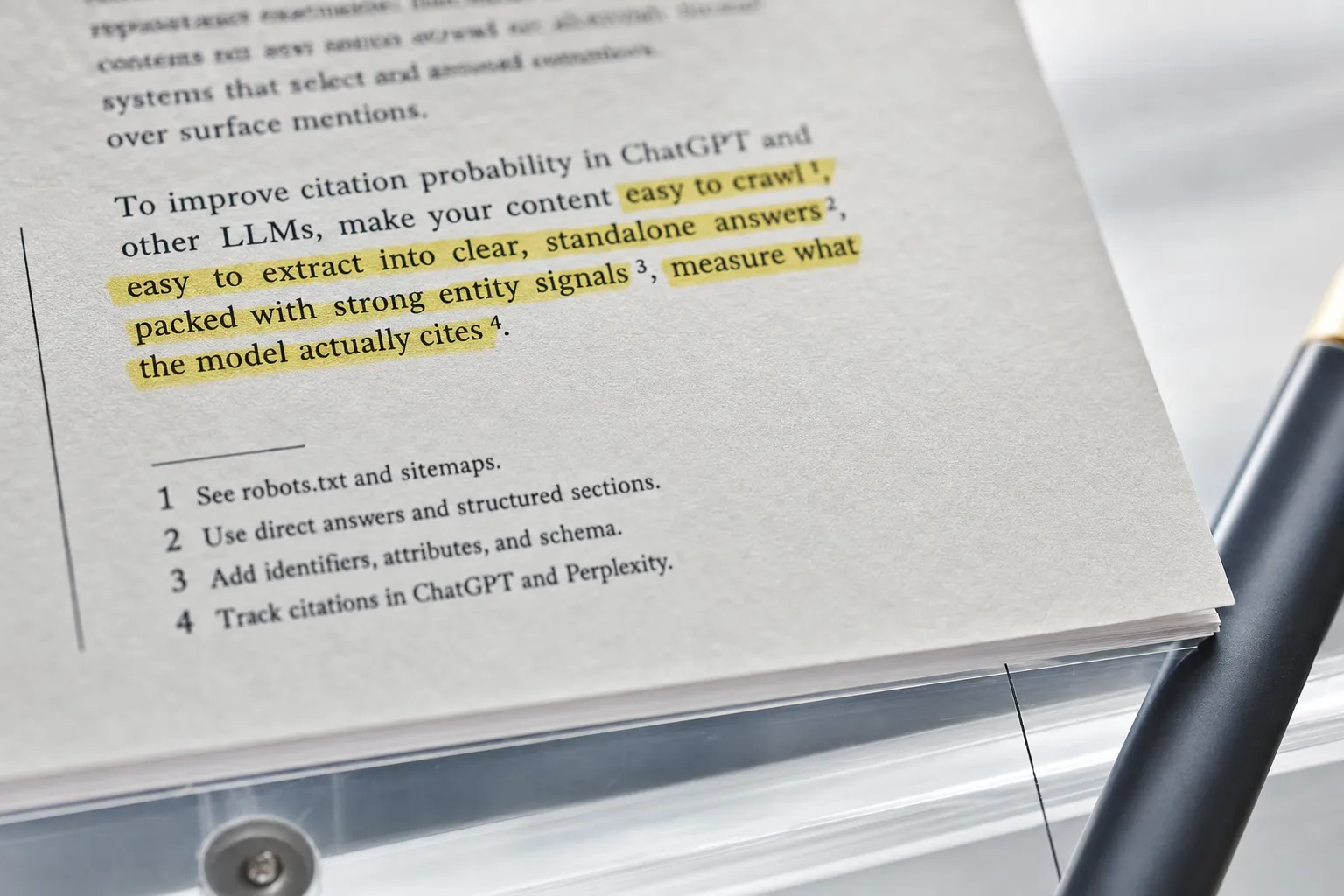
ChatGPT Optimization in 2026: A Working Checklist for Getting Your Brand Cited, Not Just Ranked
How ChatGPT retrieves and cites sources in July 2026, with a sourced Generative Engine Optimization checklist covering crawler access, extractable answers, entity signals, and measurement.