Walmart: ChatGPT Checkout Converted 3x Worse Than the Website—A Structured Data Problem, Not a UX Problem
Why ChatGPT-style checkout can convert 3x worse than Walmart.com—and how Structured Data, not chat UX, fixes intent, trust, and accuracy gaps.
Walmart: ChatGPT Checkout Converted 3x Worse Than the Website—A Structured Data Problem, Not a UX Problem
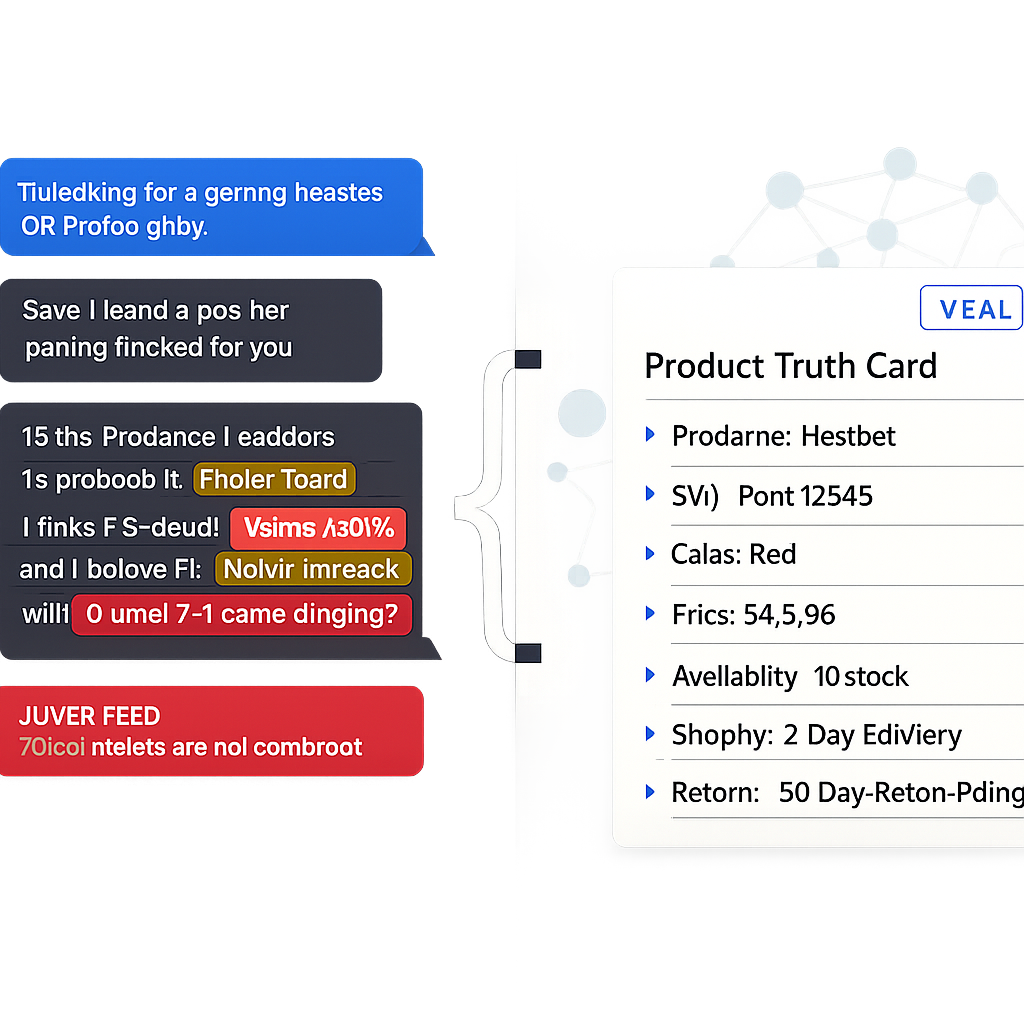
Walmart’s reported test—where in-chat purchases converted at roughly one-third the rate of click-out transactions—gets framed as “chat UX isn’t ready.” But the more repeatable explanation is an information integrity gap: conversational checkout underperforms when the assistant can’t reliably ground to authoritative product truth (SKU/variant, price, stock, shipping promise, and returns). When those facts aren’t machine-readable and consistently resolvable, the model has to guess—then ask extra questions to compensate—creating friction exactly where ecommerce funnels are most fragile.
This matters beyond “chat.” As AI answer engines push users toward summarized, agentic shopping flows, structured product and offer data becomes a prerequisite for visibility and conversion—core to modern Generative Engine Optimization (GEO) and knowledge-graph grounding (see our related briefing on what GPT-5.4 releases signal for Knowledge Graph grounding in Google AI Overviews).
If “ChatGPT checkout” converts 3x worse, the fastest path to parity is usually not redesigning the chat interface—it’s reducing truth mismatches by making Product→Offer→Fulfillment constraints explicit, fresh, and ID-resolvable via Structured Data and catalog-grounded retrieval.
Why “ChatGPT checkout” underperforms: the hidden tax of ambiguity
The thesis: conversational commerce fails when product truth isn’t machine-readable
Large language models are probabilistic. They can be excellent at describing products, comparing options, and translating intent into queries. But they are not authoritative commerce state. Without strong structured signals, the assistant may approximate (or hallucinate) attributes like the exact model number, the eligible seller, the current price, or whether “arrives tomorrow” is actually possible for the user’s ZIP code. That uncertainty becomes a conversion tax: extra disambiguation steps, extra confirmations, and more moments where the user feels the system is unreliable.
Where the funnel breaks: intent capture vs. fulfillment accuracy
Chat excels at the top of funnel: “I need a 65-inch TV under $700 that works well for gaming.” The break happens when that intent must be mapped to a specific purchasable entity: a particular SKU/variant, with a specific Offer (price + seller), under specific constraints (availability, delivery window, return policy, taxes/fees). Websites do this deterministically because the user is selecting from structured UI elements tied directly to catalog entities. Chat must do the same mapping—only in language—which is brittle when product truth isn’t cleanly structured and retrievable.
What “3x worse conversion” likely reflects (and what it doesn’t)
In Walmart’s test coverage, the headline is that in-chat purchases converted at about one-third the rate of click-out transactions—suggesting Walmart preferred embedding its own assistant and keeping checkout in its owned experience rather than relying on in-chat checkout flows.
That gap does not automatically mean “chat is bad UX.” It can reflect: (1) higher uncertainty about what will be purchased, (2) lower trust in final price/availability, (3) more steps to confirm details the website already encodes, and (4) weaker disclosure/compliance cues. The key is that many of these are downstream of data grounding, not message bubble styling.
Hypothetical drivers of conversion loss in chat checkout (ambiguity tax)
Illustrative breakdown of where chat-based checkout can lose conversions when product/offer truth is not fully grounded. Values are directional, not Walmart-specific.
For the original report context, see: https://searchengineland.com/walmart-chatgpt-checkout-converted-worse-472071.
The “product truth gap”: LLMs can’t reliably infer offers, variants, and constraints
Variants are the silent killer: size/color/model mismatch
Variant ambiguity is the #1 failure mode in conversational commerce. In a webpage flow, variants are explicit selections tied to a variant ID. In chat, users describe variants (“the black one,” “128GB,” “works with iPhone,” “queen not full”), and the assistant must map that language to the correct purchasable variant. If Structured Data doesn’t clearly model variant relationships (and the assistant can’t retrieve the right entity), the model may choose the wrong SKU—or ask multiple follow-ups—raising abandonment risk.
Offers are dynamic: price, promos, memberships, and regional availability
“The product” is not enough. Checkout depends on the Offer: price, currency, seller/merchant, eligibility constraints, and availability. Offers change by time, region, inventory, and promo logic. When an assistant can’t deterministically bind to the current Offer entity, users see the most conversion-damaging moment: “Why did the price change?” or “Why is delivery different than you said?” Even small mismatch rates upstream can balloon at checkout because trust collapses right before payment.
Constraints matter: delivery windows, substitutions, and returns
In chat, users implicitly ask for constraints: “arrives tomorrow,” “easy returns,” “no substitutions,” “works in my area.” These are not “nice-to-have” details—they’re purchase criteria. A knowledge-graph style model (Product → Offer → Merchant → ShippingDetails → ReturnPolicy) reduces ambiguity because it encodes typed relationships that an assistant can retrieve and quote. This is exactly why knowledge-graph readiness predicts AI-search visibility and performance (related: GEO adoption research on Knowledge Graph readiness).
Chat checkout often adds confirmation steps (clarify variant, confirm seller, confirm shipping). If the assistant had authoritative structured facts, many of those steps disappear. Without them, “UX” is forced to compensate for uncertainty—and conversion drops look like an interface problem even when the root cause is data grounding.
This grounding dynamic is also influenced by how models choose sources and citations; assistants tend to privilege consistent, machine-readable signals and frequently-cited domains (see: https://beomniscient.com/blog/how-llms-source-brand-information/).
Structured Data as the conversion lever: what to mark up so LLMs stop guessing
Minimum viable Structured Data for LLM checkout flows (Schema.org essentials)
An opinionated MVP for “LLM-ready commerce” is less about adding every field and more about making the purchase-critical facts explicit, consistent, and resolvable. Start with Schema.org’s core entity chain and ensure it reflects the same truth as your catalog and checkout system.
- Product: name, brand, image, description, category, gtin (or mpn), sku, and canonical URL.
- Offer: price, priceCurrency, availability, itemCondition, seller/merchant, url, and eligibleRegion (where applicable).
- Shipping & delivery: shippingDetails (rates, deliveryTime windows), handlingTime, and fulfillment method signals when possible.
- Returns: MerchantReturnPolicy / returnPolicyCategory, returnWindow, returnFees, and returnMethod.
- Trust & reassurance: AggregateRating and Review (when policy-compliant), plus clear merchant identity.
From markup to Knowledge Graph: typed relationships that reduce friction
The strategic shift is to treat structured markup as a public-facing slice of your commerce knowledge graph. When Product, Offer, Merchant, ShippingDetails, and ReturnPolicy are linked with consistent IDs and canonical URLs, assistants can ground answers and reduce clarification prompts. This is increasingly relevant as search becomes more assistant-like (related: Google’s Gemini 3 and the “thought partner” direction for GEO).
What “LLM-ready” looks like: consistency, freshness, and resolvable IDs
Three properties matter most:
- Consistency: the same product should not appear as multiple conflicting entities across URLs, feeds, and markup.
- Freshness: stale price/availability is a conversion killer; update pipelines must match offer volatility.
- Resolvable identifiers: stable product IDs (SKU/GTIN/MPN) and canonical URLs that the assistant can fetch and cite.
Structured Data alone won’t fix payment UX, fraud checks, or user preference for visual comparison. But it removes the most abandonment-prone moment in chat checkout: the “why did this change?” mismatch between what the assistant said and what the cart shows. For operational validation, run crawl-based audits (related: Screaming Frog case study on using crawl data to improve GEO).
From chat intent to deterministic checkout: the grounding flow
A conceptual flow showing how Structured Data + retrieval grounding reduces ambiguity between user intent and a purchasable offer.
How to test the claim: an experiment design Walmart (or any retailer) can run in 30 days
Define success metrics: accuracy rate, clarification rate, and checkout completion
To isolate “Structured Data vs UX,” prioritize leading indicators that happen before payment:
- Answer accuracy rate: % of sessions where the assistant’s recommended item matches the final cart SKU/variant and Offer.
- Clarification rate: clarifying prompts per session (variant, shipping ZIP, substitutions, seller).
- Time-to-cart: median time from first query to a cart-ready selection.
- Checkout completion rate: cart→purchase conversion for chat-originated sessions.
Instrumentation: logging “truth mismatches” between chat output and catalog
Create a mismatch taxonomy and log it like errors:
- Wrong variant: size/color/model/storage not matching user intent.
- Wrong price/promo: assistant stated price differs from Offer at add-to-cart.
- Wrong availability: in stock vs out of stock / not eligible for region.
- Wrong shipping promise: delivery date/window differs at checkout.
- Wrong return policy: return window/fees/method differs from what was stated.
A/B: Structured Data + retrieval grounding vs. baseline chat
Run a 30-day test in two categories: one high-variant (electronics) and one low-variant (household staples). Treatment group gets: (1) improved Schema.org markup (Product/Offer/Shipping/Returns), (2) stable IDs and canonical URLs, and (3) retrieval that fetches the current Offer entity before presenting a “Buy now” action. Baseline group uses the same chat UI but weaker grounding. If conversion improves primarily through reduced mismatches/clarifications, the “data not UX” hypothesis holds.
| KPI | Baseline (chat-only) | Treatment (Structured Data + grounded retrieval) | 30-day target |
|---|---|---|---|
| Clarification prompts / session | High (e.g., 2.0) | Lower (e.g., 1.2) | ↓ 30–40% |
| Truth mismatch rate | Moderate (e.g., 6%) | Lower (e.g., 3%) | ↓ 40–60% |
| Time-to-cart (median) | Longer (e.g., 95s) | Shorter (e.g., 70s) | ↓ 20–30% |
| Cart→purchase completion | Lower | Higher | ↑ 15–30% (directional) |
This experiment design aligns with how enterprises are starting to measure GEO performance (e.g., “share of AI voice,” citation presence, and answer accuracy), reflecting broader adoption trends (see: https://www.digitaljournal.com/pr/news/vehement-media/latest-global-top-10-generative-199993375.html).
Counterargument: maybe chat checkout is inherently worse—and why Structured Data still matters
When chat is the wrong interface (high-stakes, high-choice purchases)
Some purchases are visually comparative and high-stakes: TVs, laptops, strollers, mattresses. For these, chat can add cognitive load because users want side-by-side specs, filters, and confidence from familiar UI patterns. Even with perfect data grounding, chat may remain lower-converting for certain categories.
Trust and compliance: disclosures, taxes, fees, and payment flows
Checkout is also a disclosure-heavy moment (taxes, fees, delivery exclusions, return exceptions). Assistants can compress or omit details, which can create compliance and trust issues. This is one reason many retailers prefer to keep final checkout in their owned environment. Still, structured facts about shipping and returns reduce the chance that the assistant misstates policies—lowering disputes and support contacts.
The call to action: treat Structured Data as the prerequisite for conversational commerce
Even if chat checkout never beats the website, Structured Data improves the whole ecosystem: AI Overviews, assistants, internal search, customer support bots, and merchandising analytics. It also reduces risk: fewer “expectation mismatches” that lead to returns and chargebacks. If you’re updating your GEO playbook amid rapid model and policy changes, also consider how legal and sourcing dynamics affect machine-readable content strategies (related: Anthropic’s settlement and what it means for GEO).
Run a Structured Data audit on your top revenue categories, then prioritize Offer + ShippingDetails + ReturnPolicy coverage and stable identifiers (GTIN/SKU + canonical URLs). If you can’t ground those, chat checkout will keep paying the ambiguity tax—no matter how polished the UI is.
Key Takeaways
Chat checkout underperforms primarily when it can’t deterministically map intent to a purchasable entity (variant + offer + constraints)—a Structured Data and grounding problem more than a UI problem.
Variants, dynamic offers, and shipping/return constraints are the conversion killers; even small mismatch rates can cause outsized abandonment due to trust erosion.
An MVP “LLM-ready” markup set includes Product + Offer + ShippingDetails + MerchantReturnPolicy, with fresh updates and resolvable IDs (GTIN/SKU + canonical URLs).
You can validate the hypothesis in 30 days by A/B testing grounded retrieval + improved structured markup and measuring mismatch rate, clarification rate, and cart→purchase completion.
FAQ
Further context on how model capabilities evolve (and why grounding still matters even as chat gets smoother) can be found in OpenAI’s product updates: https://openai.com/index/gpt-5-3-instant/. And for a general overview of GEO terminology and evolution, see: https://en.wikipedia.org/wiki/Generative_engine_optimization.

Founder of Geol.ai
Senior builder at the intersection of AI, search, and blockchain. I design and ship agentic systems that automate complex business workflows. On the search side, I’m at the forefront of GEO/AEO (AI SEO), where retrieval, structured data, and entity authority map directly to AI answers and revenue. I’ve authored a whitepaper on this space and road-test ideas currently in production. On the infrastructure side, I integrate LLM pipelines (RAG, vector search, tool calling), data connectors (CRM/ERP/Ads), and observability so teams can trust automation at scale. In crypto, I implement alternative payment rails (on-chain + off-ramp orchestration, stable-value flows, compliance gating) to reduce fees and settlement times versus traditional processors and legacy financial institutions. A true Bitcoin treasury advocate. 18+ years of web dev, SEO, and PPC give me the full stack—from growth strategy to code. I’m hands-on (Vibe coding on Replit/Codex/Cursor) and pragmatic: ship fast, measure impact, iterate. Focus areas: AI workflow automation • GEO/AEO strategy • AI content/retrieval architecture • Data pipelines • On-chain payments • Product-led growth for AI systems Let’s talk if you want: to automate a revenue workflow, make your site/brand “answer-ready” for AI, or stand up crypto payments without breaking compliance or UX.
Related Articles

What a GEO Platform Actually Costs in 2026: The Pricing Guide Vendors Won't Write
Real published prices for the Generative Engine Optimization tool market in 2026: self-serve entry tiers, enterprise quote walls, metering math, and honest tool-versus-consultant economics.

ChatGPT Optimization in 2026: A Working Checklist for Getting Your Brand Cited, Not Just Ranked
How ChatGPT retrieves and cites sources in July 2026, with a sourced Generative Engine Optimization checklist covering crawler access, extractable answers, entity signals, and measurement.