Apple's Safari to Integrate AI Search Engines: A Strategic Shift in Browsing
Deep dive on Safari’s AI search integration: strategic drivers, market impact, and what it means for SEO/entity optimization, with data and expert insights.

Apple's Safari to Integrate AI Search Engines: A Strategic Shift in Browsing
Apple is reportedly exploring adding AI search engines as options inside Safari—potentially alongside (not necessarily replacing) traditional default search. If this rolls out, the strategic shift isn’t that Safari “becomes a search engine,” but that Safari becomes a multi-provider discovery layer where answer-first experiences can compete with classic blue-link SERPs. For brands and publishers, that changes the optimization target: visibility increasingly means being named, cited, and correctly represented as an entity—not just ranking #1.
Reporting indicates Apple has discussed integrating AI search providers such as OpenAI, Perplexity, and Anthropic into Safari (exact UX and defaults TBD). Source: TechCrunch (May 2025).
Think of Safari as the distribution switchboard: if Apple offers multiple AI “answer engines” inside the browser, it can redirect user intent without building a full Google-style search business—while reshaping what “visibility” means for every website.
Executive Summary: Why Safari’s AI Search Integration Matters Now
What Apple is changing (and what it likely won’t)
Based on current reporting, the most plausible near-term change is provider integration rather than Apple launching its own standalone web search engine. That could look like: (1) optional AI search providers in Safari settings, (2) a choice screen during setup, (3) an “Ask” or “AI Search” mode that routes queries to a selected provider, or (4) query routing that uses on-device signals (privacy-preserving) to decide whether a query is better served by classic search vs an AI answer.
What likely won’t change overnight: Safari still needs a reliable default for broad web navigation, monetization, and user expectations. The shift is incremental—but strategically meaningful because it introduces competition at the point of intent (the address bar).
The strategic bet: controlling discovery without owning a search engine
Apple’s leverage isn’t just device share—it’s the default pathway to search on iPhone for many users. Historically, defaults concentrate query volume and advertising economics. AI answer engines disrupt that concentration by changing the product: users ask longer questions, expect synthesized answers, and may not click through. If Safari becomes a multi-engine hub, Apple can: reduce dependency on a single search partner, increase negotiating power, and align discovery with its brand pillars (privacy, UX control, services revenue).
For marketers, the inflection is that the “result” becomes an answer containing entity mentions and citations. If your brand isn’t recognized as the right entity (or isn’t cited), you can lose mindshare even if you still rank in classic SERPs.
Distribution Economics: Default Search Deals vs. Multi-Provider AI Search
How default placement shapes search market share
Default placement is one of the strongest “soft monopolies” in consumer software: most users don’t change defaults, and the default captures a disproportionate share of queries. That’s why default-search agreements have been worth billions of dollars annually in industry estimates and court discussions. Apple doesn’t need to replace a default to change the market; it just needs to introduce a credible alternative at the moment users express intent.
AI search engines have started to demonstrate demand at scale. For example, Perplexity reported serving 100 million queries per week—a signal that answer engines are no longer niche tools. Source: TechCrunch (Oct 2024).
What changes when “answers” replace “links”
Classic search monetizes through ads and clicks. AI answer engines monetize through subscriptions, enterprise APIs, or hybrid models—while reducing the necessity of outbound clicks for informational queries. That creates two economic shifts:
- Query volume can fragment across multiple providers inside the same browser, weakening any single default’s dominance.
- Value accrues to providers that deliver trusted summaries with citations—so being a cited source becomes a primary growth lever for publishers and brands.
Default Search vs. Multi-Provider AI Search in Safari (Conceptual)
| Dimension | Default Search Model | Multi-Provider AI Search Model |
|---|---|---|
| Primary output | Ranked links (SERP) | Synthesized answer + citations |
| User behavior | Query → click → website | Query → answer (sometimes no click) |
| Winner-take-most dynamics | High (default concentrates volume) | Lower (choice and task-based routing) |
| Optimization target | Rankings + CTR | Entity mentions + citations + trust signals |
| Apple’s leverage | Negotiates with 1–2 partners | Negotiates with multiple providers; can route intent |
If Safari surfaces AI answers prominently, informational traffic may decline even when your content powers the answer. Your strategy must include citation capture and conversion paths that don’t rely on high-volume top-of-funnel clicks.
User Experience Shift: From Query-to-Click to Query-to-Answer in Safari
AI search UX patterns Apple could adopt (without breaking Safari)
Apple tends to ship UX changes that feel native, optional, and reversible. Likely patterns include:
- An AI answer panel at the top of results with citations and “open sources” links.
- A sidecar assistant (similar to a reader/sidebar) that summarizes the page you’re on and suggests follow-up searches.
- A dedicated “Ask” mode in the address bar that routes to a selected AI provider (or a system-recommended provider by task type).
We already see the direction of travel across the market: Perplexity has pushed AI search deeper into browsing via products like its Comet browser concept (background context: Wikipedia entry). Apple doesn’t need to copy Comet; it can incorporate the most successful interaction pattern—answer + sources—into Safari.
Implications for traffic, attribution, and trust
Answer-first interfaces typically compress the journey: users get a synthesized response, then only click when they need depth, verification, or transaction steps. That puts pressure on:
- Top-of-funnel informational pages that historically monetized via volume.
- Attribution models that assume search → landing page → conversion.
- Trust and brand safety: being cited next to competitors (or incorrect info) becomes a reputational variable.
Citations matter because they are the new “placement.” For example, Anthropic’s Claude web search addition emphasizes up-to-date results and direct citations—a pattern that aligns with what Apple could prefer for user trust. Source: TechCrunch (Mar 2025).
In AI search UX, the scarce real estate is no longer “position #1.” It’s being the source the model chooses to cite—and the entity name the user remembers.
Strategic Implications for Entity Optimization (Focused Playbook for AI Search in Safari)
Entity clarity: how AI systems decide what to cite and name
AI answer engines typically retrieve passages from multiple sources, then synthesize. They prefer sources that are easy to interpret, corroborated elsewhere, and clearly attributable to a real-world entity. Practically, that means your site should make it unambiguous:
- Who you are (legal name, brand name, leadership, location, history).
- What you do (products/services, categories, differentiators).
- Why you’re credible (proof points, certifications, third-party references, policies).
Content and schema priorities for multi-engine retrieval
If Safari offers multiple AI providers, you’re optimizing for generalizable signals—not one engine’s quirks. Prioritize:
Publish a definitive entity hub
Create (or upgrade) an About page that acts as your canonical entity definition: consistent naming, concise description, founding date, leadership, locations, contact, and links to authoritative profiles. Use Organization schema where appropriate.
Build corroboration around key claims
AI systems are more confident when multiple sources agree. For your core claims (pricing, specs, research findings, awards), ensure they are repeated consistently across your site and supported by third-party references where possible.
Write extractable passages
Add short, factual blocks that can be safely quoted: definitions, step-by-step instructions, pros/cons, and “what to do if…” sections. Use clear headings and avoid burying answers in long intros.
Implement structured data that travels well
Prioritize schema types that clarify entities and relationships: Organization/Person/Product, plus FAQPage and HowTo where relevant. Keep it accurate and aligned with visible page content.
Measurement: what to track when rankings matter less
If Safari AI answers reduce clicks, measurement must expand beyond rank and sessions. Build a before/after baseline with:
| Metric | Baseline to capture now | Why it matters in AI search | ||||||
|---|---|---|---|---|---|---|---|---|
| Safari/iOS share of sessions | Segment by device + browser in analytics | Measures exposure to Safari-level UX changes | Branded vs non-branded organic | Queries and landing pages by intent | AI answers can reduce non-branded clicks; brand demand may become more important | Entity mentions/citations in AI answers | Manual sampling + tooling across major answer engines | The new “share of voice” is share of answers (and share of citations) |
Internal deep dives (for implementation details): Entity Optimization for AI: Complete Guide; How AI Search Engines Retrieve and Cite Sources; Schema Markup Strategy for Entity-Based SEO; Measuring AI Search Visibility: Mentions, Citations, and Share of Answers; iOS/Safari Audience Insights: How to Segment and Report Apple Device Traffic.
What to Watch Next: Signals, Stakeholders, and Expert Perspectives
Regulatory and platform signals (choice screens, privacy, antitrust)
The biggest leading indicators won’t be blog posts—they’ll be UI and policy changes. Watch for: choice screens for search providers, changes to Safari’s default search settings, new “AI” toggles in iOS, and language around on-device processing vs cloud routing. Any regulatory pressure around default search remedies could accelerate multi-provider options.
Expert quote opportunities and stakeholder viewpoints
If you’re building a narrative (PR, investor comms, or a GEO strategy deck), the most useful perspectives to source are:
- Browser product leaders: tradeoffs between speed, trust, and hallucination risk in answer-first UX.
- Antitrust/legal experts: how defaults and choice screens can reshape distribution economics.
- SEO/GEO practitioners: what drives citations (entity clarity, corroboration, extractable passages, and technical accessibility).
Scenario outcomes for publishers and brands
Three rollout scenarios (and what they imply)
- Conservative: AI providers appear as optional settings; limited behavior change
- Moderate: “Ask” mode becomes common; noticeable shift in informational traffic patterns
- Aggressive: AI answers become default for many queries; citations become the primary discovery mechanism
- Conservative: minimal immediate upside for early optimizers; slow feedback loops
- Moderate: attribution gets messy; publishers see selective click loss
- Aggressive: significant top-of-funnel click decline; brand/entity visibility becomes existential
A key market accelerant is the maturation of “real-time” AI search capabilities. Perplexity’s push into APIs (e.g., Sonar) illustrates how AI search is becoming infrastructure that can be embedded into products—not just a destination site. Source: VentureBeat. That’s consistent with a future where Safari can swap or add providers without redesigning the browser.
Key Takeaways
Safari integrating AI search is best understood as a distribution-layer shift: the browser becomes a multi-engine discovery hub where answers compete with SERPs.
Default economics may fragment: introducing credible AI providers increases Apple’s leverage and can redirect intent without Apple building its own search engine.
Answer-first UX shifts value from rankings to citations and entity representation—being named and cited becomes a primary visibility KPI.
Prepare with an entity optimization playbook: canonical entity hubs, corroborated claims, citation-ready passages, and structured data that generalizes across engines.
FAQ: Safari + AI Search Engines

Founder of Geol.ai
Senior builder at the intersection of AI, search, and blockchain. I design and ship agentic systems that automate complex business workflows. On the search side, I’m at the forefront of GEO/AEO (AI SEO), where retrieval, structured data, and entity authority map directly to AI answers and revenue. I’ve authored a whitepaper on this space and road-test ideas currently in production. On the infrastructure side, I integrate LLM pipelines (RAG, vector search, tool calling), data connectors (CRM/ERP/Ads), and observability so teams can trust automation at scale. In crypto, I implement alternative payment rails (on-chain + off-ramp orchestration, stable-value flows, compliance gating) to reduce fees and settlement times versus traditional processors and legacy financial institutions. A true Bitcoin treasury advocate. 18+ years of web dev, SEO, and PPC give me the full stack—from growth strategy to code. I’m hands-on (Vibe coding on Replit/Codex/Cursor) and pragmatic: ship fast, measure impact, iterate. Focus areas: AI workflow automation • GEO/AEO strategy • AI content/retrieval architecture • Data pipelines • On-chain payments • Product-led growth for AI systems Let’s talk if you want: to automate a revenue workflow, make your site/brand “answer-ready” for AI, or stand up crypto payments without breaking compliance or UX.
Related Articles

The Complete Guide to Entity Optimization for AI: Mastering Knowledge Graphs and Semantic Relationships
Learn entity optimization for AI: build knowledge graphs, strengthen semantic relationships, implement schema, and measure results with a step-by-step plan.
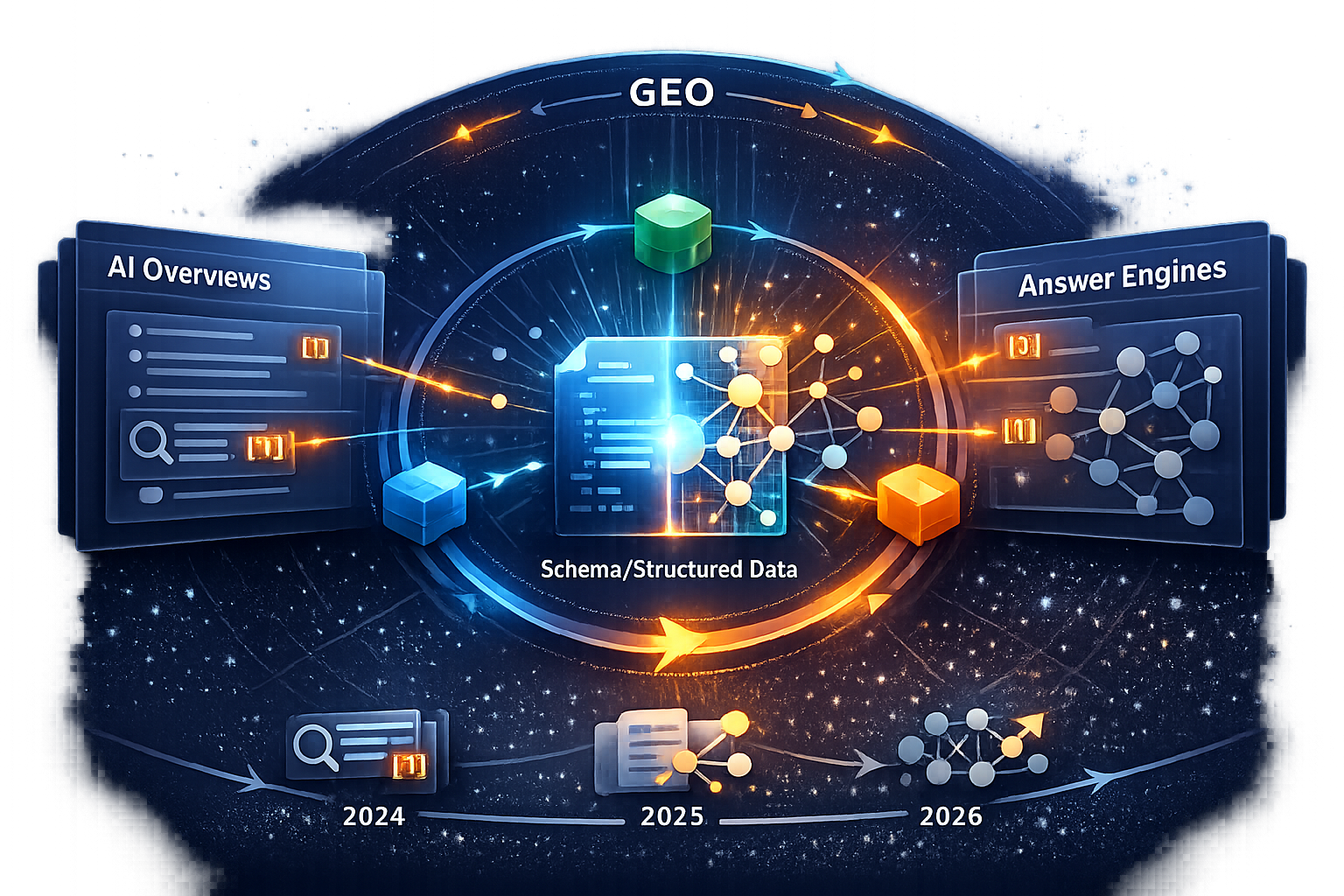
Structured Data in 2026: What Recent AI Search Changes Mean for Schema Markup Strategy
News analysis on how AI Overviews and answer engines are changing Structured Data priorities in 2026—what to update, measure, and expect next.