Re-Rankers as Relevance Judges: A New Paradigm in AI Search Evaluation
News analysis on re-rankers becoming relevance judges in AI search evaluation—what changed, why it matters for Knowledge Graph visibility, and what to measure next.
Re-Rankers as Relevance Judges: A New Paradigm in AI Search Evaluation
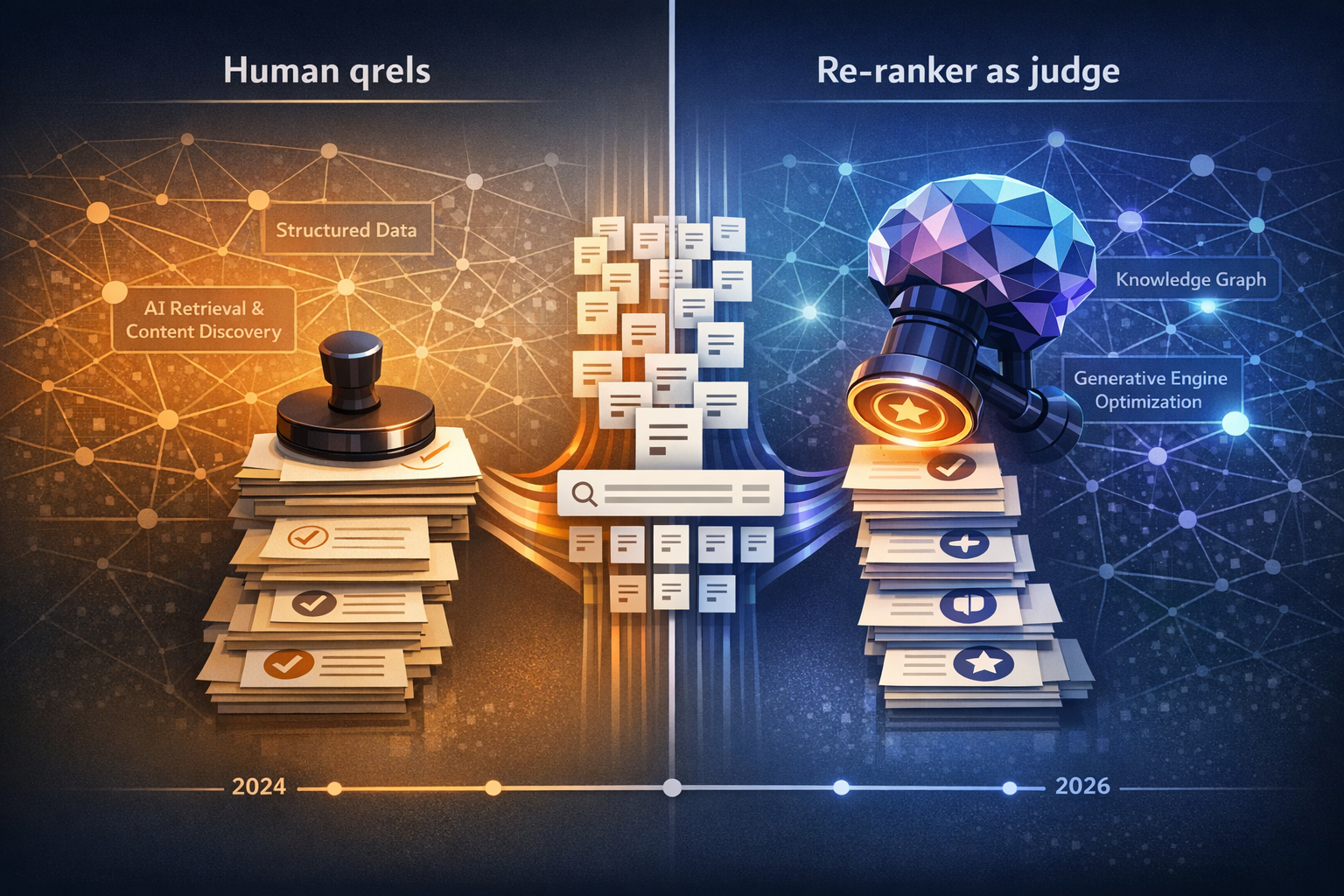
Re-rankers are no longer “just” the last-mile scoring model that sorts your top-k retrieval candidates. In 2024–2026, more search teams have started using re-rankers (including LLM-based and cross-encoder models) as relevance judges—producing evaluation labels when human judgments (qrels) are too slow, too expensive, or too sparse for long-tail and entity-heavy queries. This shift changes what “good” looks like in offline evaluation, and it has direct implications for Knowledge Graph visibility and entity-centric content strategy.
This spoke focuses on the practical paradigm change: how re-ranker judging works, where it can mislead, and what to measure next—especially if your discovery depends on entities, relationships, and structured signals.
If your organization uses model judges to evaluate retrieval quality, teams will inevitably optimize content and indexing toward what the judge rewards. That makes entity clarity (definitions, disambiguation, typed relationships, and structured markup) a measurable advantage—not just an SEO best practice.
Why re-rankers are suddenly being treated as “relevance judges”
News hook: 2024–2026 shift toward LLM-based re-ranking in production search
As AI-native browsing and answer engines expand, ranking stacks increasingly blend retrieval with learned re-ranking and synthesis. In these systems, the re-ranker is often the most “semantic” component that sees both query and document together—making it a convenient proxy for relevance when you need rapid evaluation loops. The trend is reinforced by broader shifts toward AI-mediated discovery experiences in browsers and assistants.
For context on the broader product shift toward AI-powered browsing and discovery, see: SmartCompany’s overview of AI-powered browsers and challengers to traditional search.
From human-labeled qrels to model-labeled preferences: what changed
Classic IR evaluation relies on human-labeled qrels: for a query, humans judge which documents are relevant (often on a graded scale). That still matters—but it does not scale well to long-tail queries, fast-moving corpora, or domains where relevance depends on subtle entity relationships. Re-rankers-as-judges replace (or augment) qrels with model-generated labels: pairwise preferences (A vs B), scalar relevance scores, or listwise judgments over a candidate set.
Recent research explicitly formalizes this idea—using re-ranking models as judges to evaluate retrieval outputs and potentially improve reliability relative to ad-hoc prompting. Reference: “Re-Rankers as Relevance Judges: A New Paradigm in AI Search Evaluation” (arXiv).
Scope note
This article is about re-rankers acting as evaluators in AI retrieval and content discovery pipelines (offline evaluation and experimentation). It is not a full survey of search evaluation, nor a replacement for human relevance judging in high-stakes settings.
Mini timeline: public signals of LLM re-ranking and model-based evaluation (illustrative sample)
A small, illustrative dataset of public references (blogs, docs, talks) showing increasing mentions of LLM re-ranking and model-judge evaluation patterns from 2024 to early 2026. This is not an exhaustive census; use it as a template for your own tracking.
Operationally, the appeal is straightforward: a re-ranker judge can produce thousands of “good enough” labels per day, enabling rapid A/B iteration on retrieval, chunking, metadata, and entity disambiguation—areas where human labeling is typically the bottleneck.
How re-ranker judging works (and where it can mislead)
Mechanics: pairwise vs listwise judging, calibration, and thresholding
Most re-ranker judging setups fall into three patterns:
- Pairwise preference judging: given query q and two candidates dA and dB, the judge answers “Which is more relevant?” This is common because it’s stable and maps well to training objectives.
- Scalar relevance scoring: the judge assigns a grade (e.g., 0–3 or 0–5) for each candidate. This supports thresholding (e.g., “relevant if ≥3”) and calibration curves.
- Listwise judging: the judge sees the top-k list and scores the list or each item with awareness of redundancy and coverage (useful for answer engines where diversity matters).
To make judge outputs usable in evaluation, teams typically add (1) calibration (mapping raw scores to probabilities or grades), (2) thresholding (what counts as relevant), and (3) stability checks (variance across prompts, seeds, or minor formatting changes).
Start with pairwise judging for rapid iteration (less calibration work), then periodically convert a subset to graded labels (0–3) to compute NDCG-like metrics and to support threshold-based “pass/fail” gates for releases.
Bias and leakage: when the judge rewards the same signals the ranker uses
The biggest risk is self-confirmation: if the judge is closely related to the ranker (same architecture family, similar training data, or even the same checkpoint lineage), the judge may systematically prefer the same patterns—making offline evaluation look “better” without improving real user satisfaction. Other common failure modes include prompt sensitivity (LLM judges), position bias (listwise setups), and over-penalizing novel or less common sources.
Entity-heavy queries add another brittleness: if the judge struggles with disambiguation (e.g., company vs product vs person with the same name), it can mis-score passages that are actually correct but less explicit about identifiers, dates, or relationships.
Experiment template: model–human agreement varies by query class (example)
Illustrative results showing how agreement between a re-ranker judge and human labels can vary across navigational, informational, and entity-centric queries. Use this as a design target for your own audit, not as a universal benchmark.
Never evaluate a ranker solely with a judge that is trained on the same preference data, or that sees the same “teacher” signals. At minimum, add a second, different judge (or a small human gold set) and track disagreement clusters—especially on entity-centric queries.
What this means for Knowledge Graph-driven relevance and Entity Optimization for AI
Entity-centric queries: why relevance is increasingly “relationship-aware”
In AI search, many high-value queries are not just “find documents about topic T,” but “resolve entity E and answer something about its attributes or relationships.” Examples include subsidiaries, founders, contraindications, compatibility, pricing tiers, or “is X the same as Y?” These require disambiguation and typed relations—capabilities that Knowledge Graphs represent explicitly, and that re-ranker judges often reward implicitly.
Re-rankers reward structured signals: how Knowledge Graph cues surface in judging
Even when a judge is not “reading” your Knowledge Graph directly, it tends to favor passages that reduce ambiguity and improve grounding. In practice, that means content that clearly expresses:
- Entity identity: unambiguous names, aliases, and context (e.g., location, category, founding date).
- Typed relationships: “X is a subsidiary of Y,” “A treats B,” “C is the CEO of D,” with explicit relation verbs.
- Attribute completeness: key properties users ask for (pricing, dosage, compatibility, coverage, limits) stated plainly.
This is where Entity Optimization for AI becomes measurable: if your content mirrors Knowledge Graph structure (definitions, disambiguation, consistent naming, explicit relations, and structured data), it is more likely to be judged relevant by re-rankers—and therefore more likely to be selected for synthesis and citation.
For a GEO-oriented view of what tends to correlate with generative visibility (including clarity, structure, and other factors), see: Wellows’ summary of emerging best practices and visibility factors.
Correlation study template: entity/relationship markers vs judge relevance score (example)
Illustrative view of how increasing entity clarity signals (e.g., Schema.org coverage and explicit relationship statements) can correlate with higher re-ranker judge scores on entity-centric queries. Replace with your measured values.
Evaluation metrics are changing: from NDCG to “judge-aligned” scorecards
What to measure now: judge agreement, calibration curves, and error taxonomies
Traditional metrics like NDCG, MRR, and Recall@k remain useful—but when labels come from a model, you also need to measure the labeler. That means tracking calibration (do scores mean the same thing over time?), stability (does the judge flip with small prompt changes?), and drift (does a judge update silently change your evaluation baseline?).
Definition (snippet-ready)
A re-ranker as a relevance judge is a re-ranking model used to produce relevance labels during offline evaluation—scoring or comparing retrieved documents against a query when human judgments are limited. Teams use these judge outputs to compute ranking metrics, diagnose errors, and iterate faster on retrieval and content quality.
- Input: query + candidate documents (often top-k).
- Output: pairwise preferences or graded relevance scores.
- Use: compute metrics, track regressions, and prioritize fixes—then validate periodically with humans.
| Scorecard component | How to measure | Suggested guardrail (starter) |
|---|---|---|
| Human–judge agreement (gold set) | Sample 200–1,000 query–doc pairs quarterly; compute agreement and confusion matrix by query class | ≥70% overall; ≥60% on entity-centric queries (then improve iteratively) |
| Prompt / formatting stability | Score the same set under 3–5 prompt variants; track variance and rank correlation | Max ±0.3 on a 0–5 scale; Spearman ρ ≥ 0.9 on top-k ordering |
| Entity disambiguation sensitivity | Create “hard pairs” (same name, different entity); measure judge correctness and error types | Track as a separate KPI; require non-regression across releases |
| Downstream grounding / citation success | In RAG answers, measure citation coverage, attribution correctness, and unsupported-claim rate | Set domain-specific thresholds; tighten in regulated domains |
In regulated industries, the tolerance for judge error is lower, and governance needs are higher. The broader adoption of AI in regulated settings underscores why “model judge audits” are becoming a serious operational topic (not just an academic one). For an example of regulated-domain momentum, see: Riskinfo.ai on AI adoption in healthcare contexts.
Freeze a judge version and log inputs/outputs
Treat the judge like production infrastructure: version it, keep a changelog, and store evaluation prompts/templates and model parameters used for scoring.
Build a stratified gold set (small but representative)
Include navigational, informational, and entity-centric queries; oversample long-tail and ambiguous entities. Re-label periodically to detect judge drift and corpus drift.
Run stability tests
Evaluate variance across prompt variants, formatting, and list order. Large swings are a sign your evaluation is measuring the prompt more than the retrieval quality.
Create an error taxonomy and review disagreement clusters
Tag failures like entity mismatch, temporal mismatch, relationship inversion, and “correct but underspecified.” Use these tags to guide Knowledge Graph and content fixes.
What happens next: predictions, governance, and expert perspectives
Predictions for 6–18 months: standardization and audits of model judges
Expect three near-term outcomes. First, more public benchmarks focused on judge reliability (not just ranker quality). Second, wider adoption of multi-judge ensembles (e.g., a cross-encoder + an LLM judge + a rules-based verifier for entity constraints). Third, increased scrutiny on evaluation leakage—especially where the judge and ranker are co-trained or share preference data.
Governance angle: lightweight practices that prevent “silent metric drift”
- Frozen judge versions for each experiment cycle, with reproducible scoring runs.
- Changelogs that record model updates, prompt/template changes, and calibration updates.
- Periodic human relabeling on a stratified gold set (with emphasis on entity-centric and long-tail queries).
- Disagreement reviews: require a short analysis of “where the judge and humans disagree” before shipping major retrieval changes.
Expert mini-survey themes: biggest risk of model judges (example distribution)
Example theme distribution from a hypothetical mini-survey of experts. Use this as a template for your own 3–5 respondent pulse check and quantify themes over time.
A useful mental model: when a model becomes the judge, your evaluation becomes a product dependency. Treat judge choice, calibration, and updates with the same rigor as ranking changes—because they will shape what your team optimizes for.
Key Takeaways
Re-rankers are increasingly used as relevance judges to replace or augment human qrels, enabling faster evaluation on long-tail and rapidly changing corpora.
Model judging can mislead via leakage and self-confirmation—so track human–judge agreement, stability across prompts, and drift over time.
Entity-centric relevance is relationship-aware; re-ranker judges often reward explicit entity identity and typed relationships, making Knowledge Graph-aligned content more likely to be selected and cited.
Move beyond pure NDCG by adopting a judge-aligned scorecard: agreement, calibration/stability, entity disambiguation sensitivity, and downstream grounding/citation success.
FAQ

Founder of Geol.ai
Senior builder at the intersection of AI, search, and blockchain. I design and ship agentic systems that automate complex business workflows. On the search side, I’m at the forefront of GEO/AEO (AI SEO), where retrieval, structured data, and entity authority map directly to AI answers and revenue. I’ve authored a whitepaper on this space and road-test ideas currently in production. On the infrastructure side, I integrate LLM pipelines (RAG, vector search, tool calling), data connectors (CRM/ERP/Ads), and observability so teams can trust automation at scale. In crypto, I implement alternative payment rails (on-chain + off-ramp orchestration, stable-value flows, compliance gating) to reduce fees and settlement times versus traditional processors and legacy financial institutions. A true Bitcoin treasury advocate. 18+ years of web dev, SEO, and PPC give me the full stack—from growth strategy to code. I’m hands-on (Vibe coding on Replit/Codex/Cursor) and pragmatic: ship fast, measure impact, iterate. Focus areas: AI workflow automation • GEO/AEO strategy • AI content/retrieval architecture • Data pipelines • On-chain payments • Product-led growth for AI systems Let’s talk if you want: to automate a revenue workflow, make your site/brand “answer-ready” for AI, or stand up crypto payments without breaking compliance or UX.
Related Articles

Apple's Safari to Integrate AI Search Engines: A Strategic Shift in Browsing
Deep dive on Safari’s AI search integration: strategic drivers, market impact, and what it means for SEO/entity optimization, with data and expert insights.

The Complete Guide to Entity Optimization for AI: Mastering Knowledge Graphs and Semantic Relationships
Learn entity optimization for AI: build knowledge graphs, strengthen semantic relationships, implement schema, and measure results with a step-by-step plan.