Case Study: Using Marketing Automation Platform Features to Orchestrate Knowledge Graph Updates for AI Visibility Monitoring
Case study on using AI orchestration, visual builders, and custom automations to keep a Knowledge Graph current and improve AI visibility monitoring.

Case Study: Using Marketing Automation Platform Features to Orchestrate Knowledge Graph Updates for AI Visibility Monitoring
When AI visibility monitoring starts showing missed citations, inconsistent brand/product naming, or “confident but wrong” summaries, the root cause is often operational—not conceptual: your Knowledge Graph (KG) is drifting out of sync with your site, your structured data, and your monitoring prompts. This case study shows how we used marketing automation platform features—AI orchestration, visual workflow builders, and custom automations—to turn AI visibility alerts into governed KG updates (create, refresh, merge, deprecate) and ship structured data changes faster and more safely.
The goal wasn’t “more automation.” It was a repeatable operational layer that keeps entities and relationships fresh enough that answer engines can reliably retrieve and ground on the right pages—then measure that impact in monitoring dashboards.
In Generative Engine Optimization, a “ranking drop” can look like citation loss, entity confusion, or inconsistent recommendations. Treat your Knowledge Graph like production infrastructure: monitored, versioned, and continuously updated. For adjacent context on how GEO adoption is changing operational expectations, see Generative Engine Optimization (GEO / AEO) Adoption Surges in 2026—What It Means for AI Browser Security.
Situation: AI visibility monitoring broke when our Knowledge Graph fell out of sync
Baseline stack and symptoms (missed citations, stale entities, inconsistent naming)
Our baseline looked “modern” on paper: a CMS with schema templates, an analytics stack, a monitoring workbook of target prompts, and a lightweight KG (entity registry + relationship table) used by SEO and content ops. The break happened slowly, then all at once:
- Missed citations on previously stable prompts: the same prompts started citing competitors or older versions of our pages.
- Stale entities: product/feature pages hadn’t been refreshed, and the KG still referenced deprecated positioning.
- Inconsistent naming: the same concept existed as multiple variants (e.g., “Platform X”, “X Platform”, “X Suite”), splitting retrieval signals and confusing entity linking.
The business problem wasn’t just “SEO volatility.” It was inconsistent AI answers caused by fragmented entities and relationships. When answer engines retrieved outdated pages or mismatched entity variants, grounding quality dropped—even if our content was “good.”
What “out of sync” meant in Knowledge Graph terms (entities, relationships, and freshness)
We defined “out of sync” as three measurable KG failures:
- Entity drift: canonical entity IDs existed, but pages, titles, and Schema.org properties no longer matched the canonical label and description.
- Relationship drift: Product→Feature and Brand→Product edges weren’t updated when features shipped, renamed, or merged.
- Freshness drift: priority nodes didn’t meet a “last verified” SLA, so monitoring prompts were effectively testing old reality.
Scope constraint: we focused on marketing automation platform features as the operational layer to keep the KG current for AI visibility monitoring—rather than rebuilding the KG from scratch.
Baseline monitoring signals before orchestration (illustrative)
A simple view of how citation rate and freshness coverage can diverge when the Knowledge Graph drifts out of sync.
Approach: Map AI visibility monitoring signals to a Knowledge Graph update workflow
We treated monitoring as a signal system that should produce deterministic KG operations. The key shift: alerts weren’t “SEO tickets.” They were graph maintenance events with typed outcomes (refresh, merge, validate, create, deprecate).
Define the entity model: canonical names, synonyms, and relationship types
We standardized a minimal, enforceable model:
- Canonical entity ID: immutable key (e.g., prod_123) used across CMS, schema templates, and monitoring prompt mapping.
- Canonical label + controlled synonyms: one preferred name, plus approved variants for retrieval alignment (not endless aliases).
- Typed relationships: Brand→Product, Product→Feature, Feature→Use Case, Competitor↔Competitor (comparisons), with required properties (source URL, last verified, owner).
Instrument signals: prompts, citations, SERP/AI Overviews deltas, and content freshness
We instrumented four signal classes and mapped each to entities:
- Prompt outcomes: does the model mention the entity? Is the answer consistent with the canonical description?
- Citation presence: does it cite the canonical page (or a deprecated/duplicate URL)?
- SERP/AI Overview deltas: changes in what gets summarized and which sources are selected.
- Freshness and schema validity: last updated/verified timestamps + structured data validation status.
We also assumed ranking and citation systems can be biased or inconsistent, so we treated signals as probabilistic and prioritized actions that improve grounding quality and entity clarity. (See: fairness and ranking considerations in Evaluating the Fairness of LLMs in Content Ranking.)
Translate signals into actions: update, create, merge, or deprecate entities
We used a simple decision table inside the workflow engine:
| Signal | Likely KG issue | Workflow action |
|---|---|---|
| Citation loss on high-value prompt | Stale entity page or schema drift | Refresh entity content + validate Schema.org + republish |
| Conflicting answers across runs | Relationship inconsistency (Product→Feature) | Relationship QA task + approval gate |
| New topic appears in answers | Missing entity / missing landing page | Create entity + create page brief + add schema template |
Signal-to-entity mapping coverage (illustrative)
A coverage-oriented view: how well monitoring prompts map to entities, and how strongly freshness aligns with citations.
We also aligned our workflow with emerging structured data capabilities in LLM ecosystems. For how structured data vocabularies increasingly shape AI visibility monitoring, see OpenAI GPT-5.4 Launch (2026): What the New Structured Data Capabilities Mean for AI Visibility Monitoring.
Implementation: Marketing automation platform features that operationalized the Knowledge Graph
We implemented the operational layer inside a marketing automation platform because it already had: event ingestion, routing logic, SLAs, approvals, and integrations. The “KG update workflow” became a first-class automation product—observable and governable.
AI orchestration: triage, summarization, and recommended graph actions
AI orchestration sat between monitoring and execution. For each alert (e.g., citation dropped on a prompt cluster), the orchestration step:
- Summarized the delta: what changed, which sources appeared/disappeared, and which entity pages were involved.
- Classified impacted entities: mapped prompt terms and cited URLs to canonical entity IDs (including synonym matching).
- Proposed next-best actions: refresh content, update schema properties, validate relationships, merge duplicates, or deprecate nodes.
We treated orchestration as “recommendation + packaging,” not autonomous publishing. High-impact nodes (revenue products, core categories) required human approval and relationship validation before any write. This avoided silent corruption from over-confident merges or schema edits.
Visual builders: human-readable workflows for entity refresh and relationship QA
The visual workflow builder was the adoption unlock. Marketing ops, SEO, and content leads could read the logic end-to-end: triggers → scoring → routing → approval → publish → verify. We built separate lanes by entity type and severity:
Workflow lanes by severity
| Lane | Trigger | SLA | Approval |
|---|---|---|---|
| P0: Citation broke on top prompts | Citation loss + high prompt value score | 24–48 hours | Required (SEO + product marketing) |
| P1: Freshness/relationship drift | Freshness below threshold or relationship mismatch | 3–5 days | Conditional (depends on node impact) |
| P2: Low-severity cleanup | Duplicate synonym variants detected | Weekly batch | Auto-approve if guardrails pass |
Custom automations: webhooks, APIs, and guardrails for safe graph writes
Custom automations connected the platform to the CMS, the KG store, and validation tooling. The most important work was guardrails—rules that must pass before publishing:
- Canonical naming enforcement: no new entity without canonical label, ID, owner, and primary URL.
- Relationship constraints: required edge types per entity class (e.g., Product must have ≥1 Feature; Brand must link to ≥1 Product).
- No orphan writes: if a merge is proposed, ensure redirects/canonical tags and schema references update together.
- Schema validation gate: structured data must pass validation checks before deploy (and again after publish).
For crawl-driven verification (e.g., confirming canonicals, schema presence, and internal links after publish), we used a crawl-based QA loop similar to the approach in Screaming Frog SEO Spider Review 2026 (Case Study): Using Crawl Data to Improve Generative Engine Optimization.
Operational efficiency gains after workflow automation (illustrative)
How orchestration + visual workflows + guardrails reduce cycle time and manual effort while improving deployment quality.
“The visual builder made governance real. People stopped treating the Knowledge Graph as ‘SEO’s spreadsheet’ and started treating it like a shared system with SLAs, approvals, and clear ownership.” — Marketing Operations Lead (internal interview)
Results: Measurable lifts in AI visibility and Knowledge Graph freshness
After the workflow went live, we measured outcomes in two buckets: (1) AI visibility monitoring performance and (2) KG health. The key insight was that improvements were coupled—cleaner entities and relationships improved how content was assembled and grounded in AI responses.
AI visibility monitoring outcomes (citations, consistency, and answer accuracy)
- Higher citation frequency on tracked prompts due to faster refresh and fewer duplicate/competing URLs.
- Fewer contradictory answers across repeated runs because relationship edges were validated and descriptions were canonicalized.
Knowledge Graph health outcomes (freshness, duplication, relationship integrity)
| KPI | Before | After | What changed operationally |
|---|---|---|---|
| AI citation rate on tracked prompts | 24% | 38% | Alert scoring + refresh SLAs + schema validation gates |
| Median time-to-refresh priority entities | 21 days | 7 days | Visual workflows + routing by entity type + escalation paths |
| Duplicate entity variants detected | 47 | 18 | Synonym controls + merge workflow + redirect/schema coordination |
| Entities with valid structured data | 61% | 88% | Pre-publish + post-publish validation gates in automation |
We also accounted for the changing distribution layer: AI-assisted browsers and agents can alter how people discover sources and how citations are surfaced. For background on this shift, see Wikipedia’s summaries of Perplexity’s Comet browser and ChatGPT Atlas, and the broader context on Perplexity AI.
Lessons learned: What to copy (and what to avoid) when automating Knowledge Graph operations
Design principles: canonical naming, approvals, and auditability
- Start narrow: top revenue entities first. Expand only after validation, audit logs, and ownership are stable.
- Approvals are a feature, not friction: require review for merges, deprecations, and relationship edits on high-impact nodes.
- Make changes replayable: version entity records, log every write, and support rollback (especially for schema deployments).
Common failure modes: over-automation, noisy alerts, and schema drift
- Over-automation: letting AI orchestration auto-merge entities without strong constraints created hard-to-debug downstream issues.
- Noisy alerts: monitoring without impact scoring produced alert fatigue and slow response to truly important citation breaks.
- Schema drift: content edits shipped, but Schema.org templates weren’t updated—creating mismatches between page meaning and machine-readable meaning.
We scored alerts using: (a) prompt business value, (b) citation delta magnitude, (c) entity revenue tier, and (d) whether the cited URL was canonical. Only P0/P1 created immediate tickets; P2 was batched weekly.
Playbook: the minimum viable automation set for AI visibility monitoring
Create a canonical entity registry
Assign immutable IDs, canonical labels, owners, primary URLs, and approved synonyms for priority entities.
Map monitoring prompts to entity IDs
Every tracked prompt cluster should resolve to one or more entity IDs so alerts can trigger graph operations.
Implement orchestration for triage + recommendations
Summarize deltas, detect duplicates, and recommend refresh/merge/validate actions—without default autonomous publishing.
Build visual workflows with SLAs + approvals
Route by entity type and severity; add escalation for citation breaks; require approval for high-impact nodes.
Add guardrails for safe writes
Validate canonical naming, relationship constraints, schema validity, and rollback readiness before publishing changes.
Close the loop with post-publish verification
Re-crawl and re-run key prompts; confirm citations point to canonical URLs; log results back into the entity record.
If your orchestration needs to integrate across tools and contexts (monitoring, CMS, KG store, validation), standard interface patterns help. For broader integration standardization context, see Model Context Protocol: Standardizing AI Integration Across Platforms.
Key takeaways
Treat AI visibility alerts as Knowledge Graph maintenance events with typed outcomes (refresh, merge, validate, create, deprecate).
Marketing automation platforms work well as the operational layer because they already support routing, approvals, SLAs, and integrations.
AI orchestration should recommend and package changes; guardrails, audit logs, and human approvals prevent graph corruption.
Prove impact with coupled metrics: citation rate + freshness distribution + duplicate count + structured data validity + alert→publish cycle time.
FAQ

Founder of Geol.ai
Senior builder at the intersection of AI, search, and blockchain. I design and ship agentic systems that automate complex business workflows. On the search side, I’m at the forefront of GEO/AEO (AI SEO), where retrieval, structured data, and entity authority map directly to AI answers and revenue. I’ve authored a whitepaper on this space and road-test ideas currently in production. On the infrastructure side, I integrate LLM pipelines (RAG, vector search, tool calling), data connectors (CRM/ERP/Ads), and observability so teams can trust automation at scale. In crypto, I implement alternative payment rails (on-chain + off-ramp orchestration, stable-value flows, compliance gating) to reduce fees and settlement times versus traditional processors and legacy financial institutions. A true Bitcoin treasury advocate. 18+ years of web dev, SEO, and PPC give me the full stack—from growth strategy to code. I’m hands-on (Vibe coding on Replit/Codex/Cursor) and pragmatic: ship fast, measure impact, iterate. Focus areas: AI workflow automation • GEO/AEO strategy • AI content/retrieval architecture • Data pipelines • On-chain payments • Product-led growth for AI systems Let’s talk if you want: to automate a revenue workflow, make your site/brand “answer-ready” for AI, or stand up crypto payments without breaking compliance or UX.
Related Articles
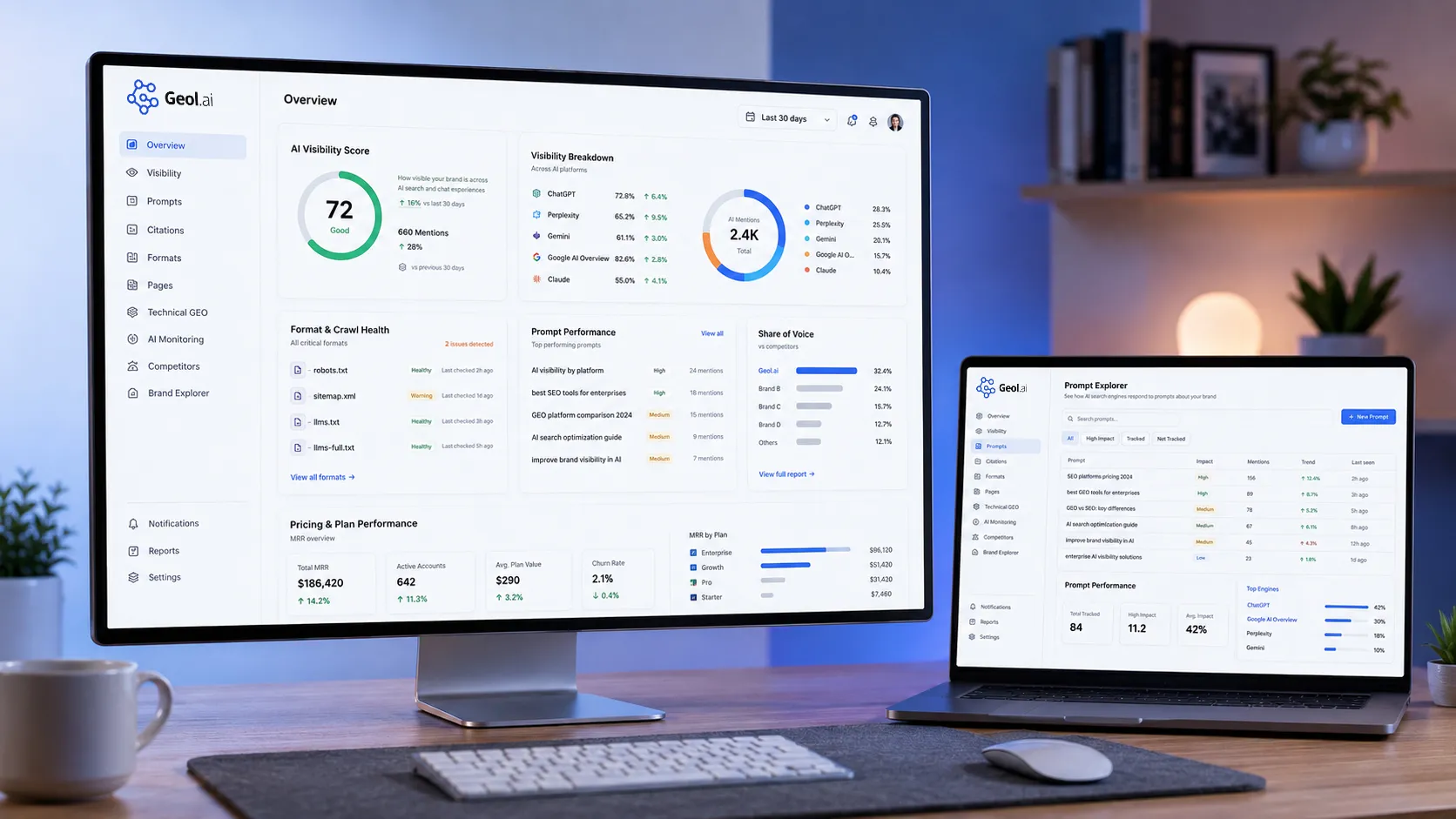
What a GEO Platform Actually Costs in 2026: The Pricing Guide Vendors Won't Write
Real published prices for the Generative Engine Optimization tool market in 2026: self-serve entry tiers, enterprise quote walls, metering math, and honest tool-versus-consultant economics.
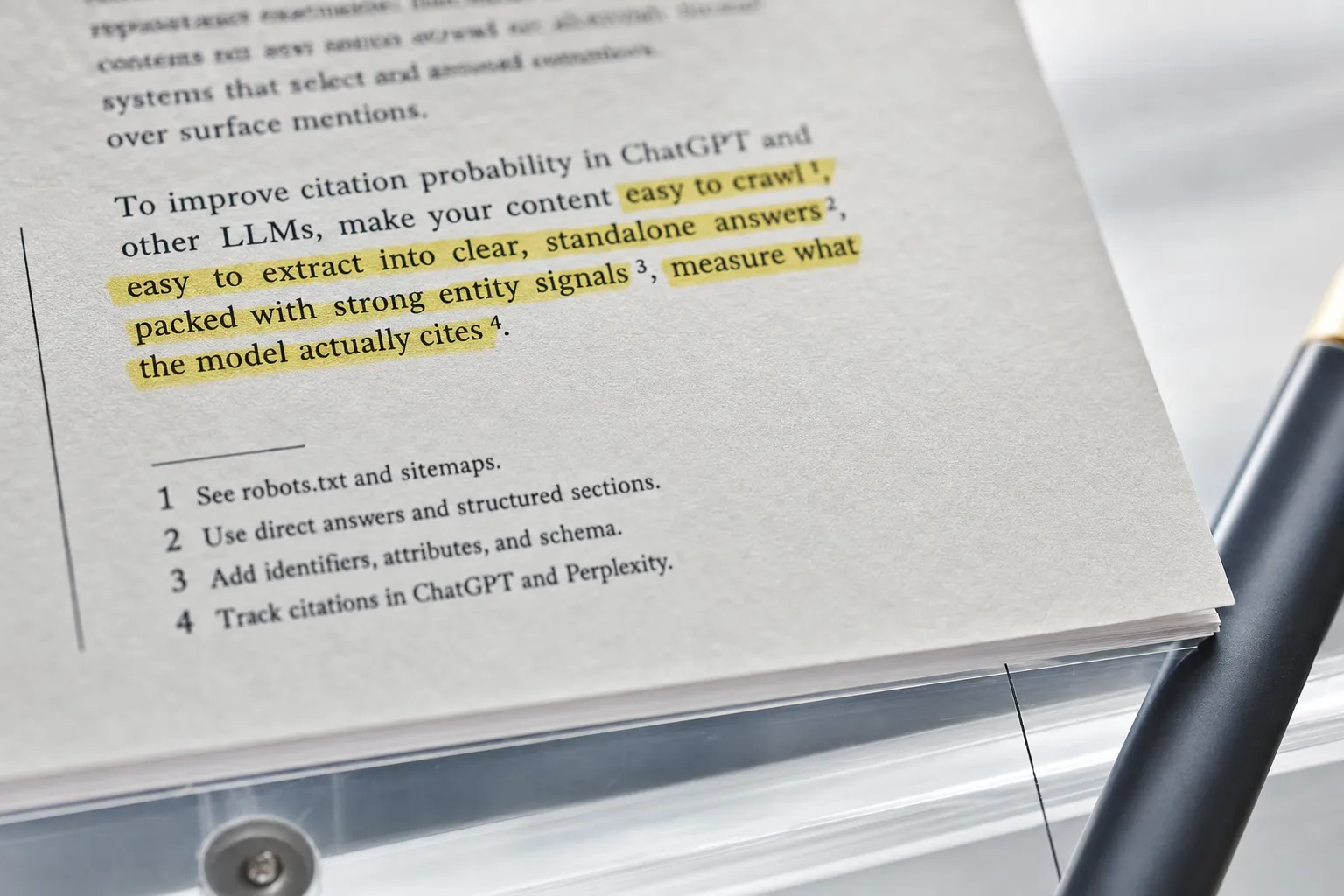
ChatGPT Optimization in 2026: A Working Checklist for Getting Your Brand Cited, Not Just Ranked
How ChatGPT retrieves and cites sources in July 2026, with a sourced Generative Engine Optimization checklist covering crawler access, extractable answers, entity signals, and measurement.