LLM Citations vs. Google Rankings: Unveiling the Discrepancies
Compare why LLMs cite different sources than Google ranks. Learn criteria, patterns, a comparison table, and how to measure AI Visibility reliably.
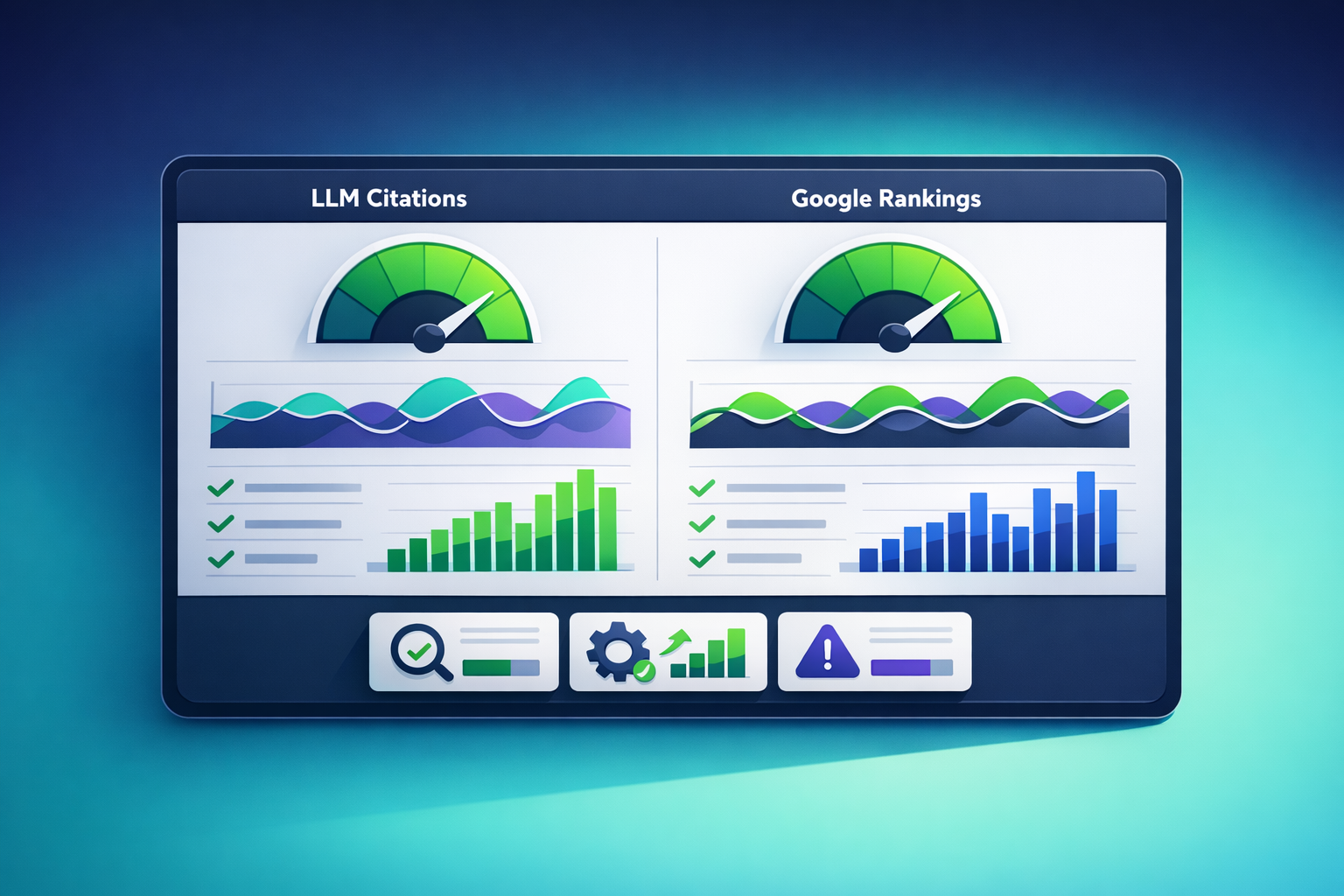
LLM Citations vs. Google Rankings: Unveiling the Discrepancies
LLMs and Google often “disagree” on which pages deserve attention because they’re solving different problems. Google rankings optimize the order of results on a SERP, while LLM citations reflect a retrieval-and-synthesis pipeline that prioritizes sources that are easy to extract, attribute, and justify inside a generated answer. The practical outcome: a page can rank #1 and never get cited—or get cited frequently while sitting outside the top 10. This article explains why that happens, how to measure the gap, and how to prioritize optimization when your goal is AI Visibility (being discoverable, retrievable, and citable by AI answer engines).
For deeper context on why answer engines increasingly pull from non-traditional sources (including UGC and “reference hubs”), explore The Rise of User-Generated Content in AI Citations: A New SEO Frontier.
What We’re Comparing: LLM Citations vs. Google Rankings (and why it matters for AI Visibility)
Definitions: citation, ranking, and AI Visibility
To compare these systems cleanly, define the outputs:
- Google ranking: a position (e.g., #1–#10) in the search results for a query, shaped by relevance, quality, and usability signals, plus SERP feature competition.
- LLM citation: a URL explicitly referenced within an AI-generated answer (e.g., Perplexity citations, AI Overviews links, “Sources” panels), typically after retrieval and selection.
- AI Visibility: the measurable degree to which content is discoverable, retrievable, and citable by AI answer engines—across a defined query set, models, and time window.
Scope: when a “top-ranked” page won’t be cited (and vice versa)
A high-ranking page can fail to get cited when it’s hard to extract (heavy JavaScript rendering, limited visible text, intrusive interstitials), unclear to attribute (no author/date, ambiguous claims), or misaligned with the specific sub-question the LLM is answering. Conversely, a lower-ranked page can be cited frequently if it contains crisp definitions, step-by-step instructions, tables, or canonical documentation that the model can quote and justify.
Featured-snippet setup: the core discrepancy in one sentence
Testable thesis
Discrepancies occur because LLMs and Google use different selection criteria, data sources, and presentation constraints—so “best page to rank” is not always “best source to cite.”
Sample 30–50 queries. For each: record Google top 10 URLs and the URLs cited by your target LLM experience. Compute (1) overlap rate, (2) Jaccard similarity, and (3) the average Google rank position of cited URLs. This gives you a repeatable “citation–rank gap” baseline before you change any content.
Industry reporting has repeatedly observed this gap between rankings and citations, especially in AI-first search products and citation-driven interfaces (e.g., Perplexity). See: Search Engine Journal’s coverage of the ranking–citation discrepancy.
Criteria That Drive Divergence: How Sources Get Selected in Each System
Google’s selection criteria (ranking signals vs. snippet eligibility)
Google’s main output is a ranked list. Rankings are shaped by relevance and quality signals, but also by intent interpretation, location, personalization, and usability. Separately, Google may apply additional layers for SERP features (featured snippets, “People also ask,” AI Overviews), each with its own constraints and eligibility rules. In other words, “ranking” and “being selected for a summarized answer” are related but not identical tasks.
Google’s own guidance emphasizes creating helpful, people-first content and strong page experience; those principles matter for rankings but don’t guarantee citation-style selection. Reference: Google Search’s guidance on creating helpful, reliable, people-first content.
LLM citation criteria (retrieval, authority heuristics, and answer fit)
LLM citations typically emerge from a pipeline like: retrieve candidate documents → select passages → synthesize an answer → attach sources that best support key claims. In practice, citations often favor sources that are:
- Easy to extract: clean HTML, minimal gating, readable text, and stable URLs.
- Easy to justify: explicit definitions, numbers, step lists, and unambiguous statements.
- Credible by heuristic: recognizable publishers, documentation sites, standards bodies, well-cited references, or pages with clear authorship and update dates.
- High answer fit: directly addresses the user’s sub-question (even if it’s not the “best overall page” for the query).
Where the pipelines differ: index, freshness, and “quotability”
Discrepancies increase when the LLM’s retrieval corpus differs from Google’s index (licensed datasets, cached snapshots, selective crawling, or provider-specific browsing). They also increase when “quotability” differs from “rankability.” A page can be excellent for users (interactive tools, product-led UX) but poor for citation (few declarative sentences).
Across cited vs. top-ranked pages, track: presence of H2/H3 structure, definition blocks, tables, author/date, outbound citations to primary sources, schema markup, and extractable text ratio (visible text / total HTML). These correlate strongly with whether a model can confidently cite a page.
Side-by-Side Review: Common Citation Patterns That Don’t Match SERP Winners
Once you start logging citations systematically, a few repeatable patterns show up. These are especially visible in AI search experiences competing on cited answers and browsing-like workflows—an area attracting significant investment and product iteration (e.g., Perplexity’s growth and funding coverage). Source: TechCrunch on Perplexity’s reported funding talks and AI search competition.
Pattern 1: Aggregators and reference hubs outrank (in citations) niche experts
LLMs frequently cite reference-style pages (glossaries, documentation, encyclopedic summaries, “best practices” hubs) because they contain concise, attributable statements. Meanwhile, Google may rank a more commercial, UX-optimized, or intent-matched page higher—even if it’s harder to quote.
Pattern 2: Freshness vs. stability (recent SERP movers vs. evergreen citations)
SERPs can be volatile due to recency, shifting intent, and SERP feature changes. Citations often skew toward evergreen sources with stable wording that stays “true” over time (docs, standards, foundational explainers). That stability makes them safer to cite for core definitions and processes.
Pattern 3: Format bias (PDFs, docs, forums, and Q&A pages)
Certain formats can be disproportionately cited because they contain direct answers, code, enumerations, or community-validated solutions. Technical docs and Q&A threads may not “win” the SERP for broad queries, but they often win the citation slot for specific sub-questions inside an LLM response.
Illustrative distribution shift: LLM-cited sources vs. Google top 10 (same query set)
Example of how source types can differ between what ranks (SERP composition) and what gets cited (answer composition). Replace with your measured distributions from 30–50 queries.
Use this breakdown to find “citation opportunities”: categories where your site could credibly compete (e.g., docs-like explainers or reference pages) even if you’re not positioned to outrank incumbents on commercial SERP terms.
Comparison Table: Measuring AI Visibility When Rankings and Citations Disagree
Recommended metrics (overlap, citation share, and citation position)
- SERP rank: your Google position for each query (and whether you appear in top 3 / top 10).
- Citation presence: whether your URL is cited at least once for the query.
- Citation frequency / share of voice: citations to your domain divided by total citations across the query set.
- Average cited rank: the average Google rank position of URLs that get cited (helps diagnose whether citations pull from outside top 10).
- Source-type mix: composition of cited sources by type (docs, news, forum, academic, etc.).
A practical comparison table (what to track, how to collect, pitfalls)
| Reporting approach | What you track | How to collect | Pitfalls / blind spots |
|---|---|---|---|
| Google-first (traditional SEO) | Rank, impressions, clicks, CTR, landing pages, SERP features | Search Console + rank tracking; annotate updates; segment by intent | May miss citation demand entirely; assumes SERP position predicts being referenced in answers |
| AI Visibility-first (citation-first) | Citation presence, citation share, source-type mix, average cited rank, “citation–rank gap” | Run a fixed query set weekly; log model/version, location, and citations; store URLs and snippets for audit | Model outputs vary; retrieval corpora change; citations can be incomplete or interface-dependent—requires consistent methodology |
Custom visualization plan: overlap matrix for quick diagnosis
A fast way to diagnose discrepancies is to visualize overlap by query category (informational vs. transactional) and by model/interface. While a true heatmap isn’t a supported chart type here, you can represent an “overlap matrix” using a composed or bar chart and track a single score over time.
Citation–Rank Gap Score by query type (example visualization plan)
Gap Score = 1 - normalized overlap (higher means citations diverge more from Google top 10). Replace with your computed values and confidence intervals over time.
Run the same query set on a fixed cadence (weekly), control for location/device, and log the model + version + interface. Without this, you’ll mistake product changes for performance changes.
Recommendation: How to Prioritize Optimization When You Want Citations (Not Just Rankings)
Decision framework: when to chase rank vs. when to chase citations
Prioritize citation-focused optimization when business value depends on being referenced inside answers: top-of-funnel education, B2B evaluation, technical guidance, comparison research, and “how do I…” troubleshooting. Prioritize rank-focused optimization when value depends on clicks into a conversion path (product pages, local intent, or high-competition transactional queries). In practice, most teams need both, but the weighting should match how users discover you.
Tactical checklist for citation readiness (without over-optimizing)
Add explicit definitions and tight claim sentences
Include a one- or two-sentence definition near the top (and under a clear H2/H3). Make key claims declarative and specific so they can be cited verbatim.
Improve extractable structure
Use descriptive H2/H3 headings, short paragraphs, bullet lists, and at least one table where appropriate. This increases passage-level retrievability and “quotability.”
Cite primary sources and standards
Link out to authoritative references (research, standards bodies, official docs). This strengthens justification and helps models anchor claims. Example: Google’s structured data documentation for how markup supports machine understanding.
Ensure crawlable, stable, and attributable pages
Prefer server-rendered or fully indexable HTML for core content. Keep URLs stable, avoid aggressive gating, and include author + last updated date where editorially appropriate.
Design for “answer fit,” not just keyword fit
Map each page to the sub-questions an answer engine will likely compose (definitions, steps, comparisons, caveats). Add a short “common questions” section that mirrors real prompts.
Expert quote opportunities and validation
Validation angle for interviews: ask an SEO lead to explain how SERP volatility and intent shifts affect rank tracking, then ask an AI search researcher how retrieval and citation selection favors extractable, attributable passages over “best overall page.” A publisher can add perspective on how paywalls and heavy JS reduce citation likelihood.
To keep the strategy grounded in market reality, monitor AI search product changes and browsing experiences (e.g., AI-powered browsers and new interfaces). Industry roundup context: Lumar’s industry news coverage on AI search and Perplexity’s Comet browser.
Before/after: tracking citation presence and citation share over 6 weeks (template)
Measure 5 updated pages across 20–30 queries weekly. Expect noise; look for directionality and sustained lift rather than single-week spikes.
Key Takeaways
Google rankings and LLM citations are different outputs from different pipelines—so SERP position won’t reliably predict citation presence.
LLMs often cite sources that are extractable and attributable (docs, reference hubs, Q&A) even when those sources don’t rank top 10.
Measure AI Visibility with repeatable metrics: overlap/Jaccard, citation share, average cited rank, and source-type mix—tracked on a fixed query set over time.
Optimize for citations by improving “quotability”: clear definitions, structured headings, tables/lists, primary-source references, crawlable HTML, and stable URLs.
FAQ: LLM Citations vs. Google Rankings
If you want to operationalize this, start with the baseline overlap study, then choose 5 high-potential pages (already ranking but rarely cited) and apply the citation-readiness checklist. Track citation presence and share weekly for 4–6 weeks, and use the gap score to decide whether to invest in ranking improvements, citation improvements, or both.
Additional market context on enterprise adoption of AI-driven content strategy and GEO can be found here: AllAboutAI’s generative engine optimization statistics.

Founder of Geol.ai
Senior builder at the intersection of AI, search, and blockchain. I design and ship agentic systems that automate complex business workflows. On the search side, I’m at the forefront of GEO/AEO (AI SEO), where retrieval, structured data, and entity authority map directly to AI answers and revenue. I’ve authored a whitepaper on this space and road-test ideas currently in production. On the infrastructure side, I integrate LLM pipelines (RAG, vector search, tool calling), data connectors (CRM/ERP/Ads), and observability so teams can trust automation at scale. In crypto, I implement alternative payment rails (on-chain + off-ramp orchestration, stable-value flows, compliance gating) to reduce fees and settlement times versus traditional processors and legacy financial institutions. A true Bitcoin treasury advocate. 18+ years of web dev, SEO, and PPC give me the full stack—from growth strategy to code. I’m hands-on (Vibe coding on Replit/Codex/Cursor) and pragmatic: ship fast, measure impact, iterate. Focus areas: AI workflow automation • GEO/AEO strategy • AI content/retrieval architecture • Data pipelines • On-chain payments • Product-led growth for AI systems Let’s talk if you want: to automate a revenue workflow, make your site/brand “answer-ready” for AI, or stand up crypto payments without breaking compliance or UX.
Related Articles

Truth Social’s AI Search: Balancing Information and Control
Truth Social’s AI search will shape what users see and cite. Here’s how Structured Data can improve transparency—without becoming a tool for control.
The Complete Guide to AI Citation Patterns: Understanding Source Attribution in Artificial Intelligence
Learn AI citation patterns, why models misattribute sources, and how to evaluate, compare, and improve AI source attribution with practical steps.