Truth Social’s AI Search: Balancing Information and Control
Truth Social’s AI search will shape what users see and cite. Here’s how Structured Data can improve transparency—without becoming a tool for control.

Truth Social’s AI Search: Balancing Information and Control
Truth Social’s AI search isn’t just “search with a chatbot.” It’s a citation engine that decides which sources become the platform’s default evidence—and which sources effectively disappear from the answer layer. The core balancing act is this: better AI answers require stronger source selection rules, but stronger rules can quietly become a system of information control. The most practical lever in the middle is Structured Data: it can improve provenance and attribution, or it can be turned into a “schema gate” that limits who is eligible to be cited.
Featured snippet definition
AI citation patterns are the repeatable rules an AI answer system follows to select, quote, and attribute sources. On closed or politically aligned ecosystems, those patterns matter because citations determine legitimacy (what counts as “evidence”), not just visibility.
Truth Social’s AI Search Is Really a Citation Engine—And That’s the Power Center
Why “answers” replace “results” (and who decides the sources)
Classic search shows a list of options; AI search collapses options into a single narrative answer with a few citations. That shift concentrates influence because the platform isn’t merely ranking pages—it’s selecting which sources get to “speak” inside the answer. On a politically aligned platform, that concentration is amplified: the citation layer becomes a de facto legitimacy layer.
This is why the battleground isn’t generic “bias” (a vague and often unproductive debate). The battleground is citation selection and attribution: which domains are eligible, how freshness is interpreted, how claims are linked to sources, and what happens when citations are contested.
How AI citation patterns become de facto editorial policy
When an AI answer repeatedly cites the same cluster of outlets, think tanks, or blogs, it creates an editorial “center of gravity” even without explicit moderation. Over time, users learn: “If it’s cited, it’s credible; if it’s not cited, it’s suspect.” That’s why citation policy functions like content governance—just upstream of what people perceive as truth.
Reporting indicates Truth Social’s AI search is powered by Perplexity, while the platform can set limits on sources—meaning the “AI model” may be less decisive than the platform’s source governance choices.
Source: TechCrunch
Data opportunity to track impact: AI answers often increase “zero-click” behavior (users stop at the answer) and shift traffic toward cited sources. While the exact numbers vary by product and query type, the direction is consistent: citations are the new top-of-page real estate.
Where Structured Data Fits: The Technical Lever That Can Clarify—or Constrain—Truth Social’s AI Search
Structured Data as a transparency layer: provenance, authorship, dates, and claims
Structured Data—typically Schema.org expressed as JSON-LD—helps machines reliably interpret what a page is about, who published it, who wrote it, and when it was updated. In AI search, that matters because the system must quickly decide: is this a news report, an opinion piece, a press release, or a scraped repost? Is the author real? Is the page current? Are there clear entities (people/organizations/places) and relationships?
For publishers, this overlaps with Answer Engine Optimization (AEO): writing in question-answer formats and adding machine-readable context so answer engines can cite precisely.
References: AEO best practices; AEO techniques for improved AI responses; LLM content optimization (2026)
Structured Data as a control layer: eligibility rules, source scoring, and “approved” schemas
The same markup that improves transparency can also be used to constrain the ecosystem. Platforms can set “citation eligibility” rules such as: only cite pages with valid Article/NewsArticle markup, only cite publishers with Organization markup and verified sameAs profiles, or only cite sources that expose certain properties (like dateModified). These rules can be reasonable quality controls—or a politically selective filter if applied unevenly.
If “citability” depends on proprietary requirements (or selectively enforced rules), Structured Data becomes a gatekeeping mechanism. The safer path is to align requirements with open standards (Schema.org) and focus on provenance fields that improve accountability for everyone.
The Control Risks: When “Citation Policy” Becomes Content Governance
Soft censorship via source whitelists and citation suppression
The most effective moderation is often not removal—it’s making content uncitable and therefore functionally invisible in AI answers. If users rely on the answer layer, anything outside the citation perimeter becomes second-class information, even if it remains accessible via manual browsing.
Structured Data can unintentionally reinforce this. If the platform privileges certain Publisher/Organization markup (or “verified” entity graphs) and penalizes others, it creates a schema gate: not just “who ranks,” but “who can be referenced as evidence.”
Hard failures: hallucinated citations, stale pages, and misattribution
Even with good intentions, citation engines fail in predictable ways:
- Hallucinated or broken citations: the answer implies a source supports a claim, but the URL is missing, dead, or doesn’t contain the quoted information.
- Stale citations: the system cites older pages because freshness signals are unclear (missing dateModified, inconsistent dates, or weak update practices).
- Misattribution: authorship and publisher get mixed up when markup is missing, duplicated, or conflicts with on-page bylines.
A practical way to make these failures measurable is a “citation integrity” scorecard: percent of citations with working URLs, correct publisher attribution, and correct datePublished/dateModified. Tracking this over time turns governance from rhetoric into metrics.
A Practical Framework: Structured Data Requirements That Increase Accountability Without Centralizing Power
Minimum viable Structured Data for citability (provenance-first)
If a platform wants to improve answer quality without turning Structured Data into ideology enforcement, it should set requirements that are provenance-first (who said what, when, and where), not worldview-first. Here’s a concise, citation-ready checklist that publishers can implement and platforms can validate.
| Structured Data field | Why it matters for AI citations |
|---|---|
| Article/NewsArticle + headline + url | Clarifies content type and canonical reference target for citation. |
| publisher (Organization) + name + logo | Reduces misattribution; improves publisher-level trust modeling. |
| author (Person/Organization) + name | Improves byline accuracy and accountability for claims. |
| datePublished + dateModified | Enables freshness checks; reduces stale citations and timeline confusion. |
| about (entities/topics) + sameAs (entity profiles) | Improves entity matching and disambiguation in retrieval and citation selection. |
Verification and dispute mechanisms: how to contest citations and corrections
To prevent “citation policy” from becoming unaccountable governance, platforms should pair Structured Data requirements with transparent review loops:
- Publish a public citation rubric: high-level factors like relevance, entity match, freshness, and source reliability signals (without revealing anti-spam secrets that enable gaming).
- Expose “why cited” labels in the UI: e.g., “recent update,” “primary source,” “local relevance,” or “topic authority.”
- Add a citation dispute flow: publishers and users can report misattribution, stale citations, or broken links; track response time and outcomes.
- Offer “expand to full results” and “multiple viewpoints” controls: don’t trap users in a single synthesized answer.
Counterpoint: Platforms Need Guardrails—So Make Them Auditable
The case for tighter control: safety, defamation risk, and coordinated manipulation
The strongest argument for tighter citation controls is practical: answer engines can be gamed. Spam networks, coordinated propaganda, and low-quality republishers can flood the web with keyword-matching pages designed to win retrieval. Platforms also face legal and reputational risk when AI answers amplify defamatory or dangerous claims. Some guardrails are not only reasonable—they’re necessary.
The compromise: independent audits, public metrics, and open Structured Data standards
The compromise is not “no rules.” It’s auditable rules. Guardrails are acceptable only if measurable and reviewable—otherwise “safety” becomes a blank check for narrative control. That means: keep Structured Data standards aligned with Schema.org, publish transparency reporting, and allow independent evaluation of citation behavior.
- Citation diversity metrics: number of unique domains cited per topic cluster; concentration of citations among top N domains.
- Freshness metrics: median citation age; percent of answers citing content updated within X days for time-sensitive queries.
- Integrity metrics: broken-link rate; misattribution rate; correction rate after disputes.
- Appealability metrics: number of appeals, median time to resolution, and appeal success rate.
Zooming out: as more consumer products adopt AI answer layers (from dedicated answer engines to assistants embedded in operating systems), citation governance will increasingly determine what the public experiences as “search.”
For context on how answer engines position “deep research” and citations as a product feature, see reporting on Perplexity’s product direction: TechCrunch on Perplexity Deep Research.
Key Takeaways
In AI search, citations—not rankings—are the real power center because they define what counts as evidence in the answer layer.
Structured Data can improve transparency (provenance, authorship, dates) but can also become a “schema gate” that controls who is eligible to be cited.
The biggest governance risk is soft suppression: content can remain online yet become uncitable—and effectively invisible—inside AI answers.
Guardrails are valid only when auditable: publish a citation rubric, show “why cited” signals, and report integrity/diversity/appeal metrics regularly.
FAQ

Founder of Geol.ai
Senior builder at the intersection of AI, search, and blockchain. I design and ship agentic systems that automate complex business workflows. On the search side, I’m at the forefront of GEO/AEO (AI SEO), where retrieval, structured data, and entity authority map directly to AI answers and revenue. I’ve authored a whitepaper on this space and road-test ideas currently in production. On the infrastructure side, I integrate LLM pipelines (RAG, vector search, tool calling), data connectors (CRM/ERP/Ads), and observability so teams can trust automation at scale. In crypto, I implement alternative payment rails (on-chain + off-ramp orchestration, stable-value flows, compliance gating) to reduce fees and settlement times versus traditional processors and legacy financial institutions. A true Bitcoin treasury advocate. 18+ years of web dev, SEO, and PPC give me the full stack—from growth strategy to code. I’m hands-on (Vibe coding on Replit/Codex/Cursor) and pragmatic: ship fast, measure impact, iterate. Focus areas: AI workflow automation • GEO/AEO strategy • AI content/retrieval architecture • Data pipelines • On-chain payments • Product-led growth for AI systems Let’s talk if you want: to automate a revenue workflow, make your site/brand “answer-ready” for AI, or stand up crypto payments without breaking compliance or UX.
Related Articles

The Complete Guide to AI Citation Patterns: Understanding Source Attribution in Artificial Intelligence
Learn AI citation patterns, why models misattribute sources, and how to evaluate, compare, and improve AI source attribution with practical steps.
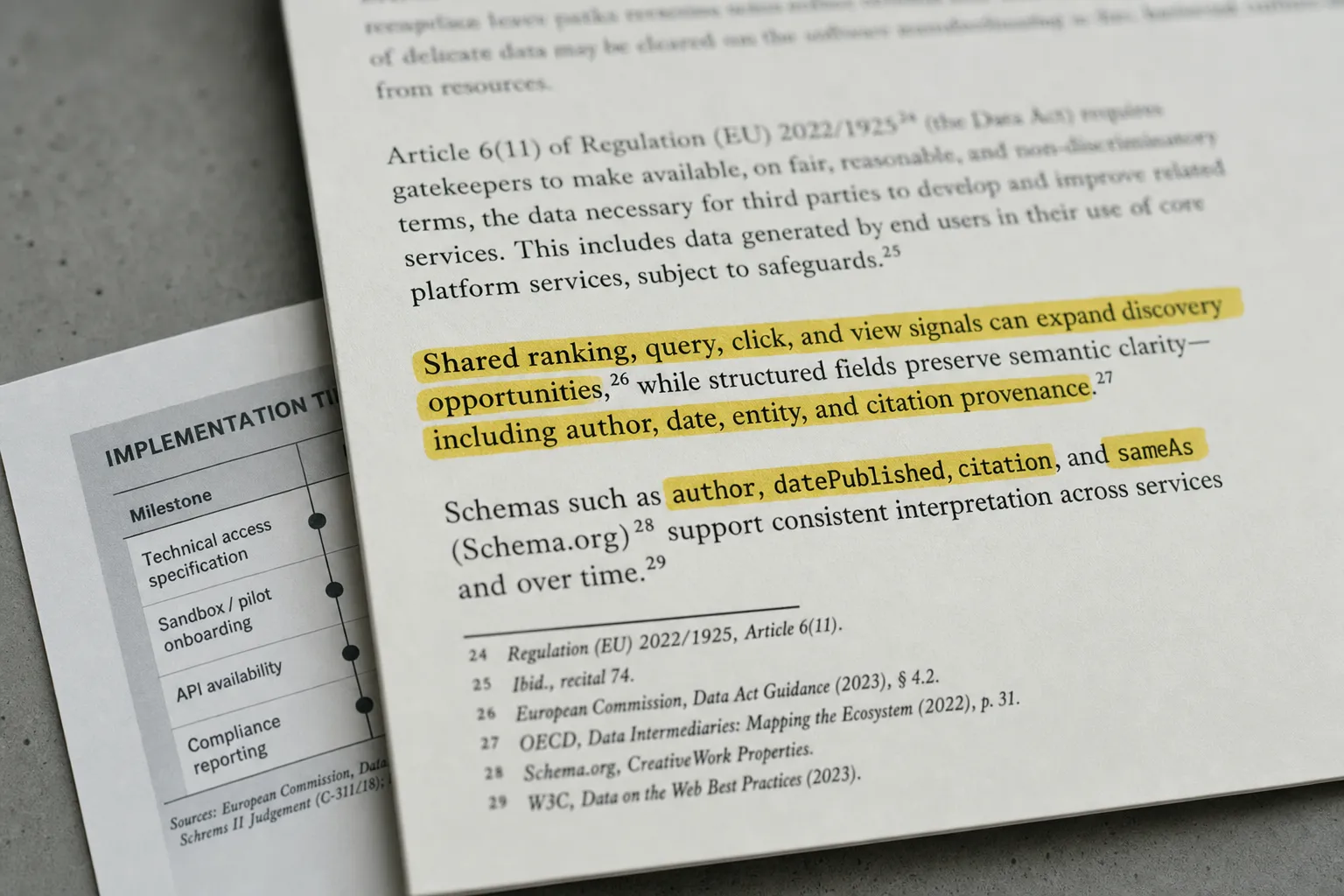
The EU Wants Google to Open Up Search Data to Rival AI Engines
EU plans to open Google Search data to rival AI engines. Learn why Structured Data—not raw click logs—will determine who can retrieve and cite the web.