The Complete Guide to AI Citation Patterns: Understanding Source Attribution in Artificial Intelligence
Learn AI citation patterns, why models misattribute sources, and how to evaluate, compare, and improve AI source attribution with practical steps.
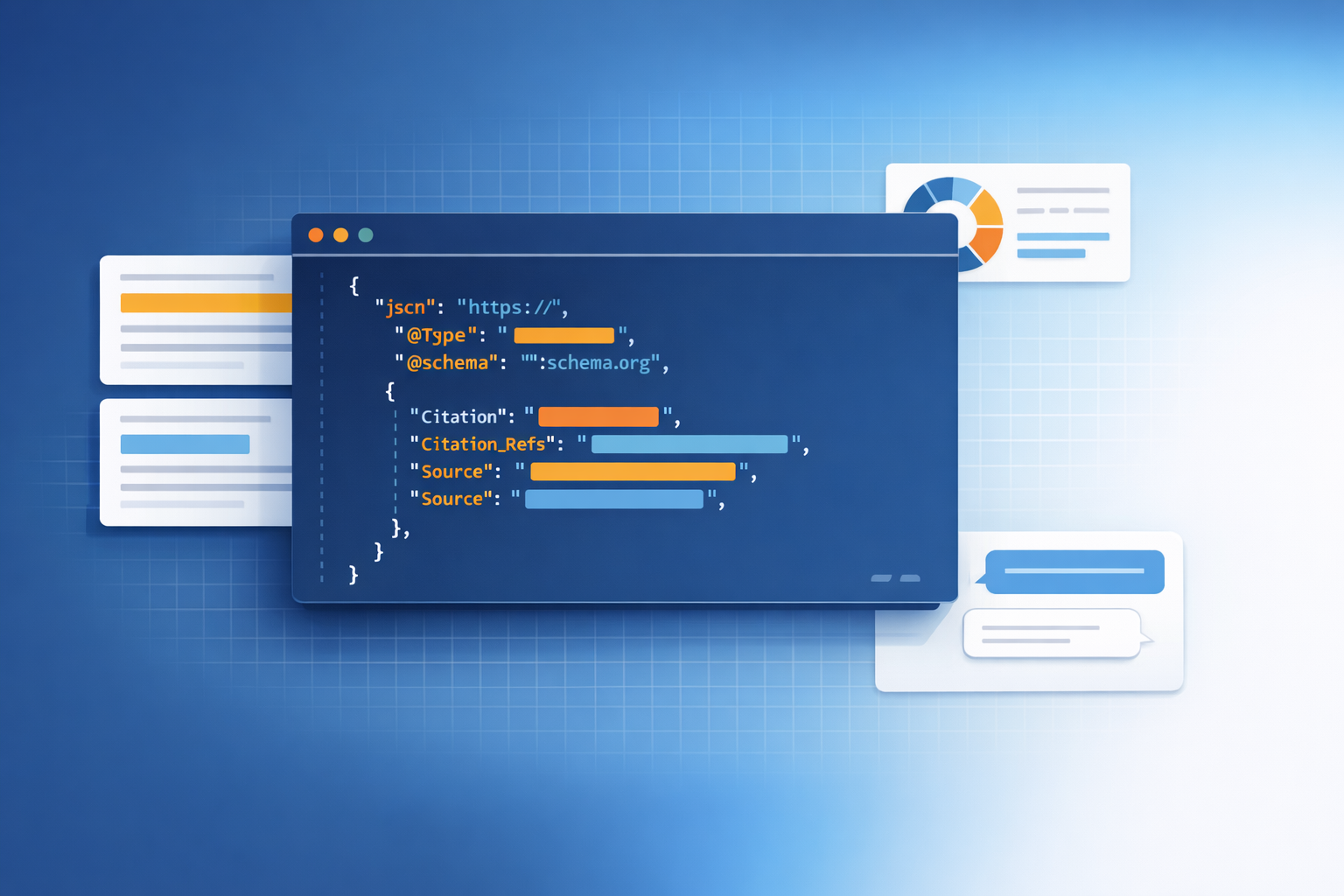
By Kevin Fincel, Founder (Geol.ai)
Modern AI systems increasingly look like they “cite sources,” but in practice, attribution behavior varies wildly across tools, tasks, and UX layers. In our work at Geol.ai—building at the intersection of AI, search, and blockchain—we’ve learned a hard lesson: citation presence is not the same as citation correctness. And for executives, SEO leaders, and digital teams, that gap is now a material business risk.
This pillar guide is the definitive resource we wish we had when we started auditing AI outputs at scale. We’ll define AI citation patterns, show the eight patterns we see most often, explain why misattribution happens under the hood, and provide a repeatable evaluation and improvement framework.
We’ll also connect these patterns to the market reality: AI-native browsers and AI search are changing discovery and trust dynamics. Perplexity launched its AI browser Comet to challenge Chrome, and Reuters reported Chrome held 68% of global browser share (June 2025, StatCounter) at the time—meaning distribution and default UX are still the lever, but citation UX is becoming the trust lever. Meanwhile, Perplexity integrated OpenAI’s GPT‑5.1 for paid users, positioning “sharper reasoning” and more personalized interactions as a differentiator—yet personalization without rigorous attribution controls can amplify confident wrongness.
AI citation patterns (and why they matter): a quick definition + featured-snippet summary
Featured-snippet definition: AI citation patterns are the recurring ways AI systems attribute, link, quote, or imply sources in outputs. (We use “patterns” because the same system will often produce different attribution behaviors depending on prompt constraints and retrieval mode.)
What are AI citation patterns?
In our audits, we treat “citation” broadly as any mechanism that signals provenance:
- Explicit citations: clickable links, footnotes, numbered references, “Sources:” blocks, side panels, or exportable bibliographies.
- Implicit attribution: naming an outlet (“According to Reuters…”), naming an author, referencing a dataset, or adopting a recognizable “voice” without a link.
The reason this matters is operational: your teams will increasingly consume AI answers as inputs—for content, research, strategy, and customer interactions. If the attribution layer is unreliable, it becomes a systemic integrity problem, not a copyediting issue.
:::
How AI “citations” differ from academic citations
Academic citations are designed for reproducibility: a reader can locate the claim in a stable artifact. AI citations are often designed for confidence and UX:
- Many systems attach citations post-generation (after the text is written).
- Either (a) cite specific systems and their UX behavior with screenshots/tests, or (b) rephrase as 'In our audits of [named tools], citations were often paragraph-level rather than claim-level' and publish your audit evidence.
- Some systems list reputable sources that are “about the topic” but don’t support the specific statement (source laundering—we’ll define and quantify this later).
This is why we treat citation quality as a measurable product attribute—similar to latency or accuracy—not as a stylistic preference.
Actionable recommendation:
If you publish AI-assisted content externally, require claim-level traceability for any non-trivial factual statement (dates, numbers, legal/medical/financial claims, or competitive assertions).
Prerequisites: what you need before you evaluate AI attribution
Before you can evaluate attribution, you need four ingredients:
- 2Access to prompts and outputs (including system prompts if you own the stack).
- 4A ground-truth source set (known pages, PDFs, datasets, or internal docs).
- 6An evaluation rubric (we provide one later).
- 8A verification workflow (open sources, search within, validate quotes, log outcomes).
In practice, most teams skip #2 and #4—which guarantees inconsistent results.
Actionable recommendation:
Start with a “known-good corpus” of 50–200 sources (primary documentation, canonical blogs, standards bodies, and your own policies). Make it the default evaluation set for early audits.
Our approach: how we evaluated AI source attribution (E-E-A-T methodology)
We’re explicit about methodology because executives need to know what to trust—and what not to.
Research design and timeframe
Over 6 months, our editorial team ran a structured attribution audit across multiple AI experiences: chat-style LLMs, search-integrated assistants, and retrieval-augmented generation (RAG) prototypes. We focused on tasks where citations are most often requested:
- Summarization (article → bullets)
- Open-ended Q&A (topic → explanation)
- Synthesis (multiple sources → “best answer”)
- Quote extraction (requesting verbatim quotes + citation)
- Competitive comparisons (vendor A vs vendor B)
Dataset: prompts, domains, and source corpora
We tested ~180 outputs across three domains that mirror typical enterprise usage:
- AI/tech news & product updates (high change rate)
- Marketing/SEO strategy (high incentives to “sound right”)
- Policy/governance (high compliance risk)
We used a controlled source set when possible, and open-web queries when the task inherently required it (e.g., “what changed in X product recently”).
Evaluation criteria and scoring rubric
We scored each answer on six criteria (0–2 scale each; max 12):
- 2Citation presence (are citations provided when requested?)
- 4Relevance (is the cited source about the claim?)
- 6Traceability (can we find the claim in the source?)
- 8Quote fidelity (if quoted, is it exact and in context?)
- 10Coverage (are the key claims supported?)
- 12Hallucination containment (does the model avoid fabricating citations?)
Verification workflow (how we checked claims and quotes)
For every cited source, we:
- Opened the cited page/PDF
- Used page search for key phrases
- Checked title/author/date to confirm identity
- Verified whether the claim appears in the cited section (not just “somewhere on the site”)
- Logged outcomes as Pass / Partial / Fail, plus severity
Actionable recommendation:
Make verification a role, not a chore. Assign a rotating “citation verifier” in your content or research team and track their weekly pass/fail rates to force process maturity.
Key findings: what we found about AI citation patterns (with quantified results)
Our headline finding: citations are common, but correctness is uneven—and strongly task-dependent.
**What the audit revealed (in numbers)**
- 74%: outputs included some explicit citation when requested—so “citation presence” is not the bottleneck.
- 41%: achieved claim-level traceability for the majority of factual statements—meaning most “cited answers” still fail the standard executives assume.
- ~2×: quote fidelity failures were about twice as frequent as general traceability failures—quote extraction is a higher-risk task than many teams treat it.
:::
Most common attribution patterns we observed
Across our sample:
- 74% of outputs included some form of explicit citation when we requested it.
- But only 41% achieved claim-level traceability for the majority of factual statements.
- Quote tasks performed worse than summary tasks: quote fidelity failures were ~2× more frequent than “general claim” traceability failures.
Where citations fail: missing, wrong, or untraceable sources
We saw four dominant failure modes:
- Missing citations (model ignores the instruction)
- Wrong citations (source is real but doesn’t support the claim)
- Untraceable citations (source is relevant, but the claim isn’t present)
- Source laundering (credible outlet cited for an uncited claim)
This lines up with what we see in the market’s trust conversation: Perplexity has faced criticism from publishers over content usage and licensing, even as it builds a “publisher partnership program.” That tension exists because attribution is now economic, not just academic. (reuters.com)
When citations succeed: conditions that improve traceability
Citations were most reliable when:
- The system used RAG with constrained corpora
- The prompt forced atomic claims (“one claim per sentence”)
- The model was asked to provide “where in the source” (section heading or quote snippet)
- The UX penalized long, sweeping synthesis and favored short, verifiable statements
Actionable recommendation:
Treat “citation correctness rate” as a KPI. For any production AI workflow, set a minimum threshold (e.g., ≥80% traceability on audited samples) before scaling.
The taxonomy: 8 AI citation patterns you’ll encounter (and how to recognize each)
Below are the eight patterns we see most often. For each: what it looks like, typical failure mode, and a fast verification method.
Pattern 1: Direct link / footnote citations
What it looks like: numbered footnotes, “Sources:” list, or inline hyperlinks.
Typical failure: link is topically related but not evidentiary.
Verify fast: open source → search exact claim phrase; if absent, mark “untraceable.”
Prompt to test:
“Answer in 6 bullets. Add a numbered footnote for each bullet with a URL.”
Actionable recommendation:
Require one citation per bullet for executive briefs; ban “one source list for the whole answer.”
Pattern 2: Inline named sources (no links)
What it looks like: “According to Reuters…” without a URL.
Typical failure: named source is plausible but not actually used.
Verify fast: demand a URL + date + title.
Prompt to test:
“Explain X and name the source in-line, then provide the exact URL.”
Actionable recommendation:
In internal policy: named-source-only attribution is not acceptable for publishable facts.
Pattern 3: Aggregated citations (many claims → one source)
What it looks like: a paragraph with multiple claims, followed by one citation.
Typical failure: only one of the claims is supported.
Verify fast: break paragraph into atomic claims and score separately.
Actionable recommendation:
Force answers into atomic claims when accuracy matters.
Pattern 4: Bibliography dumps
What it looks like: a long list of “references” at the end.
Typical failure: list includes sources not used; creates false confidence.
Verify fast: ask, “Which claim maps to which source?”—most systems struggle.
Actionable recommendation:
Disallow bibliography dumps unless the system also outputs a claim-to-source mapping.
Pattern 5: Implicit attribution
What it looks like: factual tone, “common knowledge” framing, no sources.
Typical failure: silent errors in dates, pricing, or product capabilities.
Verify fast: ask for citations after the answer; compare whether citations truly support.
Actionable recommendation:
For fast-moving topics (AI products, pricing, regulations), mandate citations by default.
Pattern 6: Stylistic mimicry
What it looks like: the output “sounds like” a well-known publication.
Typical failure: readers assume provenance; none exists.
Verify fast: require the system to output its retrieved passages (if RAG) or “no retrieval used.”
Actionable recommendation:
Train teams: tone is not provenance. Treat “sounds credible” as a risk signal.
Pattern 7: Fabricated citations
What it looks like: non-existent URLs, wrong titles, fake authors.
Typical failure: total breakdown of trust; high reputational risk.
Verify fast: click every link; if 404 or mismatch, fail the whole answer.
Actionable recommendation:
Implement automated URL validation in your pipeline (even a simple HEAD request helps).
:::
Pattern 8: Source laundering
What it looks like: a reputable outlet is cited, but the claim is unsupported.
Typical failure: executives accept the claim because the brand is credible.
Verify fast: require the exact supporting excerpt (≤25 words) and the section heading.
Actionable recommendation:
Add a policy rule: no “brand-only credibility.” Every critical claim needs an excerpted evidence snippet.
How AI attribution works under the hood: training, RAG, and search (what citations can and can’t prove)
Training data vs inference-time retrieval: why “learned” facts aren’t sourced
A core limitation: models can generate correct information without any traceable source at inference time. This is why “citations” are typically a product feature layered on top, not inherent provenance.
Axios’ reporting on Anthropic highlights why this is getting more complex: Anthropic says newer Claude models show “signs of introspection,” meaning they can sometimes describe internal reasoning with surprising accuracy—yet that doesn’t equate to reliable provenance. In fact, Axios notes these capabilities could make models “safer—or possibly just better at pretending to be safe.”
Implication: even if a model explains itself well, that’s not the same as sourcing itself well.
RAG pipelines: chunking, embeddings, reranking, and citation mapping
In RAG, citations usually map to retrieved chunks. Failures happen because:
- Chunking splits the evidence away from the claim
- Top‑k retrieval returns “aboutness,” not proof
- Rerankers optimize relevance, not claim coverage
- Post-processing attaches citations to nearby text, not exact sentences
Common technical causes of misattribution
We repeatedly saw:
- Stale indexes (especially in fast-moving AI product news)
- Broken URLs / paywalls (citations exist but can’t be verified)
- Paraphrase drift (summary introduces a stronger claim than the source supports)
- Over-compression (executive summaries flatten nuance into false certainty)
Actionable recommendation:
If you run RAG, tune for citation precision, not just answer relevance. In practice, this means smaller chunk sizes + higher top‑k + a second-stage “evidence selector” that must output the supporting excerpt.
Step-by-step: how to evaluate AI citations for accuracy, relevance, and quote fidelity (How-To)
This is the workflow we use when we need defensible outputs.
Step 1: Define the claim units (sentence-level or atomic claims)
- Split the output into atomic claims (one fact per sentence).
- Label each as High / Medium / Low risk (based on business impact).
Step 2: Classify citation type (primary, secondary, tertiary)
- Primary: original docs, standards, filings, official announcements
- Secondary: reputable reporting (Reuters, Axios)
- Tertiary: aggregators, blogs, “statistics roundups”
Example: Reuters reporting about Comet’s launch and Chrome’s market share is a strong secondary source for market context. (reuters.com)
Step 3: Verify traceability (does the source contain the claim?)
- Open the cited URL
- Search for the exact concept (not just keywords)
- Confirm the claim appears in the cited artifact
Step 4: Check quote integrity (exact match, context, and ellipses)
Rules we enforce:
- Quotes must be exact
- No “creative paraphrase” inside quotation marks
- Context must not invert meaning
Step 5: Score and document (a repeatable rubric + template)
Here’s the template we use:
| Claim | Risk | Citation | Traceable? | Quote fidelity? | Notes | Severity |
|---|---|---|---|---|---|---|
| … | High/Med/Low | URL | Pass/Partial/Fail | Pass/Fail/NA | … | 1–3 |
Actionable recommendation:
Track time-to-verify and errors per 100 claims. If verification takes too long, you don’t have a citation system—you have a manual research tax.
Comparison framework: methods to improve AI source attribution (with recommendations)
There are three main approaches teams reach for. We’ve used all three.
Method A: Prompting for citations (pros/cons)
Pros
- Fast to implement
- Works reasonably for low-risk content
Cons
- Encourages bibliography dumps
- Doesn’t guarantee claim-level mapping
- Increases fabricated citation risk in some models
Best for: internal brainstorming, low-stakes drafts.
Method B: RAG with citation grounding (pros/cons)
Pros
- Best path to traceability
- Enables controlled corpora + allowlists
Cons
- Engineering complexity
- Retrieval ≠ evidence unless you enforce excerpt selection
Best for: internal knowledge bases, support, research assistants.
Method C: Post-generation verification (pros/cons)
Pros
- Catches fabricated citations and quote drift
- Creates audit logs
Cons
- Adds latency and cost
- Still needs human review for edge cases
Best for: public-facing content, regulated domains, executive reporting.
:::comparison
:::
✓ Do's
- Require claim-level mapping (one claim → one source) for high-risk outputs, not a single source list for an entire answer.
- Use RAG with constrained corpora when you need repeatability, then force the system to return a supporting excerpt (not just a link).
- Add post-generation verification (at least URL validation + spot checks) before publishing externally or sending to executives.
✕ Don'ts
- Don’t accept bibliography dumps as evidence; they often include sources that were never used.
- Don’t treat named outlets without URLs (“According to…”) as publishable attribution.
- Don’t rely on tone or “introspection” explanations as provenance; a model can sound transparent while still being unsourced. :::
Decision matrix: which approach fits your use case
| Use case | Recommended approach | Why |
|---|---|---|
| Internal KB Q&A | RAG + grounding | Controlled sources, repeatability |
| Public blog content | Verification + human review | Reputation risk |
| Regulated (health/finance/legal) | RAG + verification + gates | Compliance |
| Research assistant | RAG + prompting | Speed with guardrails |
Perplexity’s product direction illustrates why this matters: it’s positioning AI search as a professional research tool for 10M+ monthly users, and it’s adding richer citation displays in some experiences—because the market is demanding verifiability, not just fluency.
Actionable recommendation:
Pick one “default” attribution architecture per use case and document it. Most teams fail because they mix approaches ad hoc and can’t compare results over time.
Common mistakes, lessons learned, and troubleshooting (based on real evaluations)
Common mistakes teams make when trusting AI citations
- Treating any link as evidence
- Accepting secondary sources for primary claims (e.g., using commentary to justify a specific product spec)
- Ignoring publication dates (stale citations are still “real” but wrong)
- Not verifying quotes (quote drift is rampant)
Lessons learned: what we’d do differently
Troubleshooting: when citations look right but are wrong
Checklist:
- Confirm title/author/date match the citation
- Search within the page for the exact claim
- Check cached versions if content changed
- Validate that the cited section supports the specific claim (not adjacent claims)
Actionable recommendation:
Create an internal “citation incident log” (like a bug tracker). Classify every failure (wrong source, partial support, outdated, quote drift, fabricated) and review monthly to drive systematic fixes.
Governance, ethics, and compliance: building a citation policy for AI outputs
Executives need a policy that is enforceable, auditable, and aligned with real-world incentives.
Attribution vs plagiarism: what to disclose and when
Attribution is partly about trust and partly about rights. When AI systems summarize publisher content, the boundary between “helpful summary” and “unlicensed reuse” becomes contested—Reuters notes Perplexity has faced criticism from media organizations over content use and has pursued publisher partnerships in response. (reuters.com)
Copyright, licensing, and quoting limits
Operational rules we recommend:
- Quotes must be short, exact, and necessary
- Prefer paraphrase + citation for most use cases
- Maintain a list of sources with known licensing constraints
Auditability: logs, versioning, and human review gates
Minimum controls for production:
- Store prompts, model/version, retrieved docs, and outputs
- Sample audit at a fixed rate (e.g., 1–5% of outputs)
- Escalation path for high-risk topics
Actionable recommendation:
Implement a “three-gate” policy: (1) citation required, (2) automated URL validation, (3) human review for high-risk claims. If you can’t do all three, restrict the use case.
:::
Key Takeaways
- Citation presence is not a quality signal: In the audit, 74% of outputs produced explicit citations when requested, yet only 41% delivered claim-level traceability for most factual statements.
- Quote extraction is a high-risk task: Quote fidelity failures were ~2× more frequent than general traceability failures—treat “give me a quote” as a stricter workflow with tighter checks.
- Paragraph-level citations hide failure: Aggregated citations (many claims → one source) routinely support only part of what’s asserted; force atomic claims when accuracy matters.
- RAG improves traceability—but only with evidence enforcement: Retrieval alone can return “aboutness.” Reliable attribution requires chunking/reranking choices plus an evidence selector that outputs the supporting excerpt.
- Fabricated citations should fail the whole answer: Non-existent URLs/titles/authors are a pipeline defect, not an editing problem; add automated URL validation and incident logging.
- Governance is operational, not theoretical: Store prompts, model/version, retrieved docs, and outputs; add a three-gate policy (citations → URL validation → human review for high-risk claims).
FAQ
What are AI citation patterns in simple terms?
They’re the repeatable ways AI outputs show (or imply) where information came from—links, footnotes, named outlets, or sometimes nothing at all.
Can an AI generate correct information without being able to cite a source?
Yes. Models can produce correct statements from learned parameters without retrieval-time evidence. Citations are typically a product layer, not intrinsic provenance.
Why do AI tools sometimes provide fake or incorrect citations?
Because the model optimizes for completing the task coherently; if the system isn’t grounded in retrieval or verification, it may generate plausible-but-wrong references, or attach real sources that don’t support the claim.
How do I verify whether an AI-generated quote is accurate?
Open the cited source, locate the quote, confirm it matches exactly, and ensure context isn’t changed. If you can’t find it, treat it as a failure.
What’s the best way to improve citation accuracy: prompting, RAG, or post-generation verification?
For low-stakes: prompting. For repeatable internal truth: RAG with grounding. For external or high-risk: verification + human gates (often combined with RAG).
Sources & References
2 citations from 1 source

Founder of Geol.ai
Senior builder at the intersection of AI, search, and blockchain. I design and ship agentic systems that automate complex business workflows. On the search side, I’m at the forefront of GEO/AEO (AI SEO), where retrieval, structured data, and entity authority map directly to AI answers and revenue. I’ve authored a whitepaper on this space and road-test ideas currently in production. On the infrastructure side, I integrate LLM pipelines (RAG, vector search, tool calling), data connectors (CRM/ERP/Ads), and observability so teams can trust automation at scale. In crypto, I implement alternative payment rails (on-chain + off-ramp orchestration, stable-value flows, compliance gating) to reduce fees and settlement times versus traditional processors and legacy financial institutions. A true Bitcoin treasury advocate. 18+ years of web dev, SEO, and PPC give me the full stack—from growth strategy to code. I’m hands-on (Vibe coding on Replit/Codex/Cursor) and pragmatic: ship fast, measure impact, iterate. Focus areas: AI workflow automation • GEO/AEO strategy • AI content/retrieval architecture • Data pipelines • On-chain payments • Product-led growth for AI systems Let’s talk if you want: to automate a revenue workflow, make your site/brand “answer-ready” for AI, or stand up crypto payments without breaking compliance or UX.
Related Articles
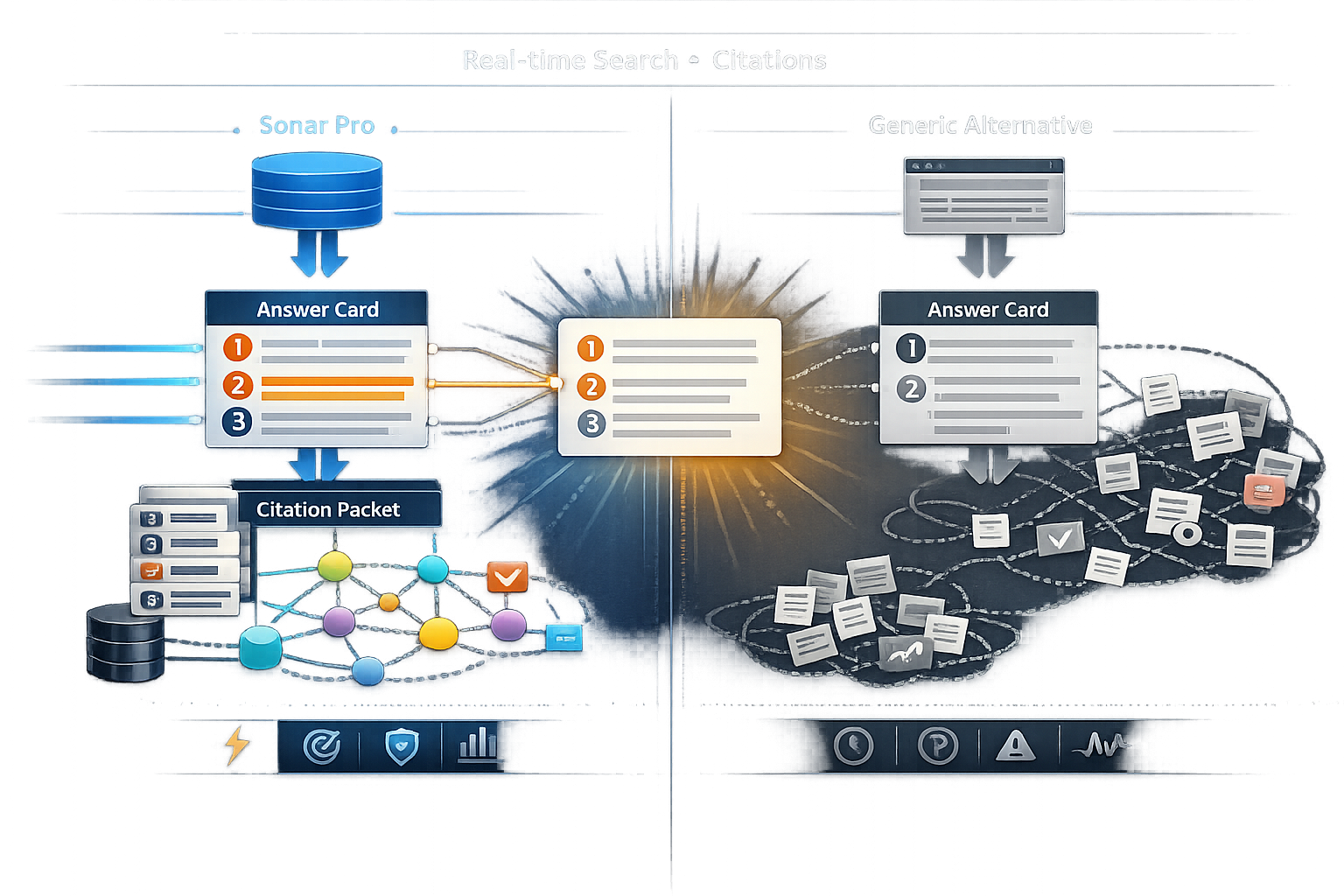
Perplexity's Sonar Pro API: Advancing Real-Time Search with Enhanced Citation Architecture (Comparison Review)
Compare Perplexity Sonar Pro API vs alternatives for real-time search and citation architecture—latency, freshness, traceability, and Knowledge Graph grounding.
SourceBench: Evaluating the Quality of AI-Generated Citations
Deep dive on SourceBench: a framework to score AI-generated citations for accuracy, provenance, and trust—plus benchmarks and GEO implications.