The AI Agent Arms Race: How OpenClaw is Reshaping Workplace Automation
Deep dive on OpenClaw’s AI agent approach to workplace automation—why it’s accelerating the agent arms race, what changes, and how to measure ROI.
The AI Agent Arms Race: How OpenClaw is Reshaping Workplace Automation
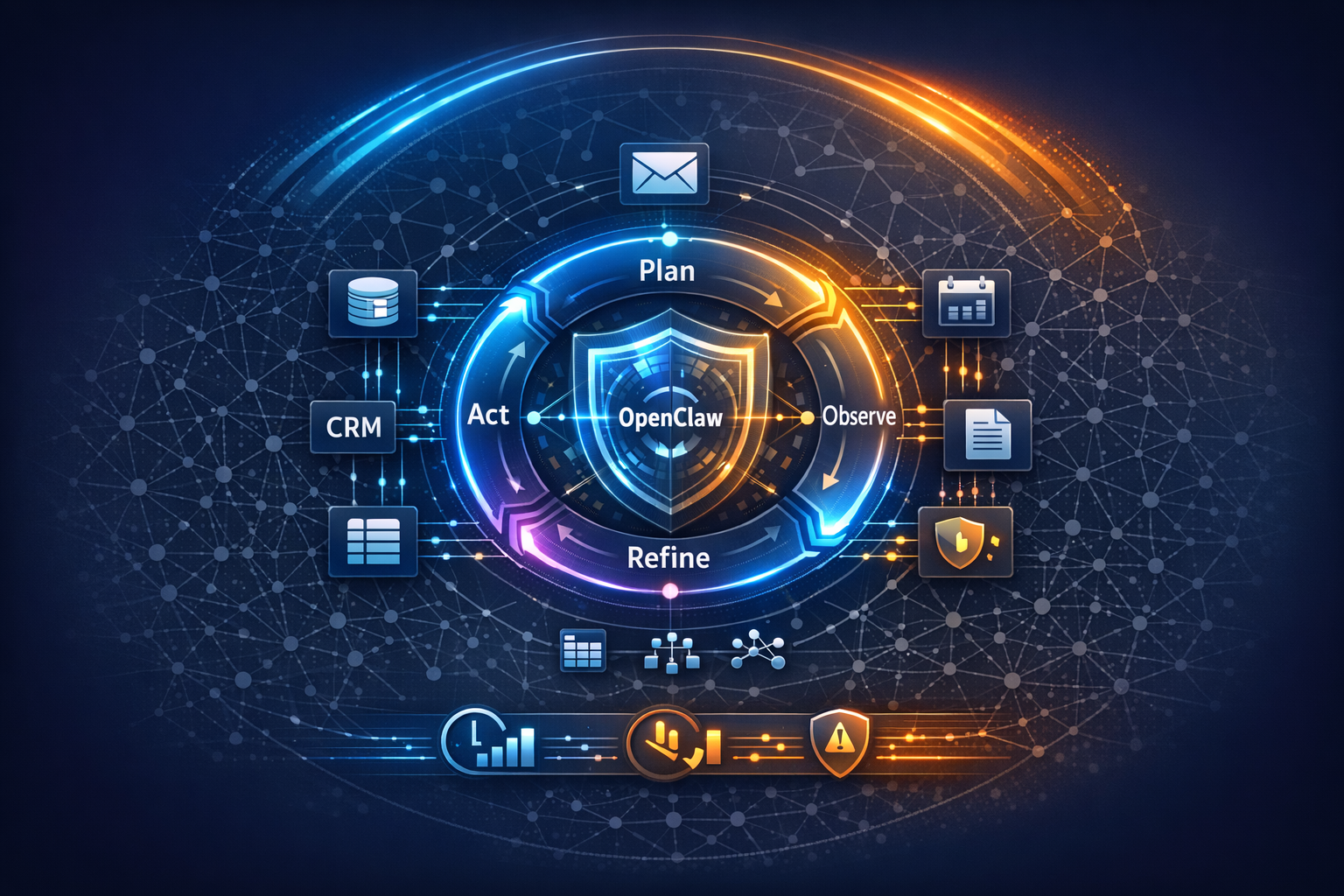
The “AI agent arms race” is the accelerating competition to deploy autonomous, tool-using AI systems that can execute multi-step workflows across enterprise apps—reliably, safely, and at scale—with minimal human oversight. OpenClaw matters in this race because it pushes workplace automation beyond “answering” (chatbots) and beyond brittle “click-path scripts” (classic RPA) toward agentic execution: systems that plan, take actions in tools, observe results, and refine—while staying grounded in the organization’s real entities, permissions, and policies.
This spoke article focuses on what changes when automation is built around Knowledge Graph-backed context, tool orchestration, and measurable operational outcomes. It does not attempt to cover every vendor; instead, it uses OpenClaw as a lens for understanding what “winning” looks like in agentic workplace automation: higher automation rates, fewer risky actions, and clearer ROI.
As frontier models improve reasoning and tool-use, the differentiator shifts from model IQ to grounding + governance: the ability to constrain actions, prove provenance, and operate within least-privilege access. For adjacent signals on how model releases are increasingly framed around grounding and safety, see Anthropic's Claude 4: Redefining AI Search with Enhanced Reasoning and Safety and GPT-5.4 Thinking vs GPT-5.4 Pro: What the Release Signals for Knowledge Graph Grounding in Google AI Overviews.
Key takeaways
The AI agent arms race is about deploying autonomous, tool-using agents that complete multi-step workflows with measurable quality and auditability.
OpenClaw’s wedge is execution: planning + tool orchestration + state tracking, grounded in enterprise context (entities, relationships, permissions).
Knowledge Graph-backed context reduces cross-system ambiguity (same-name entities, mismatched IDs) and helps constrain actions to least privilege.
ROI should be proven with workflow KPIs (automation rate, first-pass success, review rate, time-to-complete, cost per workflow) plus risk metrics (policy violations, audit completeness).
Executive Summary: OpenClaw’s role in the AI agent arms race
Featured-snippet setup: What is the “AI agent arms race” in workplace automation?
The AI agent arms race in workplace automation is the competition among platforms to deploy autonomous agents that (1) interpret goals, (2) break work into steps, (3) invoke tools (CRM, ITSM, ERP, email, BI), (4) track state across steps, and (5) complete workflows with measurable quality and auditability. The “arms” are speed, breadth of tool integrations, safety controls, and reliability under real enterprise constraints (permissions, data quality, edge cases, compliance).
Why OpenClaw matters now (and what it changes vs. chatbots and RPA)
OpenClaw’s significance is less about “better answers” and more about “better actions.” In practice, that means orchestrating multi-step work across systems, while grounding decisions in structured context (entities, relationships, permissions) so the agent does the right thing for the right customer, in the right system, with the right level of access. That’s a different value proposition than chatbots (helpful conversation) and different failure modes than RPA (brittle UI automation).
OpenClaw’s emergence has been positioned as a competitive inflection point for autonomous agents and workplace productivity, with implications for security and governance (Axios reporting).
- Chatbots: optimize for response quality (answers), often with limited, supervised actions.
- RPA: optimize for repeatable UI/API steps, but can break under UI changes, exceptions, and cross-system ambiguity.
- Agentic automation (OpenClaw-like): optimize for end-to-end completion using planning + tools + state + grounded context + approvals.
To strengthen snippet eligibility, add 2–3 market signals here (e.g., % of knowledge workers using AI weekly, projected spend on agentic automation, or adoption of AI copilots) and 1 benchmark stat on time saved for a workflow category (ticket triage, reporting, invoice matching).
Example benchmark slots: time saved by workflow category (fill with your sources)
Use this as a template to insert sourced benchmarks once selected. Values below are placeholders and should be replaced with cited data.
What makes OpenClaw different: Agent architecture grounded in a Knowledge Graph
From prompts to plans: how agents decompose work into executable steps
The core shift from “LLM as a responder” to “LLM as an agent” is the loop: plan → act → observe → refine. Instead of returning a single answer, an agent translates an objective (e.g., “resolve this ticket” or “prepare the QBR deck”) into a sequence of tool calls, checks intermediate results, and updates its plan based on what it learns. This is where workplace automation becomes real: the system must track state, handle exceptions, and know when to ask for approval.
Plan the workflow
Decompose the goal into steps, identify required systems (ITSM, CRM, ERP), and define success criteria (e.g., ticket closed with correct category and customer notified).
Act via tools (with constraints)
Invoke APIs and automations (search knowledge base, fetch customer contract, draft response, create/update records) while enforcing permissions and policy checks.
Observe outcomes and evidence
Validate tool outputs, capture provenance (which documents/records were used), and detect mismatches (wrong customer, missing approvals, conflicting data).
Refine, escalate, or finalize
Retry with alternative strategies, route to a human for approval, or complete the workflow and write back to systems with an audit trail.
Knowledge Graph as the “control plane” for context, permissions, and relationships
A Knowledge Graph is a semantic network of entities (people, teams, customers, contracts, tickets, invoices, systems) connected by typed relationships (owns, reports_to, covered_by, linked_to, approved_by). In agentic automation, that graph can function like a control plane: it disambiguates entities across systems, encodes “who can do what,” and provides relationship-aware constraints so actions are less likely to be hallucinated or misapplied.
Many enterprise failures aren’t model failures—they’re identity and relationship failures: two customers with similar names, a contract stored in one system but referenced in another, or a permission boundary that isn’t visible to the agent. A Knowledge Graph helps resolve these before the agent acts.
Grounding and retrieval: connecting AI Retrieval & Content Discovery to safe action
Retrieval pipelines (indexing, freshness, ranking, access filtering) feed the agent evidence: the right policy doc, the right runbook, the right contract clause, the right ticket history. The Knowledge Graph adds disambiguation and policy constraints: it can map “Acme” in the ticket to the correct legal entity and contract, and it can enforce that only approved actions are available for that entity and user context. This is the bridge from AI Retrieval & Content Discovery to safe, auditable execution.
If you need foundational context, see the internal references: Knowledge Graph fundamentals and AI Retrieval & Content Discovery pipelines.
Where the arms race is happening: Workflow domains OpenClaw accelerates first
High-volume, low-variance workflows (service ops, IT, finance ops)
Early “wins” for OpenClaw-like agents tend to show up where inputs and outputs are clear, volume is high, and SLAs are measurable. Three common battlegrounds are: (1) ticket triage and resolution suggestions in ITSM/service desks, (2) invoice/PO matching and exception handling in finance ops, and (3) recurring reporting and narrative generation across BI + CRM + ERP.
Cross-system knowledge work (revops, procurement, HR)
The next tier of competition is cross-system knowledge work: tasks that require joining data and documents across tools, not just executing a single-system playbook. A Knowledge Graph helps by mapping entities across systems (customer ↔ contract ↔ invoice ↔ ticket) and enabling consistent identity resolution, relationship reasoning, and policy checks—so the agent can act with confidence and consistency even when systems disagree.
The “last mile” problem: approvals, audit trails, and human-in-the-loop
In real enterprises, the last mile is governance: approvals, segregation of duties, and audit trails. The practical pattern is human-in-the-loop by design: the agent drafts actions, routes approvals, logs evidence, and writes back to systems. This preserves speed while reducing risk—especially for money movement, access changes, and customer-impacting communications.
Measurement template by domain (fill with your baselines and post-rollout results)
Placeholder values illustrate how to structure reporting across domains: cycle time, automation/deflection, and unit cost. Replace with your measured data and cite benchmarks where available.
Measuring impact (and avoiding hype): A KPI framework for agentic workplace automation
North-star metrics: automation rate, quality, and unit economics
To keep agent deployments grounded in outcomes (not demos), use a KPI set that captures completion, quality, and economics. Snippet-ready list: Automation Rate, First-Pass Success, Human Review Rate, Mean Time to Complete, Cost per Workflow, Error/Rework Rate, and Audit Completeness.
- Automation Rate: % of workflows completed end-to-end without human execution (humans may still approve).
- First-Pass Success: % completed correctly on the first attempt (no retries, no rework).
- Human Review Rate: % requiring human review/approval beyond the default policy gates.
- Mean Time to Complete (MTTC): time from request creation to workflow completion.
- Cost per Workflow: (labor + platform + integration + oversight) / completed workflows.
- Error/Rework Rate: % requiring correction (wrong entity, wrong field, wrong action, missing step).
- Audit Completeness: % with complete provenance (inputs, retrieved sources, actions taken, approvals).
Risk metrics: permission violations, hallucinated actions, and compliance gaps
Agentic automation introduces new failure modes that must be measured explicitly: attempted permission violations, actions taken without sufficient evidence, and compliance gaps (missing approvals, incomplete logs). Knowledge Graph instrumentation helps because you can log at the entity level (which customer, which contract, which ticket) and enforce relationship-based policy checks (e.g., only a manager can approve a refund; only specific roles can change access).
Operational telemetry: tracing, evaluation sets, and change management
Treat agents like production software: trace every tool call, store prompts and retrieved evidence, and maintain evaluation sets (“golden workflows”) for regression testing. Tie evaluation to the AI Content Processing lifecycle—ingestion → retrieval → synthesis → action/evaluation—so you can reproduce outcomes and isolate failures to data freshness, retrieval ranking, tool brittleness, or policy constraints.
Rollout telemetry example: first-pass success over time (placeholder)
Illustrative trendline for phased rollout. Replace with your measured first-pass success and review rate by week.
ROI ≈ (workflow volume × minutes saved × blended labor rate) − (platform + integration + oversight costs). Track review rate and failure rate separately so “time saved” isn’t overstated by rework.
For deeper implementation framing, connect this to: AI Content Processing lifecycle and Structured data and Schema.org for AI systems.
Expert perspectives: Why Knowledge Graph-grounded agents are the next automation layer
Axios frames OpenClaw as a meaningful catalyst in the autonomous agent landscape, especially where productivity gains collide with security and governance requirements. To make this section actionable for enterprise readers, use quote slots that reinforce the governance-first thesis and acknowledge current limitations.
Quote slot (CIO / Head of Automation): “The model isn’t the hard part anymore—integrating safely with our systems and proving what the agent did, for which entity, under which permissions, is the hard part.”
Quote slot (Knowledge Graph / ontology expert): “Entity resolution and typed relationships are what turn retrieval into reliable action—otherwise agents guess which ‘Acme’ you mean.”
Quote slot (Security / compliance leader): “Least-privilege, approvals, and audit trails aren’t optional. If you can’t reconstruct the evidence path, you can’t ship agents into regulated workflows.”
Counterpoint slot: “Agents still fail on edge cases—tool brittleness, messy data, and shifting policies. The mitigation is structured context, evaluation sets, and human approvals for high-risk actions.”
If you add external stats (e.g., % of AI projects impacted by data quality/governance), place them adjacent to the claim and keep the sentence structure simple so AI Overviews can quote it cleanly.
Bottom line: OpenClaw’s competitive advantage is the ability to execute reliably across tools by grounding actions in a Knowledge Graph and retrieval evidence—turning automation into a measurable system, not a demo.
FAQ: OpenClaw, AI agents, and Knowledge Graph-driven workplace automation
People Also Ask
Related reading: Generative Engine Optimization and Google AI Overviews.

Founder of Geol.ai
Senior builder at the intersection of AI, search, and blockchain. I design and ship agentic systems that automate complex business workflows. On the search side, I’m at the forefront of GEO/AEO (AI SEO), where retrieval, structured data, and entity authority map directly to AI answers and revenue. I’ve authored a whitepaper on this space and road-test ideas currently in production. On the infrastructure side, I integrate LLM pipelines (RAG, vector search, tool calling), data connectors (CRM/ERP/Ads), and observability so teams can trust automation at scale. In crypto, I implement alternative payment rails (on-chain + off-ramp orchestration, stable-value flows, compliance gating) to reduce fees and settlement times versus traditional processors and legacy financial institutions. A true Bitcoin treasury advocate. 18+ years of web dev, SEO, and PPC give me the full stack—from growth strategy to code. I’m hands-on (Vibe coding on Replit/Codex/Cursor) and pragmatic: ship fast, measure impact, iterate. Focus areas: AI workflow automation • GEO/AEO strategy • AI content/retrieval architecture • Data pipelines • On-chain payments • Product-led growth for AI systems Let’s talk if you want: to automate a revenue workflow, make your site/brand “answer-ready” for AI, or stand up crypto payments without breaking compliance or UX.
Related Articles
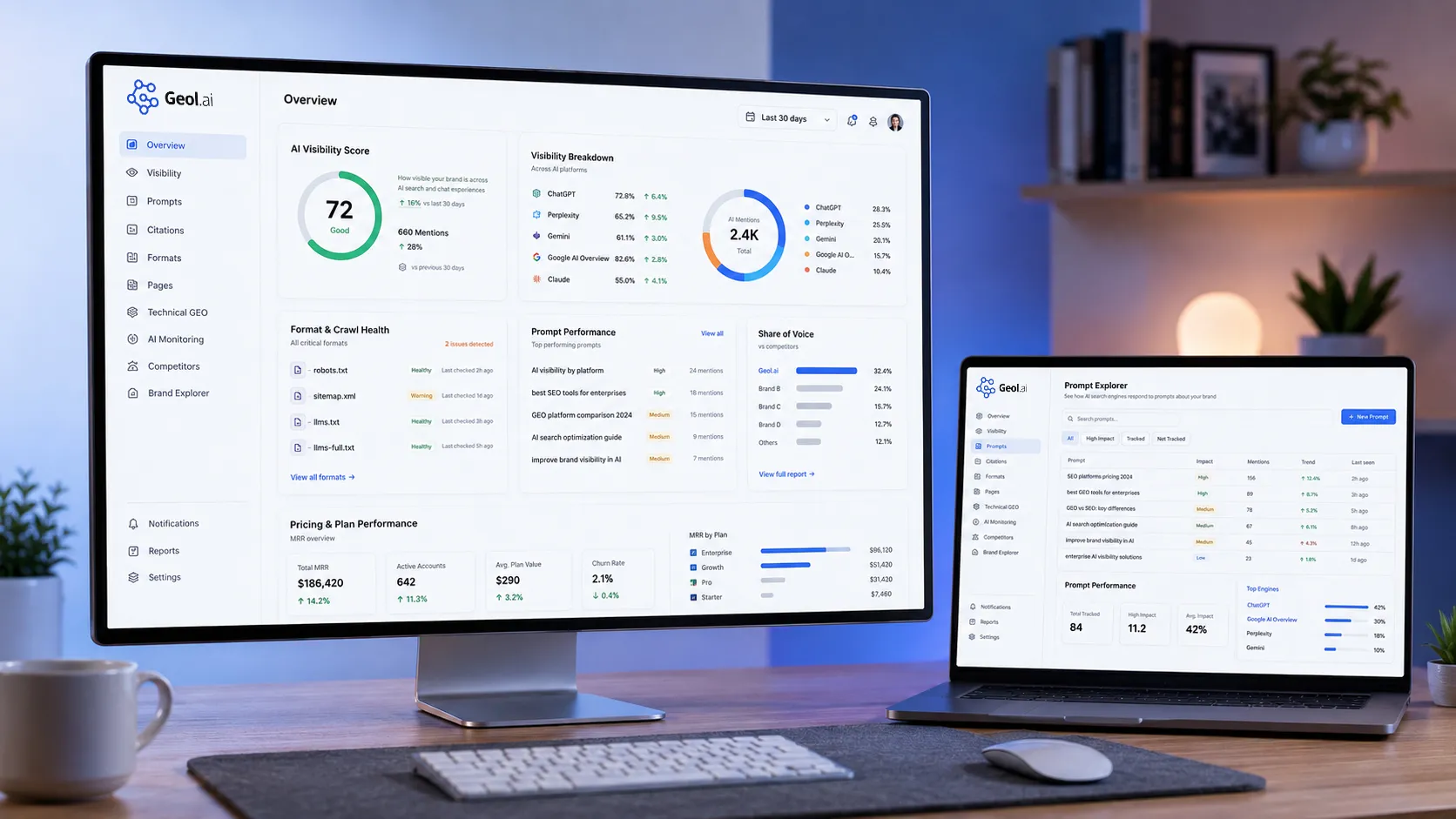
What a GEO Platform Actually Costs in 2026: The Pricing Guide Vendors Won't Write
Real published prices for the Generative Engine Optimization tool market in 2026: self-serve entry tiers, enterprise quote walls, metering math, and honest tool-versus-consultant economics.
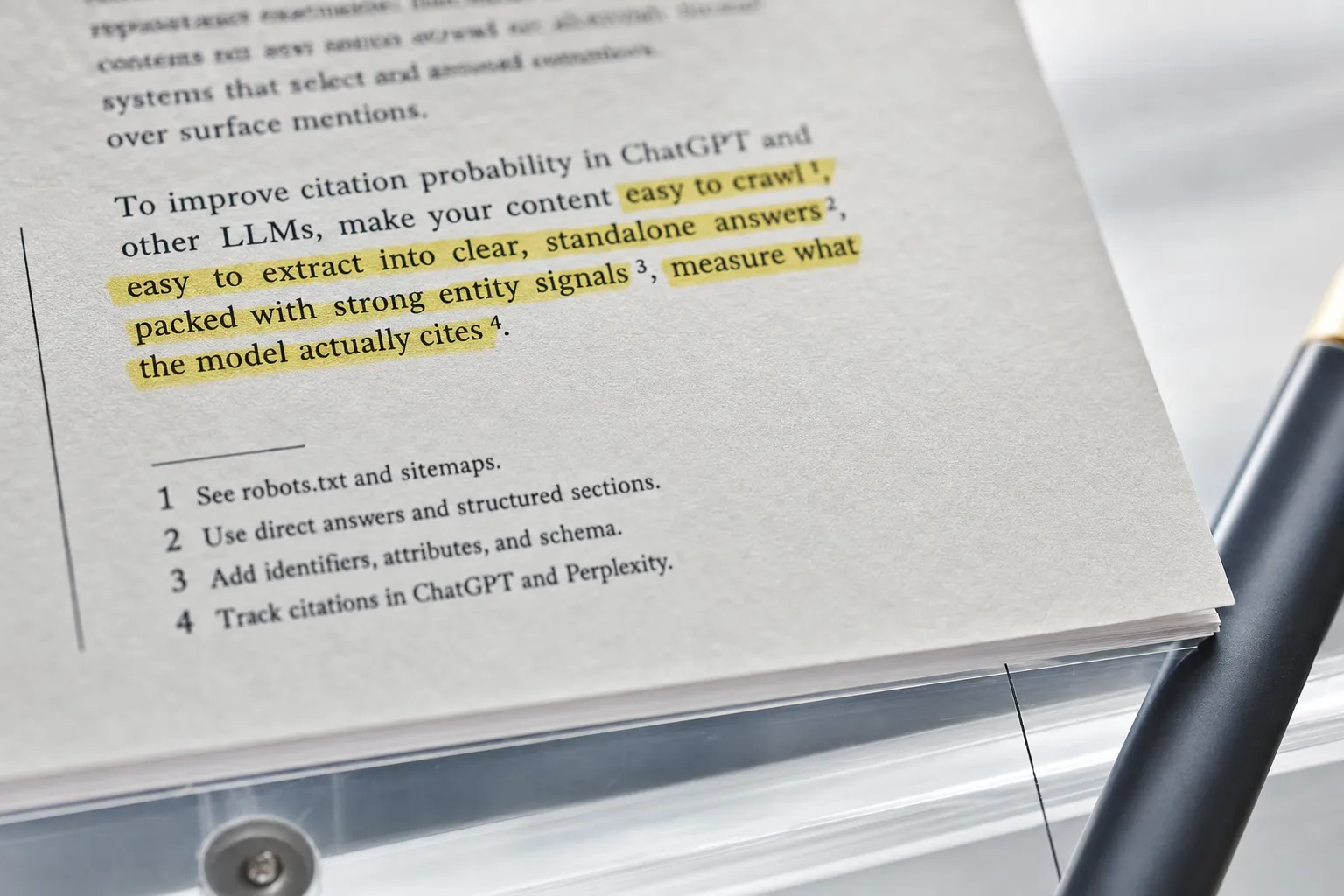
ChatGPT Optimization in 2026: A Working Checklist for Getting Your Brand Cited, Not Just Ranked
How ChatGPT retrieves and cites sources in July 2026, with a sourced Generative Engine Optimization checklist covering crawler access, extractable answers, entity signals, and measurement.