The Rise of Generative Engine Optimization (GEO): Navigating AI-Driven Search Landscapes (Case Study: Knowledge Graph–Led Entity Optimization)
Case study: how a Knowledge Graph-led entity optimization program improved AI citations and search visibility—plus lessons for GEO in AI-driven search.

The Rise of Generative Engine Optimization (GEO): Navigating AI-Driven Search Landscapes (Case Study: Knowledge Graph–Led Entity Optimization)
Generative Engine Optimization (GEO) is the practice of improving how your brand and content are selected, grounded, and cited in AI-generated answers (AI Overviews, chat-based search, and answer engines)—not just how you rank in blue links. In this spoke case study, a mid-market B2B publisher recovered AI visibility by moving from “keyword coverage” to a Knowledge Graph–led entity optimization program: clarifying who/what each page is about, expressing relationships with structured data and internal links, and making pages easy for AI systems to retrieve and cite.
This approach aligns with the broader GEO shift toward structured, machine-readable meaning—especially as models and platforms introduce richer extraction and schema-aware pipelines (see: OpenAI’s newer structured data capabilities).
Primary KPI: AI answer inclusion and citations for a defined query set. Secondary KPIs: branded entity mentions in AI responses, CTR on remaining blue-link impressions, and assisted conversions. Rankings were tracked, but not treated as the only success metric.
Situation: AI-Driven Search Changed the Visibility Game (and Our Content Stalled)
What “Generative Engine Optimization (GEO)” meant for this site’s performance
The publisher historically won with informational content: definitional guides, comparisons, and “how-to” explainers. As AI-driven SERP features expanded, the site saw a familiar pattern: visibility (impressions) remained healthy, but click-through softened as more queries were satisfied in-SERP or in an AI answer layer. That’s where GEO becomes practical: it’s the set of techniques that increase the chance your content is used as a source in generated responses—so you still earn brand demand, downstream visits, and pipeline influence even when fewer users click immediately.
This strategic shift mirrors the industry’s 2026 adoption curve where brands treat entity understanding, provenance, and retrieval as first-class marketing concerns (context: GEO/AEO adoption surges).
Baseline symptoms: impressions up, clicks flat, and fewer brand mentions in AI answers
The team also noticed a qualitative drop: when they tested prompts in major answer engines, competitors were cited more often—even when the publisher had deeper coverage. The root issue wasn’t “thin content.” It was ambiguous entities (multiple concepts per page), inconsistent naming (synonyms used without definition), and weak relationship signals between pages.
| Baseline snapshot (60–90 days pre-change) | Value | How it was measured |
|---|---|---|
| Target cluster impressions | ↑ (steady growth) | Google Search Console (query group filter) |
| Target cluster clicks | → (flat) | GSC performance report |
| CTR on target cluster | ↓ (softening) | Clicks ÷ impressions (GSC) |
| Share of queries triggering AI answers | High (rising) | Manual SERP sampling + feature tagging |
| AI citation rate (brand/page cited) | Low (declining) | Manual prompt set (50–100) + tracking sheet |
| Branded vs non-branded traffic split | Branded stable; non-branded volatile | Analytics + GSC query classification |
The implication: to earn inclusion in AI answers, the site needed to become easier to interpret as a set of entities and relationships—not just a library of pages.
Approach: Build a Knowledge Graph-First GEO Playbook (Entity Optimization for AI)
Entity inventory and disambiguation: defining the “who/what” AI should recognize
Step one was creating an entity inventory: products, categories, standards, methods, integrations, competitors, and key people (authors and quoted experts). For each entity, the team documented: canonical name, synonyms, short definition, key attributes, and “sameAs” reference URLs. Then they mapped typed relationships in a lightweight Knowledge Graph: is a, part of, used for, compared to, requires, and measured by.
If a page can’t be summarized as “This page is primarily about one entity and one intent,” it’s a prime candidate for AI citation loss. Split it, refocus it, or add a clear primary-entity definition block at the top.
Structured data + on-page semantics: Schema.org, internal anchors, and entity-rich sections
Next, they expressed those entities in ways machines reliably consume: Schema.org structured data, consistent naming, and repeatable on-page patterns. They avoided “markup for markup’s sake” and focused on high-signal types: Organization, WebSite, WebPage, Article, Person (authors), and FAQPage where the page truly contained Q&A. Each entity record included “sameAs” references to authoritative profiles when available.
Two operational notes mattered: (1) validating at scale via crawl data (workflow inspiration: crawl-based GEO improvements), and (2) keeping structured data aligned with editorial truth to avoid trust decay.
Content-to-entity mapping: aligning pages to a single primary entity and intent
They selected 5–8 priority pages in one topic cluster (the “spoke set”) and assigned each page a primary entity. Pages were rewritten to include: a short definition, a list of attributes/criteria, and relationship links to sibling pages and the pillar. This “one page → one entity” discipline reduced overlap and gave AI systems clearer candidates to cite.
Entity optimization program lift (before vs after)
Illustrative before/after operational metrics used to verify that the Knowledge Graph and entity alignment work shipped (not just planned).
Implementation: One Spoke Page Rebuilt for GEO (Knowledge Graph as the Source of Truth)
Page changes: definitional snippet block, entity attributes, and relationship-driven internal links
40–60 word definition (top of page)
A tight, unambiguous definition that names the entity, its category (“is a”), and the decision context (“used for”). This block was written in plain language and reused consistently across the cluster (with minor contextual variation).
Attribute bullets (features/criteria)
A scannable list of 6–10 attributes (requirements, constraints, evaluation criteria). These bullets increased “extractability” for AI summarization and improved user navigation.
Relationship module (“Related entities”)
A short section linking to sibling spokes using relationship labels (e.g., “Compared to X,” “Often used with Y,” “Part of Z”). This was driven by the Knowledge Graph so internal linking stayed consistent and non-random.
Grounding citations (authoritative sources)
2–5 external citations were added to support definitions and claims, improving trust signals for both humans and AI systems that prefer grounded statements.
Retrieval & grounding considerations: making content easy for AI systems to cite
Beyond “what we wrote,” the team optimized for “how it’s retrieved.” They improved heading clarity, reduced mixed intents, and ensured stable URLs. They also only updated timestamps when the content materially changed, preserving a cleaner change history for crawlers and downstream systems.
In GEO, the unit of optimization isn’t only the page—it’s the entity graph the page implies.
This also reduced risk as AI systems become more “assistant-like” and synthesis-heavy (see how Google frames Gemini as a thought partner and what that implies for GEO: Google’s Gemini 3 and generative search behavior).
Editorial workflow: keeping the Knowledge Graph current as content ships
To prevent drift, the Knowledge Graph became a lightweight editorial gate. Every new or updated article required: (1) confirm primary entity, (2) confirm synonyms and definition, (3) add/validate relationships, (4) ensure structured data matches the page, and (5) add relationship-driven internal links (pillar + sibling spokes).
From Knowledge Graph to publish: entity-led GEO workflow
A simple flow showing how the Knowledge Graph acts as the source of truth for page structure, structured data, and internal linking.
Results: What Changed in AI Answers and Traditional Search (8–12 Weeks)
AI visibility outcomes: citations, mentions, and answer inclusion
Within 8–12 weeks, manual prompt sampling showed more frequent brand and page citations for the target query set. The most consistent “wins” happened on queries where the rebuilt spoke page had a crisp definition and where the Knowledge Graph relationships were explicitly mirrored in internal links (e.g., “X is often used with Y” and “X is compared to Z”).
Search outcomes: CTR, qualified sessions, and downstream conversions
Traditional search performance improved modestly but meaningfully: CTR rose on entity-led queries where users still clicked through for detail, and sessions landing on the rebuilt page showed stronger engagement (scroll depth and next-page navigation). The team treated this as “assist value”: even when AI answers reduced clicks overall, the visits that did arrive were more qualified.
Pre vs post: AI citation rate and CTR trend (illustrative)
An example of how teams can track GEO outcomes: AI citations (manual sample) and GSC CTR for the same query set over time. Use confidence notes and keep the prompt set consistent.
AI answer inclusion is sensitive to model changes, SERP experiments, and prompt variance. Treat results as directional unless you control for seasonality, PR spikes, and query mix. Keep a stable prompt list, log dates of changes, and annotate known external events.
The team also reviewed legal/rights considerations when adding citations and summaries, especially as AI/copyright norms evolve (related: how copyright shifts affect GEO playbooks).
Lessons Learned: Practical GEO Guidance for Entity Optimization (What We’d Do Again)
What mattered most: entity clarity beats keyword density
- A consistent primary entity per page (and a definition that matches the rest of the cluster).
- Typed relationships expressed twice: in the Knowledge Graph and in human-visible internal links/modules.
- Grounding: concise claims backed by references and stable page structure that’s easy to quote.
Common pitfalls: over-markup, ambiguous entities, and thin relationship graphs
Entity optimization: what helped vs what hurt
- Minimal, valid structured data that matches on-page reality
- Clear definitions and attribute lists
- Relationship modules that connect the cluster
- Consistent naming and synonym control
- Schema spam (marking up content that isn’t actually present)
- Multiple competing primary entities per page
- Inconsistent labels (same concept called three different names)
- Orphan pages with no inbound/outbound entity links
Next steps: scaling the Knowledge Graph across the cluster
To scale, the publisher planned to: expand the entity inventory, add author/entity pages, standardize relationship modules sitewide, and monitor AI answer inclusion as a KPI alongside rankings. They also explored standardizing integrations so entity data could flow across tools and teams (see: Model Context Protocol and cross-platform AI integration).
Operational quality metrics to scale entity-led GEO
Track these to prevent drift as you roll out Knowledge Graph-led entity optimization across more content.
Key Takeaways
GEO is about earning inclusion and citations in AI-generated answers—so measure AI presence, mentions, and assisted conversions (not rankings alone).
Knowledge Graph–led entity optimization improves AI citation likelihood by making entities unambiguous and relationships explicit across a cluster.
The highest-leverage page changes were: a 40–60 word definition block, attribute bullets, relationship-driven internal links, and a small set of authoritative citations.
Scale safely by preventing drift: validate structured data, control entity naming/synonyms, and operationalize a Knowledge Graph checklist in the editorial workflow.
FAQ: Generative Engine Optimization (GEO) and Knowledge Graph Entity Optimization

Founder of Geol.ai
Senior builder at the intersection of AI, search, and blockchain. I design and ship agentic systems that automate complex business workflows. On the search side, I’m at the forefront of GEO/AEO (AI SEO), where retrieval, structured data, and entity authority map directly to AI answers and revenue. I’ve authored a whitepaper on this space and road-test ideas currently in production. On the infrastructure side, I integrate LLM pipelines (RAG, vector search, tool calling), data connectors (CRM/ERP/Ads), and observability so teams can trust automation at scale. In crypto, I implement alternative payment rails (on-chain + off-ramp orchestration, stable-value flows, compliance gating) to reduce fees and settlement times versus traditional processors and legacy financial institutions. A true Bitcoin treasury advocate. 18+ years of web dev, SEO, and PPC give me the full stack—from growth strategy to code. I’m hands-on (Vibe coding on Replit/Codex/Cursor) and pragmatic: ship fast, measure impact, iterate. Focus areas: AI workflow automation • GEO/AEO strategy • AI content/retrieval architecture • Data pipelines • On-chain payments • Product-led growth for AI systems Let’s talk if you want: to automate a revenue workflow, make your site/brand “answer-ready” for AI, or stand up crypto payments without breaking compliance or UX.
Related Articles

What a GEO Platform Actually Costs in 2026: The Pricing Guide Vendors Won't Write
Real published prices for the Generative Engine Optimization tool market in 2026: self-serve entry tiers, enterprise quote walls, metering math, and honest tool-versus-consultant economics.
ChatGPT Optimization in 2026: A Working Checklist for Getting Your Brand Cited, Not Just Ranked
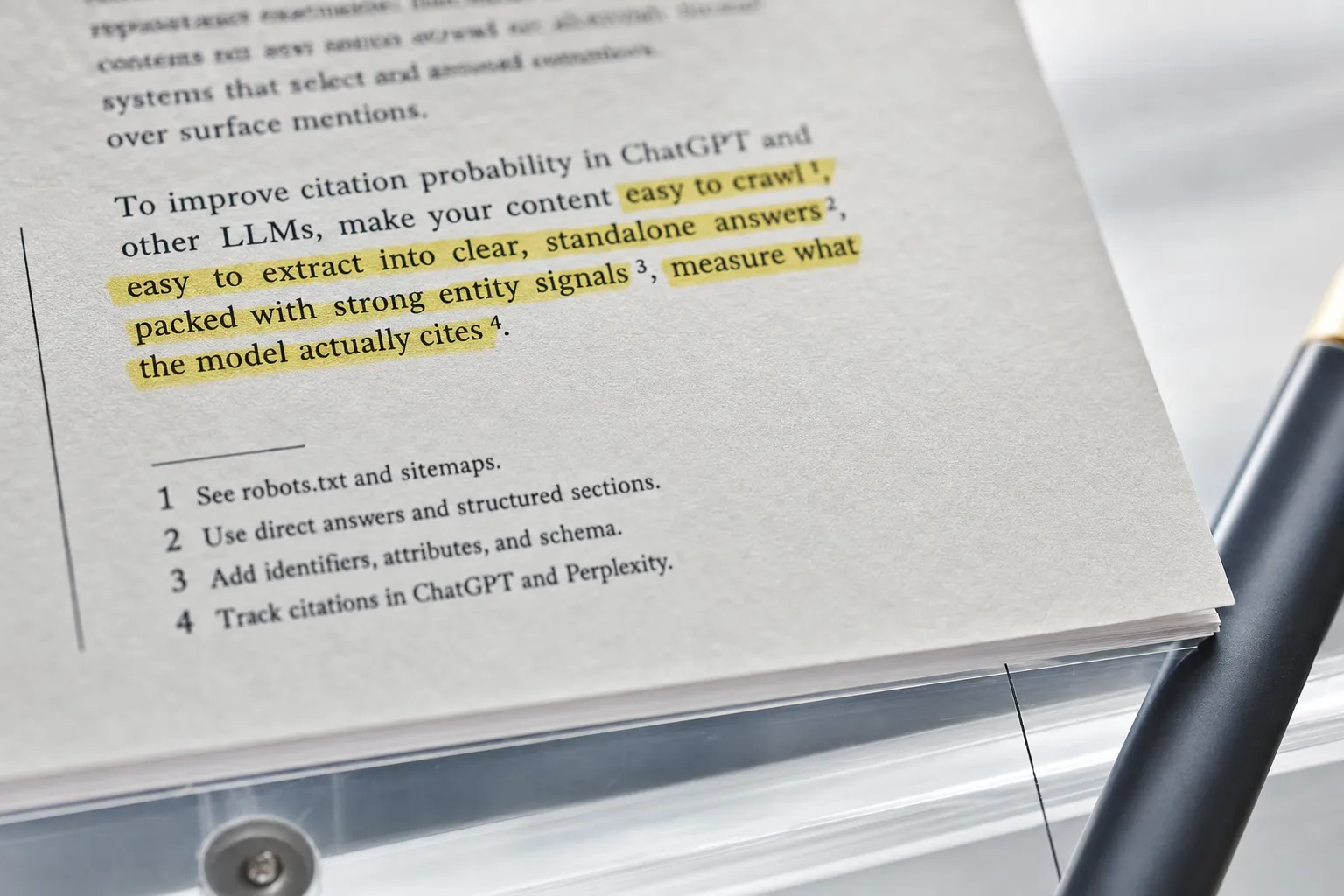
How ChatGPT retrieves and cites sources in July 2026, with a sourced Generative Engine Optimization checklist covering crawler access, extractable answers, entity signals, and measurement.