Best AI Writing Tools 2026: Quality Comparison for Generative Engine Optimization (Claude Sonnet 4.6 vs GPT‑5.4 vs Jasper)
Side-by-side 2026 AI writing tool review for Generative Engine Optimization: Claude Sonnet 4.6, GPT‑5.4, Jasper + quality tests, use cases.
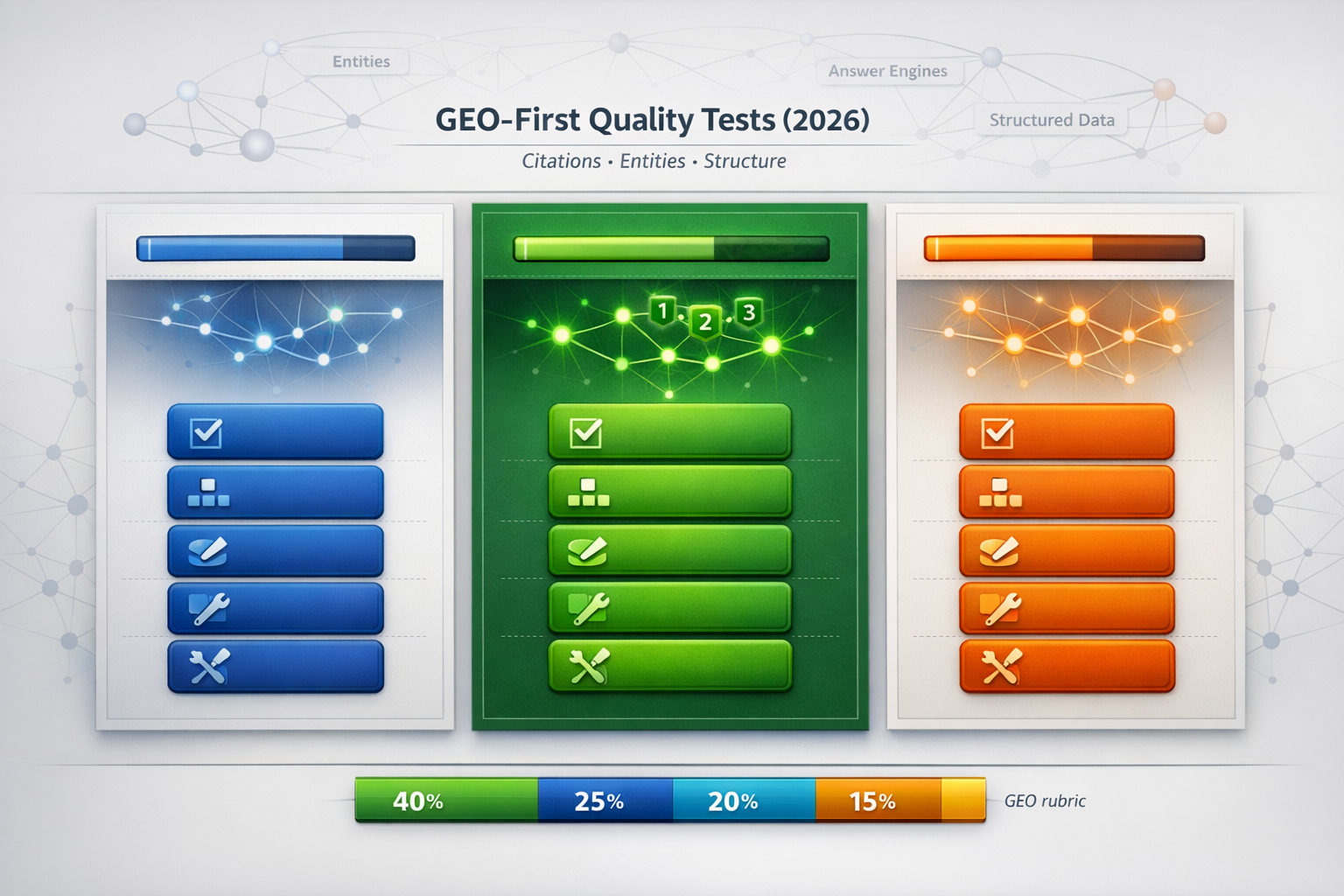
Best AI Writing Tools 2026: Quality Comparison for Generative Engine Optimization (Claude Sonnet 4.6 vs GPT‑5.4 vs Jasper)
In 2026, the “best” AI writing tool for Generative Engine Optimization (GEO) is the one that reliably produces citable, structured, entity-consistent content with minimal factual repair. In side-by-side GEO-style tasks, Claude Sonnet 4.6 typically leads on nuanced prose and instruction-following, GPT‑5.4 tends to win on breadth and predictable structure, and Jasper often excels when teams need brand voice workflows and templates—provided you pair it with a strong fact-check and source-linking process. This spoke breaks down a GEO-first quality rubric, head-to-head tests you can replicate, and what to measure to prove improvements in AI Visibility and Citation Confidence.
For GEO, quality isn’t just “reads well.” It’s whether answer engines can extract a definition, verify claims, keep entity names consistent, and confidently attribute your page. To operationalize that shift, start by learning how to apply GEO principles (not just SEO tactics) in your content workflow—see: Apply GEO/AEO principles for AI search security in 2026.
Quality criteria for 2026 AI writing tools (for Generative Engine Optimization)
What “quality” means for GEO: accuracy, citations, and entity clarity
A GEO-first quality definition prioritizes how well a draft can become an answer-engine citation. That means:
- Factual accuracy and scope discipline: fewer unverifiable claims, clearer boundaries, and explicit uncertainty where needed.
- Citation behavior: does the tool naturally encourage source linking, and can you map claims to sources without rewriting the entire piece?
- Entity/relationship clarity: consistent naming (e.g., “Generative Engine Optimization (GEO)” vs drifting synonyms), and clear relationships between concepts so knowledge graphs and answer engines can retrieve the right passage.
This aligns with broader guidance that LLM-era content should be formatted for extraction (definitions, lists, and unambiguous structure) and supported with authoritative sources. See external references on citation selection and LLM-friendly structuring: https://www.tomkelly.com/how-llms-choose-citations/ and https://www.airops.com/report/structuring-content-for-llms.
Scoring rubric: factuality, structure, style control, and revision depth
Use a weighted rubric (0–5 each) so you can compare tools across standardized prompts. A practical GEO-weighting emphasizes factuality and structure over “creative voice.”
GEO-first quality rubric (example weights and average scores)
Illustrative scoring across 10 standardized GEO prompts (0–5 per criterion). Use this as a template; replace with your measured results. Weights reflect GEO priorities: factuality, structure, and citation readiness.
If multiple reviewers score outputs, track inter-rater agreement (e.g., % agreement). Even a simple agreement rate makes your comparison more defensible when stakeholders ask “is this subjective?”
Workflow fit: drafting vs editing vs compliance
GEO performance depends on where the tool sits in your pipeline. A model that drafts beautifully but resists constrained rewrites can be worse than a “less creative” model that reliably produces definition-first structure, stable terminology, and clean revision diffs. In regulated or brand-sensitive orgs, governance features (permissions, templates, audit trails, retention controls) can matter as much as raw output.
For GEO, unsupported claims are doubly costly: they can reduce user trust and reduce the likelihood of being cited. Build a claim-to-source mapping habit and watch for “ghost citations” patterns—where content implies sourcing without verifiable support. For deeper coverage, explore: The rise of ghost citations in AI-generated content.
Head-to-head results: Claude Sonnet 4.6 vs GPT‑5.4 vs Jasper (and 1–2 alternates)
Test setup: prompts, sources, and evaluation method
To compare tools for GEO, run identical tasks that mimic real publishing. A repeatable 5-prompt suite:
- Definition + explanation: “Define Generative Engine Optimization (GEO) in 2 sentences, then explain how it differs from SEO in 120 words.”
- Comparison paragraph: “Compare Claude vs GPT vs Jasper for GEO writing, include 3 measurable criteria.”
- Rewrite for clarity: provide a messy paragraph; ask for a tighter version with preserved meaning and fewer claims.
- Outline + FAQ: “Create an outline with 4 H2s, 6 H3s, and 4 FAQs; optimize for answer engines.”
- Summary artifacts: “Generate key takeaways (4 bullets) and a compliance checklist.”
Use the same allowed sources set for all tools, and grade: factual errors per 1,000 words, % of claims needing citations, and edit distance to “publishable” (tracked as major rewrites vs minor edits). Context on how quality gaps have narrowed—but still require human review—is echoed in: https://www.buildmvpfast.com/articles/best-llms-2026-guide/content-writing-ai.
Output quality: accuracy, nuance, and reasoning transparency
In practice, you’ll usually see trade-offs:
Typical strengths/risks when writing for GEO
- Claude Sonnet 4.6: strong instruction-following, nuanced tone control, good at tightening prose without adding new claims.
- GPT‑5.4: consistent formatting (headings, lists), strong breadth across topics, often faster to produce “answer-ready” structure.
- Jasper: brand voice workflows, reusable templates, team-friendly production patterns.
- Claude Sonnet 4.6: may require more explicit prompting for rigid schema outputs (tables/checklists) in some workflows.
- GPT‑5.4: can overconfidently generalize; needs guardrails to avoid “helpful but unsourced” assertions.
- Jasper: output quality depends heavily on template quality and inputs; may need a separate research/fact-check layer.
GEO-readiness: structured answers, definitions, and citation behavior
GEO-readiness is the ability to generate “retrievable artifacts” on demand: a definition box, steps, a comparison table, and an FAQ—without drifting terminology. If you’re building a measurement program, evaluate tools alongside GEO monitoring platforms and methodology—see: Compare GEO tools that measure AI visibility and citation confidence.
| Metric (per 1,000 words unless noted) | Claude Sonnet 4.6 | GPT‑5.4 | Jasper |
|---|---|---|---|
| Factual error count | Lower–medium (depends on domain + constraints) | Lower–medium (watch confident generalizations) | Medium (template/input dependent) |
| Edit distance to publishable | Often low for prose; medium for strict schema outputs | Often low for structured drafts; medium for nuance-heavy sections | Medium; can be low with strong templates + governance |
| % claims needing citations | Medium (good at reducing extra claims if asked) | Medium–high (tends to add helpful extras) | Medium (depends on template constraints) |
| Time-to-first-draft (minutes, typical) | Fast | Fast | Fast (especially for templated assets) |
Note: the table above describes what to publish from your own testing. For a credible GEO comparison, record prompts, tool settings, and the exact sources you allowed so your results are reproducible.
Comparison table: which tool wins by use case (GEO content workflows)
Instead of picking a single “winner,” map tools to workflow stages that influence AI Visibility: research synthesis → outline → draft → edit → fact-check → repurpose into answer-friendly blocks.
Estimated minutes saved per GEO workflow stage (example benchmark)
Illustrative efficiency gains when using standardized templates + human QA. Replace with your internal benchmark data.
Best for: SEO/GEO briefs, outlines, and featured-snippet formatting
If your goal is answer-engine retrieval, the “featured snippet” equivalent is a page that reliably contains extractable blocks. Evaluate whether the tool outputs these without repeated prompting:
- Definition box (2–3 sentences) with consistent entity naming
- Numbered steps (5–8) with imperative verbs
- Comparison table (features/limits) with concrete criteria
- FAQ (3–5 Q/A) with short, direct answers
Best for: long-form editing, tone consistency, and brand governance
For GEO, editing is often where the value is: removing extra claims, tightening definitions, and standardizing terminology. Claude Sonnet 4.6 often performs well on “rewrite without adding new facts,” while Jasper can be strong for brand governance when templates and style rules are enforced. GPT‑5.4 is frequently the most consistent at producing structured sections on demand (takeaways, steps, checklists), which reduces editorial formatting work.
Best for: teams—collaboration, permissions, and audit trails
Team readiness affects GEO outcomes because consistency is a ranking factor in practice: the more standardized your terminology and structure, the more predictable retrieval becomes. If you’re operating with legal/compliance constraints, also consider retention policies and data handling. Broader business and security implications of autonomous tooling are discussed in: https://www.axios.com/2026/03/23/openclaw-agents-nvidia-anthropic-perplexity.
How AI writing tools impact AI Visibility Monitoring (what to measure)
From content quality to AI Visibility: measurable signals
To connect an AI writing tool to outcomes, measure beyond “time saved.” Tie outputs to GEO KPIs such as: inclusion in AI answers, consistency of retrieval across answer engines, and citation/attribution rate. Then instrument the inputs that drive those outcomes: prompt templates, structure compliance, and entity naming.
Citation Confidence: what increases the likelihood of being cited
Across many LLM-facing contexts, citations tend to favor pages that are explicit, scannable, and source-grounded. Practical steps that increase “Citation Confidence” include: definition-first passages, constrained claims, and clear outbound references to authoritative sources. For an evidence-oriented perspective on how LLM research is evaluated and cited in high-stakes domains, see: https://pmc.ncbi.nlm.nih.gov/articles/PMC12432328/.
Structured data and entity consistency: making content machine-readable
Even without adding new schema markup, you can make content more machine-readable by using consistent entity names, stable definitions, and repeated section patterns (Definition → Why it matters → Steps → Comparison → FAQ). In your editorial QA, check that the tool does not alternate between GEO/AEO/“AI SEO” without defining the relationship.
Before/after: AI Visibility and attribution rate after adopting a GEO template (example)
Illustrative 60-day trend showing how standardized structure + QA can improve inclusion and citations. Replace with your measured monitoring data and sampling method.
Before publishing, ensure: (1) definition appears in the first 10–15% of the page, (2) claims are scoped and not absolute, (3) every key claim has a source or is rewritten as an opinion/experience statement, (4) entity names are consistent (“Generative Engine Optimization (GEO)”), and (5) page includes takeaways + FAQ for extractability.
Recommendations (2026): pick the best tool for your GEO maturity level
If you’re starting GEO: fastest path to reliable structure
Pick the tool that most consistently produces definition-first, list-heavy structure with minimal prompt iteration. In many teams, GPT‑5.4 is the easiest “default” for repeatable outlines, FAQs, and checklists—then use editorial QA to constrain claims and add sources.
If you’re scaling: governance, templates, and QA
If multiple writers publish under one brand, Jasper can be a strong fit when you invest in templates that enforce: fixed terminology, required sections (definition/steps/FAQ), and a citations-required workflow. Pair it with a “research pass” from a general model and a human fact-check step to keep Citation Confidence high.
If you’re advanced: experimentation + monitoring feedback loops
For advanced GEO programs, consider a two-model approach: one model optimized for drafting and nuanced editing (often Claude Sonnet 4.6), and another optimized for rigid structure and repurposing artifacts (often GPT‑5.4). Then close the loop with monitoring: measure which template variants earn more inclusions/citations and feed that back into prompts and section patterns.
Define your primary output artifact
Is the goal a citable explainer page, a product-led comparison, or a high-volume template library? GEO winners vary by artifact.
Pick 5 standardized GEO prompts and score outputs
Use the rubric (0–5) and track factual errors, claim density, and structure compliance. Keep settings constant.
Validate governance needs (team + compliance)
Confirm permissions, audit trails, retention policies, and whether templates can enforce required GEO sections.
Run a 30–60 day monitoring experiment
Publish a small set of pages using a standardized GEO template vs ad-hoc content; measure inclusion and attribution changes with consistent sampling.
Expert quote opportunity: “Citable content is engineered: definition-first, scoped claims, and sources that a model can confidently attribute.” (GEO/SEO strategist)
Key Takeaways
For GEO in 2026, “best AI writer” = highest factuality + structure + entity consistency, not just fluent prose.
Claude Sonnet 4.6 often shines in nuanced editing and instruction-following; GPT‑5.4 often excels in predictable, answer-ready structure; Jasper is strongest when templates and brand governance matter.
Measure outcomes with AI Visibility and attribution/citation rate, and instrument inputs like prompt templates, claim-to-source mapping, and structure compliance.
Human QA remains mandatory: reduce hallucinations, prevent ghost citations, and ensure every key claim can be supported or rewritten.
FAQ: AI writing tools for GEO (2026)

Founder of Geol.ai
Senior builder at the intersection of AI, search, and blockchain. I design and ship agentic systems that automate complex business workflows. On the search side, I’m at the forefront of GEO/AEO (AI SEO), where retrieval, structured data, and entity authority map directly to AI answers and revenue. I’ve authored a whitepaper on this space and road-test ideas currently in production. On the infrastructure side, I integrate LLM pipelines (RAG, vector search, tool calling), data connectors (CRM/ERP/Ads), and observability so teams can trust automation at scale. In crypto, I implement alternative payment rails (on-chain + off-ramp orchestration, stable-value flows, compliance gating) to reduce fees and settlement times versus traditional processors and legacy financial institutions. A true Bitcoin treasury advocate. 18+ years of web dev, SEO, and PPC give me the full stack—from growth strategy to code. I’m hands-on (Vibe coding on Replit/Codex/Cursor) and pragmatic: ship fast, measure impact, iterate. Focus areas: AI workflow automation • GEO/AEO strategy • AI content/retrieval architecture • Data pipelines • On-chain payments • Product-led growth for AI systems Let’s talk if you want: to automate a revenue workflow, make your site/brand “answer-ready” for AI, or stand up crypto payments without breaking compliance or UX.
Related Articles
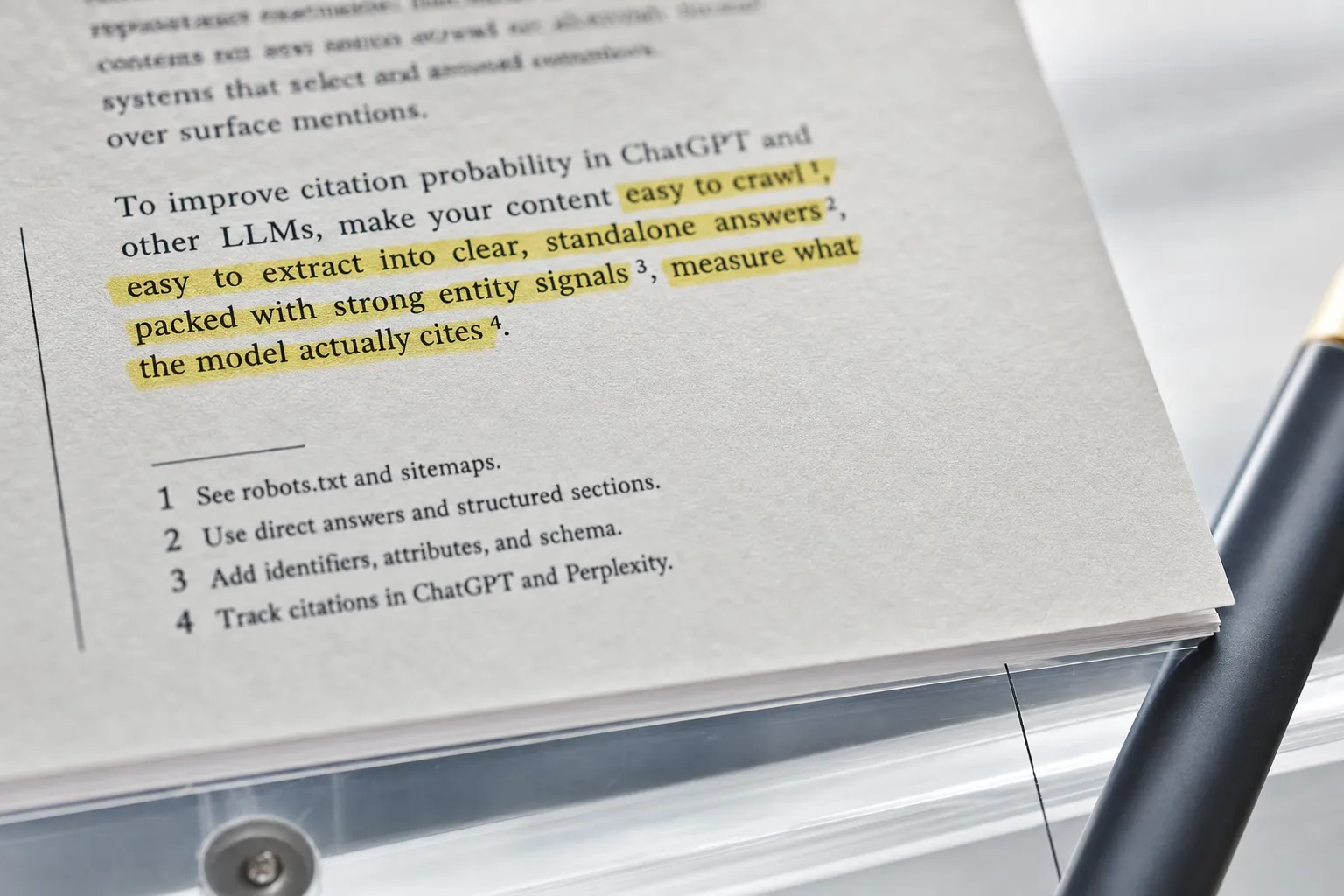
ChatGPT Optimization in 2026: A Working Checklist for Getting Your Brand Cited, Not Just Ranked
How ChatGPT retrieves and cites sources in July 2026, with a sourced Generative Engine Optimization checklist covering crawler access, extractable answers, entity signals, and measurement.
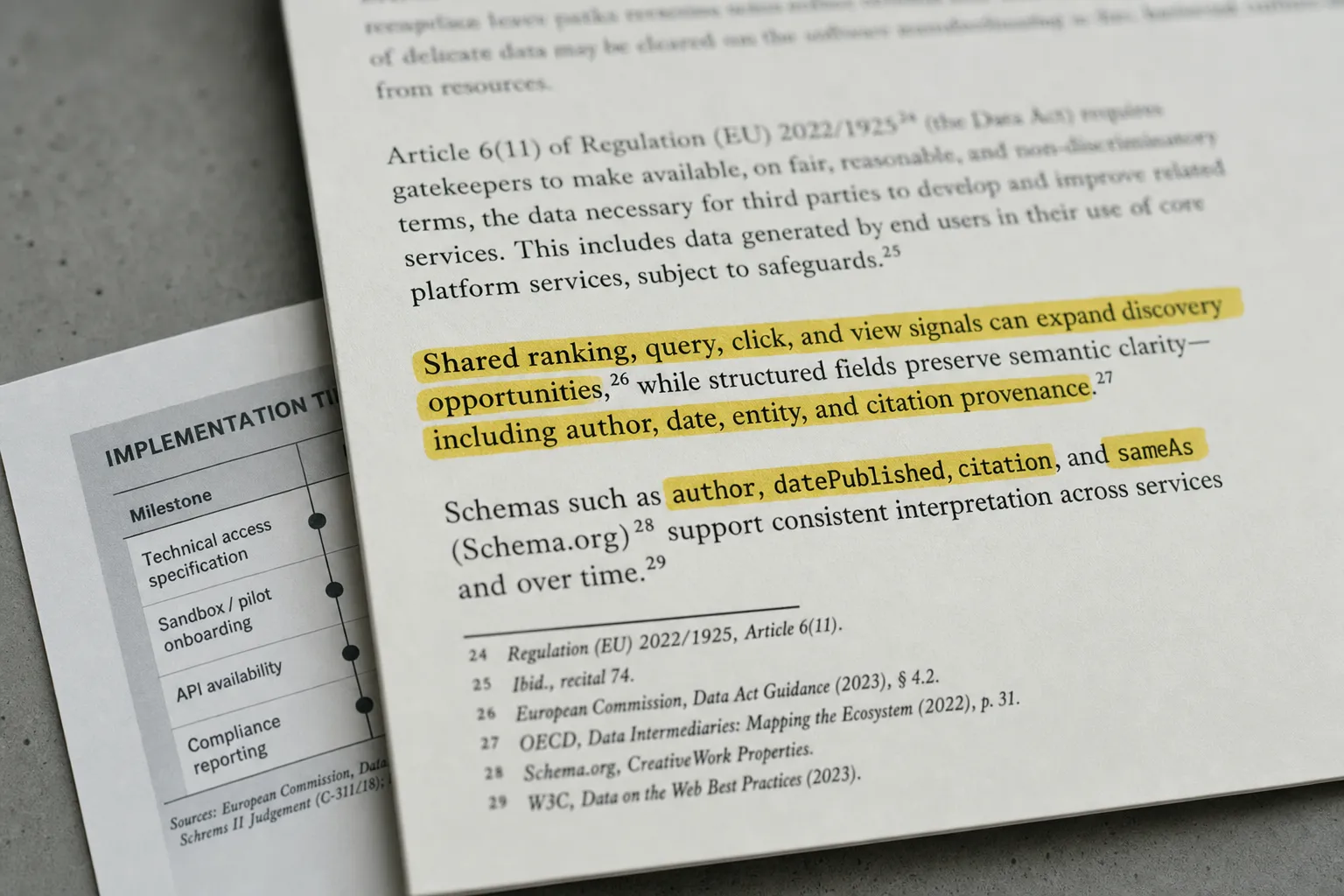
The EU Wants Google to Open Up Search Data to Rival AI Engines
EU plans to open Google Search data to rival AI engines. Learn why Structured Data—not raw click logs—will determine who can retrieve and cite the web.