Perplexity’s July 14 Product Drop Signals a New Playbook for AI-Native Discovery
A side-by-side review of Perplexity’s July 14 product drop and ChatGPT’s cited research model, with practical Generative Engine Optimization lessons.

The best AI SEO software in 2026 depends on the job: Perplexity is the stronger fit for fast, source-led discovery, while ChatGPT suits extended synthesis—an editorial verdict, not a measured benchmark. On July 14, Perplexity announced faster models, persistent context, private-company research, and website publishing, giving researchers and publishers a shorter path from query to sourced answer and action.
What did Perplexity’s July 14 product drop change?
The official Perplexity changelog describes four capability categories in the July 14, 2026 drop: faster models, persistent context, private-company research, and website publishing. Together, they signal a discovery product expanding beyond one-off answers. A user can investigate a subject, preserve context, explore information that is harder to collect, and publish an output without leaving the same environment.
Perplexity Brain Test Results on Tasks With Prior Context
Shows Perplexity's reported percentage changes from internal testing of Brain on tasks involving prior context. The results support the article's discussion of persistent context, but they are vendor-reported and the changelog does not disclose the benchmark methodology or sample size.
Date: July 14, 2026. Confirmed categories: four—faster models, persistent context, private-company research, and website publishing. The supplied first-party material does not provide a current Perplexity traffic or usage figure, so no adoption number is reported here.
This review asks one narrow question: which product presents the better model for cited, AI-native discovery? It does not compare coding, image generation, voice, or every available model. The evaluation uses six criteria: citation transparency, source quality, source diversity, freshness, research depth, and continuity between discovery and action. Those criteria matter more than feature count because a polished answer can still rest on weak or mismatched evidence.
An independent analyst’s view on whether this is a genuine discovery-model shift or repackaging would strengthen the assessment, but no such quote appears in the supplied sources. The defensible claim is narrower: Perplexity combined research and distribution capabilities in one dated release.
Perplexity review: A discovery-first approach to cited answers
Perplexity’s clearest advantage is low-friction movement between an answer and its sources. The July 14 additions extend that pattern: persistent context supports follow-up exploration, private-company research broadens the material under investigation, and website publishing creates an action after synthesis. Faster models address the waiting cost that otherwise interrupts this loop.
Perplexity Product Release Cadence Leading Up to July 14, 2026
Shows the number of calendar days between consecutive entries in Perplexity's official changelog. It adds quantitative context to the article's characterization of Perplexity as a fast-moving platform. Intervals are calculated directly from the official publication dates.
Secondary July 2026 product coverage also reports iteration on Perplexity Computer and integrations with recently released GPT-5.6 tiers. That context supports the picture of a fast-moving research platform, but it should not be substituted for the official changelog when documenting what shipped specifically on July 14.
The source set does not measure claim-level citation coverage, unique domains, primary-source share, source age, paywall incidence, or citation correctness. It therefore cannot establish that Perplexity consistently avoids repeated domains or that every synthesis is fully supported. Those are testable risks, not findings. A practical review should inspect whether each important claim maps to evidence, whether the evidence says what the answer implies, and whether primary sources appear when available.
A linked source can be relevant without supporting the exact adjacent claim. Citation Confidence requires manual validation of entailment, authority, recency, and source independence; a citation count alone does not establish quality.
For Generative Engine Optimization, this distinction is operational. A publisher can appear in an answer yet contribute little evidence, while another source may supply the passage that shapes the recommendation. Perplexity’s discovery-first interface makes source selection visible enough to study, but the supplied sources provide no platform-wide accuracy rate.
ChatGPT review: Building a cited research environment
ChatGPT is better framed as a research environment than as a source browser. Its practical role is to combine conversational synthesis, web retrieval, iterative investigation, and output creation so a user can move from an initial question toward a memo, comparison, plan, or other working artifact. That sustained workflow is the basis for the editorial verdict that it fits extended synthesis better than rapid source-led exploration.
There is an important evidence limit: the supplied research set contains no current OpenAI release note documenting ChatGPT’s exact citation placement, model availability, account-tier restrictions, or response time on July 15, 2026. Those details are therefore unverified here. Secondary coverage naming GPT-5.6 concerns Perplexity’s model integrations; it is not evidence of how ChatGPT presents or validates sources.
The useful distinction is workflow shape, not guaranteed accuracy. Perplexity puts source-led exploration near the center of the experience. ChatGPT can carry a question through longer analysis and artifact production, but that depth does not prove better citations. For a broader product-level evaluation framework, use this comparison of platforms that measure AI visibility and Citation Confidence.
Perplexity vs. ChatGPT: Which offers the stronger cited discovery workflow?
Perplexity is the stronger fit when rapid, source-led discovery is the priority; ChatGPT is better suited to extended synthesis and research-to-output work. This is a use-case verdict based on documented product direction, not a universal performance score. Results can change with the prompt, subscription tier, model, location, and test date.
Cited discovery workflow comparison
| Criterion | Perplexity | ChatGPT | Evidence status |
|---|---|---|---|
| Core orientation | Discovery-first answers and source exploration | Sustained synthesis and artifact creation | Product-direction comparison |
| Citation placement | Sources are central to the discovery experience; claim-level consistency still needs testing | Citations can support web and research workflows; current placement was not verified from an OpenAI source | No controlled benchmark supplied |
| Source inspection | Designed for quick movement from answer to source | More oriented toward continuing analysis within the conversation | Editorial workflow assessment |
| Freshness | Faster models and the July 14 release support a rapid discovery loop | Current retrieval freshness is unmeasured in the supplied sources | No median source-age data |
| Source diversity | Unique-domain performance is unknown | Unique-domain performance is unknown | Requires matched prompts |
| Research depth | Persistent context and private-company research expand continued investigation | Strong fit for long-form synthesis and iterative output development | Capabilities do not guarantee evidence quality |
| Discovery-to-action continuity | Research can move into website publishing | Research can move into created artifacts | Different action paths |
| Best initial use | Fact lookup, current-event exploration, source discovery | Literature-style synthesis, decision support, research-to-output work | Choice should follow intent |
A credible head-to-head test should use 30 identical prompts spanning informational, comparative, and current-event intent. Record the date, account tier, model, location, and prompt wording; then manually score citation coverage, unique domains, primary-source share, citation correctness, unsupported claims, source age, response time, and follow-ups required. This article does not publish normalized scores or a grouped bar chart because no raw benchmark results were supplied.
Intent changes the recommendation. Start with Perplexity for quick fact discovery, unfolding events, or product research where inspecting sources is part of the task. Start with ChatGPT when the job requires a long synthesis or a finished working document. Google is also moving into this territory by surfacing original content, trusted sources, article suggestions, and subscription links, according to Google’s account of generative AI search. For channel context, compare these workflows with the March 27, 2026 Google Search Live rollout.
What the comparison changes for Generative Engine Optimization
Generative Engine Optimization means optimizing content to be understood, cited, and recommended by AI-powered search and answer systems. The strategic shift is from optimizing only for a ranked page to supporting a multi-step chain: retrieval, entity recognition, passage selection, evidence evaluation, citation, and recommendation.
That shift is supported by emerging research. The paper arXiv:2605.14021 reports that source selection for LLM citations is not the same as classic ranking: an answer engine can cite pages that do not appear in the conventional top results. A second framework, arXiv:2604.07585, tracks visibility through share of voice, citation rate, and prompt coverage across engines. These measures separate being mentioned from supplying the cited evidence.
Publish an evidence-ready page
Lead with a direct answer, explicit claims, named authors, visible update dates, original data, and primary-source references.
Clarify entities and relationships
Use consistent names, descriptive headings, structured data, and coherent relationships so systems can identify the subject without guessing.
Make passages independently useful
Keep the claim, evidence, units, date, and qualification close enough to survive passage-level retrieval.
Validate synthesis and citation
Test whether an engine retrieves the page, represents the claim correctly, and links the citation to the right evidence.
Measure the next action
Track follow-up mentions, cited-page distribution, referrals, and conversions rather than treating a generated mention as the final outcome.
Structured data and a coherent knowledge graph improve machine interpretation, but neither replaces accessible evidence or claim-level clarity. To understand the underlying selection mechanics, read how LLM ranking and citation factors differ.
In Geol.ai testing, we separate whether a brand appears from whether a specific page is cited. A practical monthly scorecard should track citation share, citation accuracy, primary-source share, unique cited pages, prompt coverage, answer-engine referral sessions, and referral conversions.
Recommendation: Prepare for platform-specific discovery paths
Build one platform-neutral evidence layer, then test each discovery path separately. Google says its generative search experience surfaces original content and trusted sources alongside article and subscription links; Perplexity’s July 14 drop adds persistent context and publishing to its own path. The common requirement is evidence that remains intelligible when extracted from the page.
Audit citation-ready pages
Identify pages that answer priority prompts and check whether their central claims are explicit, current, and attributable.
Repair the evidence layer
Add missing primary sources, author information, update dates, concise definitions, original data, and appropriate structured data.
Run matched prompts
Use the same wording in Perplexity and ChatGPT, controlling the date, tier, model, and location wherever possible.
Validate citations manually
Check claim support, source authority, recency, primary-source use, and whether the cited URL is the best page on the site.
Update from observed gaps
Revise passages that are omitted or misrepresented, then rerun the matched prompts rather than assuming the change worked.
The bottom line: use Perplexity to test rapid source discovery and ChatGPT to test extended cited synthesis, but judge both with the same manual evidence standard. Build pages around clear claims, original evidence, explicit entities, and accessible sources. Watch whether Perplexity’s post–July 14 combination of persistent research and publishing changes which pages receive citations and downstream referrals.
Key Takeaways
Perplexity’s July 14, 2026 drop covered four confirmed areas: faster models, persistent context, private-company research, and website publishing.
Perplexity is the better initial fit for source-led exploration; ChatGPT is the better initial fit for longer synthesis and research-to-output workflows.
No controlled head-to-head results were supplied, so citation quality, source diversity, freshness, and unsupported-claim rates remain unmeasured.
GEO measurement should distinguish brand visibility from validated page citations, prompt coverage, referral traffic, and conversion outcomes.
Frequently asked questions about Perplexity, ChatGPT, and cited discovery
Frequently Asked Questions

Founder of Geol.ai
Senior builder at the intersection of AI, search, and blockchain. I design and ship agentic systems that automate complex business workflows. On the search side, I’m at the forefront of GEO/AEO (AI SEO), where retrieval, structured data, and entity authority map directly to AI answers and revenue. I’ve authored a whitepaper on this space and road-test ideas currently in production. On the infrastructure side, I integrate LLM pipelines (RAG, vector search, tool calling), data connectors (CRM/ERP/Ads), and observability so teams can trust automation at scale. In crypto, I implement alternative payment rails (on-chain + off-ramp orchestration, stable-value flows, compliance gating) to reduce fees and settlement times versus traditional processors and legacy financial institutions. A true Bitcoin treasury advocate. 18+ years of web dev, SEO, and PPC give me the full stack—from growth strategy to code. I’m hands-on (Vibe coding on Replit/Codex/Cursor) and pragmatic: ship fast, measure impact, iterate. Focus areas: AI workflow automation • GEO/AEO strategy • AI content/retrieval architecture • Data pipelines • On-chain payments • Product-led growth for AI systems Let’s talk if you want: to automate a revenue workflow, make your site/brand “answer-ready” for AI, or stand up crypto payments without breaking compliance or UX.
Related Articles
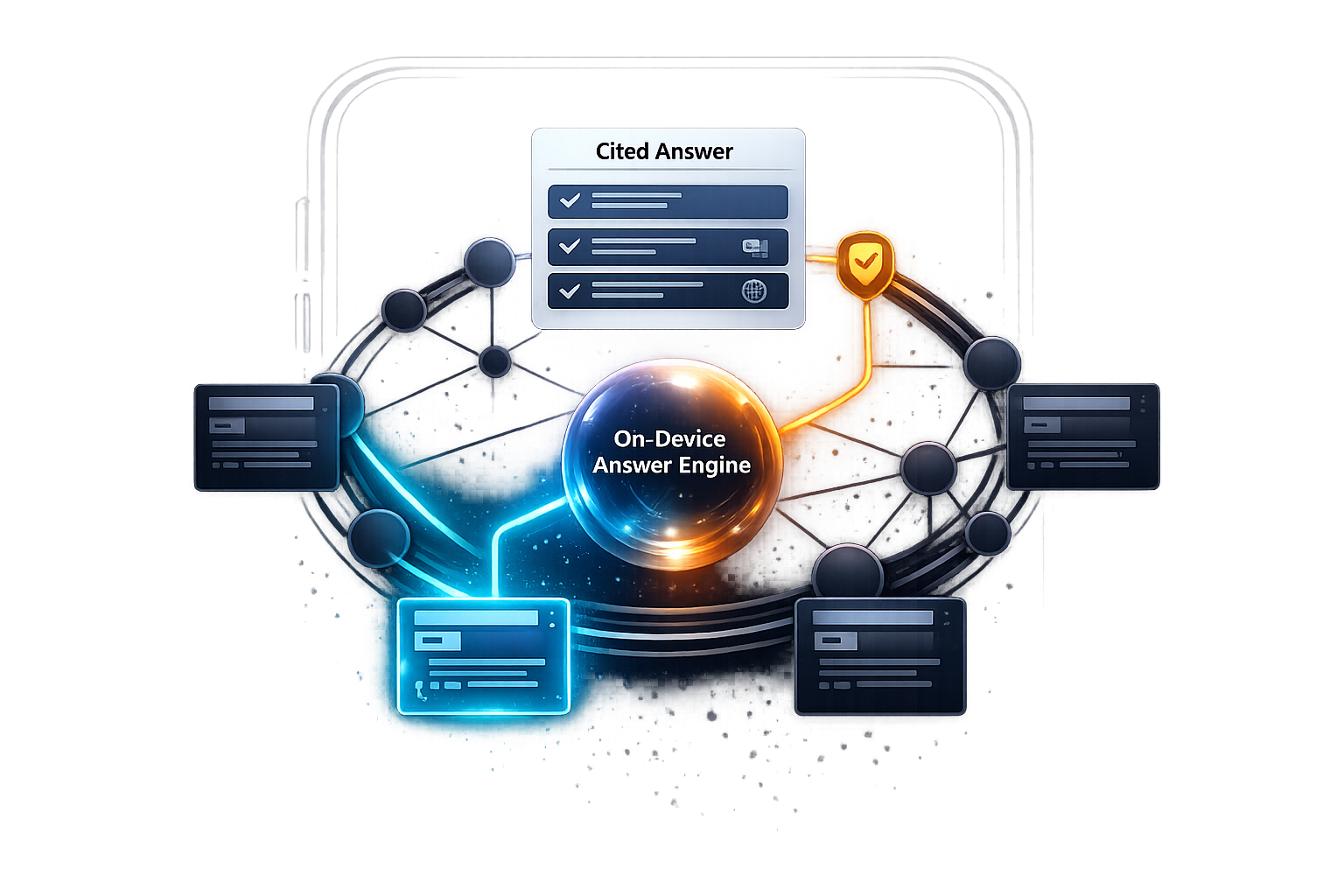
Perplexity AI on the Samsung Galaxy S26: Why On-Device Citations Will Redefine Generative Engine Optimization
Perplexity AI’s rumored Galaxy S26 integration could mainstream cited answers on mobile—raising the bar for Generative Engine Optimization and AI visibility.

Perplexity's Model Council: Harnessing Multiple AI Models for Superior Answers
How to use Perplexity’s Model Council to improve answer quality, citations, and AI Visibility—step-by-step prompts, evaluation, and troubleshooting for GEO.