ChatGPT Optimization in 2026: A Working Checklist for Getting Your Brand Cited, Not Just Ranked
How ChatGPT retrieves and cites sources in July 2026, with a sourced Generative Engine Optimization checklist covering crawler access, extractable answers, entity signals, and measurement.
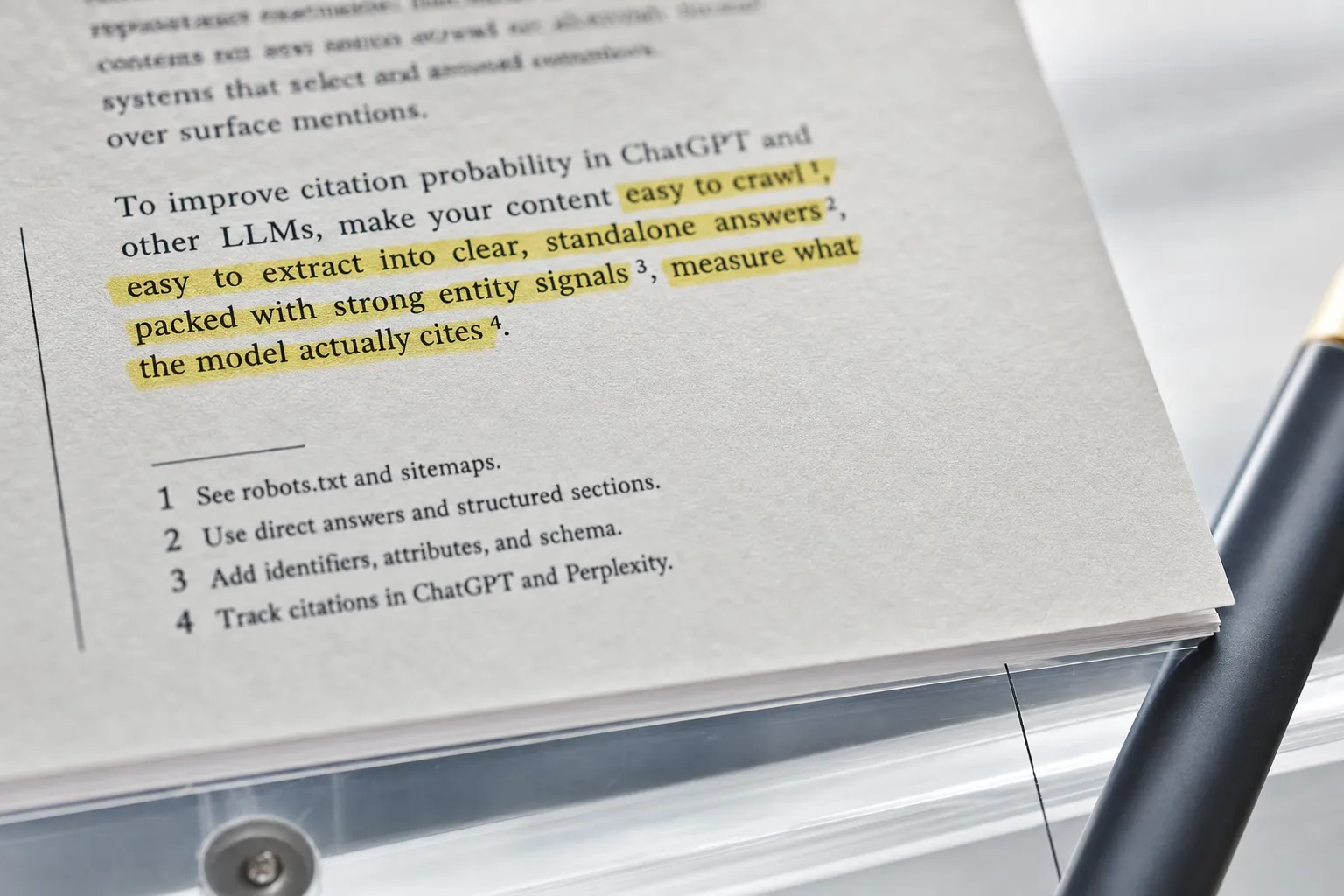
ChatGPT optimization in 2026 is mostly a retrieval problem, not a reputation project: when OpenAI's search crawler can fetch your pages and lift a self-contained answer from them, citations can move in weeks. That is an editorial claim about how the retrieval layer works, not a measured benchmark. The scale stopped being niche a while ago. OpenAI reported 800 million weekly ChatGPT users at DevDay in October 2025, users send more than 2.5 billion prompts a day, and since July 9, 2026 those prompts run on GPT-5.6.
Most of what ranks for this query was written for a different product. The top results lean almost entirely on off-page reputation, cite little that is newer than 2025, and skip the crawler layer completely. What follows is how ChatGPT selects sources today, the ten checklist items that influence selection, and how to tell whether any of it worked.
What is ChatGPT optimization?
ChatGPT optimization is the work of making a brand and its pages easy for ChatGPT to retrieve, extract, and cite in answers. It is a subset of Generative Engine Optimization (GEO), which applies the same work across every answer engine, including Perplexity, Gemini, Claude, and Google's AI Overviews.
How ChatGPT decides what to cite in 2026
ChatGPT answers from two places. Training data gives the model its background sense of your brand, and that layer changes slowly. Retrieval is the layer you can work with: when a prompt needs current information, ChatGPT runs a live search, reads a handful of pages, and composes an answer with inline source links.
OpenAI describes the search backend as third-party providers plus content from its own crawl. In practice, a system that historically leaned on Bing's index has been shifting toward OpenAI's own index, built by OAI-SearchBot. Several crawl-log analyses through 2025 and 2026 point the same direction, but OpenAI has not confirmed a full transition, so treat the backend as a hybrid and plan for a black box.
Two numbers reframe the whole discipline. Answer engines cite roughly 2 to 7 domains per response, against the 10 blue links you were used to competing for. And citation does not follow rank: in Semrush's July 2025 study of ChatGPT search behavior, cited pages sat at Google position 21 or worse almost 90 percent of the time. Extractable passages win slots that rankings never could.
ChatGPT Weekly Active Users, Late 2023 to Late 2025
OpenAI-announced milestones only. Aggregators report roughly 900 million weekly users by early 2026 and Sensor Tower estimated 1 billion monthly app users in June 2026, but neither figure has an OpenAI primary source, so this chart stops at the last official number.
The four OpenAI crawlers and what each one controls
OpenAI documents four distinct agents in its crawler and bot documentation, and each answers a different question about your site. The settings are independent, which most teams miss: you can keep your content out of model training while staying fully visible in ChatGPT search.
| Crawler | What it does | robots.txt | What to do |
|---|---|---|---|
| OAI-SearchBot | Builds the index behind ChatGPT search. Sites that block it do not appear in search answers. | Respected. Changes take about 24 hours to affect eligibility. | Allow it. This is the visibility switch. |
| GPTBot | Collects content for training future OpenAI models. | Respected. | Your call. Blocking it does not remove you from ChatGPT search. |
| ChatGPT-User | Fetches a page live when a user asks about it in a conversation. | May not apply, because fetches are user-triggered. | Allow it and keep pages fast. It retrieves what users see quoted. |
| OAI-AdsBot | Validates landing pages submitted for ChatGPT ads. Not used for training. | Respected. | Relevant once you buy ChatGPT ads, a live surface in 2026. |
Cloudflare now blocks AI crawlers by default, and plenty of WAF rules serve 403s to legitimate OpenAI fetches. Check your server logs for OAI-SearchBot and ChatGPT-User hits, then check them against OpenAI's published IP ranges before assuming you are crawlable.
The 2026 ChatGPT optimization checklist
Every item below maps to a mechanism above or a study cited later in this briefing. Together they cover crawler access, extraction, entity signals, and measurement. Work them in order; the first three are the fastest movers because they change what the crawler and the extractor see on the next fetch.
Open the door to the right crawlers
Allow OAI-SearchBot and ChatGPT-User in robots.txt, decide GPTBot separately, and whitelist OpenAI's published IP ranges in your WAF. Search eligibility updates roughly 24 hours after a robots.txt change.
Put the answer in the first 40 to 60 words of each section
Models select passages, not pages. Open every section with a self-contained, direct answer under a question-shaped heading, then add depth below it.
Write passages that carry your brand name
An extracted sentence travels without its page. A line like "Acme cut checkout abandonment 25 percent for Vuori" survives extraction with the brand attached. "Our tool improved conversions" does not.
Add sourced, dated statistics
Concrete numbers are the most consistently cited content trait across the 2025 and 2026 studies. Adding two or three sourced statistics to a key page is the fastest single content change you can make.
Show a real last-updated date, and mean it
Seer Interactive measured 89 percent of AI crawler hits landing on content updated within the last three years. Refresh commercial pages on a cadence matched to how fast the topic actually moves.
Ship intent-matched schema without expecting miracles
Article, FAQPage, HowTo, and Organization markup keep your entities unambiguous. Treat schema as disambiguation rather than a citation unlock: adding it to already-cited pages showed no measurable lift.
Make your entity consistent everywhere ChatGPT looks
Use the same name, description, and category across your site, Wikipedia or Wikidata where warranted, LinkedIn, and review platforms. Brands with G2, Capterra, or Trustpilot profiles see roughly three times more AI citations.
Earn mentions on the surfaces ChatGPT already cites
Wikipedia and Reddit alone account for over a quarter of US ChatGPT citations, LinkedIn became a top-five source this year, and YouTube presence is the strongest single correlate of AI visibility measured to date.
Cover the fan-out, not just the head query
ChatGPT decomposes prompts into sub-questions before it searches. Run your topic through the product, write down the follow-up angles it explores, and build pages that answer each one.
Measure weekly with a fixed prompt set
Baseline 20 to 30 real customer prompts per topic, run them on a schedule, and log brand mentions and cited URLs separately. Re-test after each change instead of trusting your memory of the answers.
What changed since the 2024 playbook
If you last touched this discipline in 2024, the mechanics under half the standard advice have shifted. The table grades each shift by the strength of its evidence, because several load-bearing claims in this space are vendor-reported and deserve the label.
ChatGPT optimization: 2024 assumptions against 2026 reality
| Signal | 2024 assumption | 2026 reality | Evidence status |
|---|---|---|---|
| Where answers come from | Training data; change waits for the next model release | Live retrieval through OpenAI's search crawler plus training data; robots.txt changes affect search eligibility in about 24 hours | OpenAI crawler documentation |
| The search index | Bing rankings decide everything | Hybrid of third-party providers and OpenAI's own growing index; treat it as a black box | OpenAI statement plus crawl-log analyses; full transition unconfirmed |
| Google rank | Citations mirror page-one results | Cited pages ranked at position 21 or worse almost 90 percent of the time | Semrush study, July 2025 |
| Authority signal | Backlinks and Domain Rating | Branded web mentions correlate strongest; backlink count came in last of seven factors | Ahrefs 75,000-brand study, May 2025 |
| The source mix | Stable; audit once a year | Reddit's share collapsed from about 60 percent to 10 percent in two weeks; LinkedIn jumped from 11th to 5th in a quarter | 5W audit Q1 2026, vendor-synthesized |
| llms.txt | Emerging standard, adopt early | Roughly 844,000 sites publish one; no platform has confirmed reading it | Publii census, Oct 2025; John Mueller statement |
For the discipline-wide version of this shift, our Generative Engine Optimization pillar guide covers the same mechanics across every answer engine, not just ChatGPT.
Where ChatGPT citations actually come from
The 5W Citation Source Audit for Q1 2026, which synthesizes datasets from Similarweb, Semrush, Ahrefs, and Profound, puts hard numbers on the source mix. Wikipedia at 13.15 percent and Reddit at 11.97 percent together exceed every traditional media category combined. The Wall Street Journal, the New York Times, and Bloomberg do not appear in the top 20 at all.
Top ChatGPT Citation Sources by Share, United States, Q1 2026
Share of roughly 600,000 US ChatGPT citation events, January to February 2026, measured by Similarweb and synthesized in the 5W Citation Source Audit. Outside Wikipedia and Reddit, no single domain exceeds roughly 3 percent, so the tail is where most brands compete.
The distribution matters as much as the leaders. Because no mid-tail domain clears 3 percent, the realistic goal for most brands is presence across many mid-authority surfaces rather than one flagship placement. That is also why list articles keep earning citations, a dynamic we traced in our briefing on listicles in AI search.
Semrush's 13-week tracking recorded Reddit's share of ChatGPT responses collapsing from roughly 60 percent to 10 percent inside two weeks in September 2025, and 5W measured LinkedIn rising from 11th to 5th in a single quarter. Any source strategy older than a quarter is a guess.
Mentions beat links, and the gap is not close
Ahrefs correlated seven brand factors against AI visibility across 75,000 brands in its May 2025 correlation study. Branded web mentions came out strongest at 0.664, and raw backlink count came in last at 0.218. The study measured Google AI Overviews rather than ChatGPT, so carry the exact figures over with care, but Seer Interactive's ChatGPT-specific work points the same way: presence and coverage correlate with visibility, and link authority barely does.
What Correlates With AI Brand Visibility
Spearman correlation of each factor with brand appearance in Google AI Overviews, across 75,000 brands. Measured on AI Overviews, not ChatGPT; Seer Interactive found the same ordering for ChatGPT mentions, with backlinks at roughly 0.10.
The practical translation: unlinked mentions, co-occurrence with your category terms, and third-party descriptions of your brand now do the work backlinks used to do. Digital PR and community threads have quietly become technical SEO.
The llms.txt question, answered honestly
We generate llms.txt files at Geol.ai, so we would love to tell you the standard is a ranking lever. The evidence says otherwise, and you deserve the evidence. Roughly 844,000 sites had published an llms.txt by late 2025, and OpenAI's bots have been observed fetching the files. But no major platform, OpenAI included, has committed to using them, and Google's John Mueller has stated plainly that no AI system currently consumes llms.txt.
Our stance: publish one if your documentation is deep and the effort is an hour, skip it if it displaces real work, and never confuse it with robots.txt, which OpenAI demonstrably honors and which decides your ChatGPT search eligibility today. If a platform confirms adoption, this file becomes important overnight. Until then it is inexpensive hygiene, nothing more.
Measuring ChatGPT visibility like an operator
The reason to do all of this is traffic quality, and several independent datasets point the same way. Semrush measured ChatGPT visitors converting 4.4 times better than organic search. Microsoft Clarity, across more than 1,200 publisher sites, found LLM-referred visitors signing up at 1.66 percent against 0.15 percent for organic. Adobe's retail data flipped from AI traffic converting 38 percent worse in March 2025 to 42 percent better in March 2026. The honest footnote: at least two e-commerce studies found little or no premium, so treat the multiple as a planning benchmark for high-consideration purchases, not a law of nature.
There is no native AI channel in GA4. ChatGPT visits land in generic referral or stripped direct traffic, and journeys that start in ChatGPT but convert through branded search get attributed to search. Build a custom channel group matching chatgpt.com, perplexity.ai, claude.ai, gemini.google.com, and copilot.microsoft.com, then read the result as a floor.
The loop we run is not complicated. Fix a prompt set of 20 to 30 real customer questions per topic. Run it weekly and log two things separately: whether your brand is mentioned, and which URLs get cited. Make one change at a time, and give each change a four to eight week window before judging it. Do not expect Google's reporting to carry this for you; we covered why its blended AI data leaves publishers guessing in our Search Console briefing, and for tooling options our GEO tools comparison review grades the measurement platforms against each other.
Geol.ai tracks citation share, placement, and brand mentions across ChatGPT, Claude, Perplexity, Gemini, and Grok over time. Mentions follow off-page coverage. Citations follow extraction quality. Diagnose them separately or you will spend a quarter fixing the wrong one.
Key Takeaways
ChatGPT optimization in 2026 is retrieval work: allow OpenAI's search crawler, keep pages fetchable, and structure answers for extraction, and you can enter cited answers without moving your Google rankings.
Citations ignore rank: ChatGPT cited pages sitting at Google position 21 or worse almost 90 percent of the time in a large July 2025 retrieval study, so extractable passages beat position.
Brand mentions outperform backlinks in every correlation study that tested both. Wikipedia, Reddit, YouTube, and review platforms are where the citation mass sits.
robots.txt is honored and changes search eligibility in about a day. llms.txt is widely published, but no platform has confirmed reading it.
The source mix reshuffles monthly, so measurement is a weekly loop with a fixed prompt set, not an annual audit.
Frequently Asked Questions About ChatGPT Optimization

Founder of Geol.ai
Senior builder at the intersection of AI, search, and blockchain. I design and ship agentic systems that automate complex business workflows. On the search side, I’m at the forefront of GEO/AEO (AI SEO), where retrieval, structured data, and entity authority map directly to AI answers and revenue. I’ve authored a whitepaper on this space and road-test ideas currently in production. On the infrastructure side, I integrate LLM pipelines (RAG, vector search, tool calling), data connectors (CRM/ERP/Ads), and observability so teams can trust automation at scale. In crypto, I implement alternative payment rails (on-chain + off-ramp orchestration, stable-value flows, compliance gating) to reduce fees and settlement times versus traditional processors and legacy financial institutions. A true Bitcoin treasury advocate. 18+ years of web dev, SEO, and PPC give me the full stack—from growth strategy to code. I’m hands-on (Vibe coding on Replit/Codex/Cursor) and pragmatic: ship fast, measure impact, iterate. Focus areas: AI workflow automation • GEO/AEO strategy • AI content/retrieval architecture • Data pipelines • On-chain payments • Product-led growth for AI systems Let’s talk if you want: to automate a revenue workflow, make your site/brand “answer-ready” for AI, or stand up crypto payments without breaking compliance or UX.
Related Articles
OpenAI Launches GPT-5.6 and ChatGPT Work: What Multi-Agent Modes Change for AI Search Teams
Analysis of how GPT-5.6 and ChatGPT Work multi-agent modes reshape AI search workflows, source verification, and Citation Confidence for research teams.
OpenAI is turning ChatGPT into a cited research engine for clinicians
OpenAI is turning ChatGPT into a cited research engine for clinicians — analysis and GEO implications for AI search.