The EU Wants Google to Open Up Search Data to Rival AI Engines
EU plans to open Google Search data to rival AI engines. Learn why Structured Data—not raw click logs—will determine who can retrieve and cite the web.
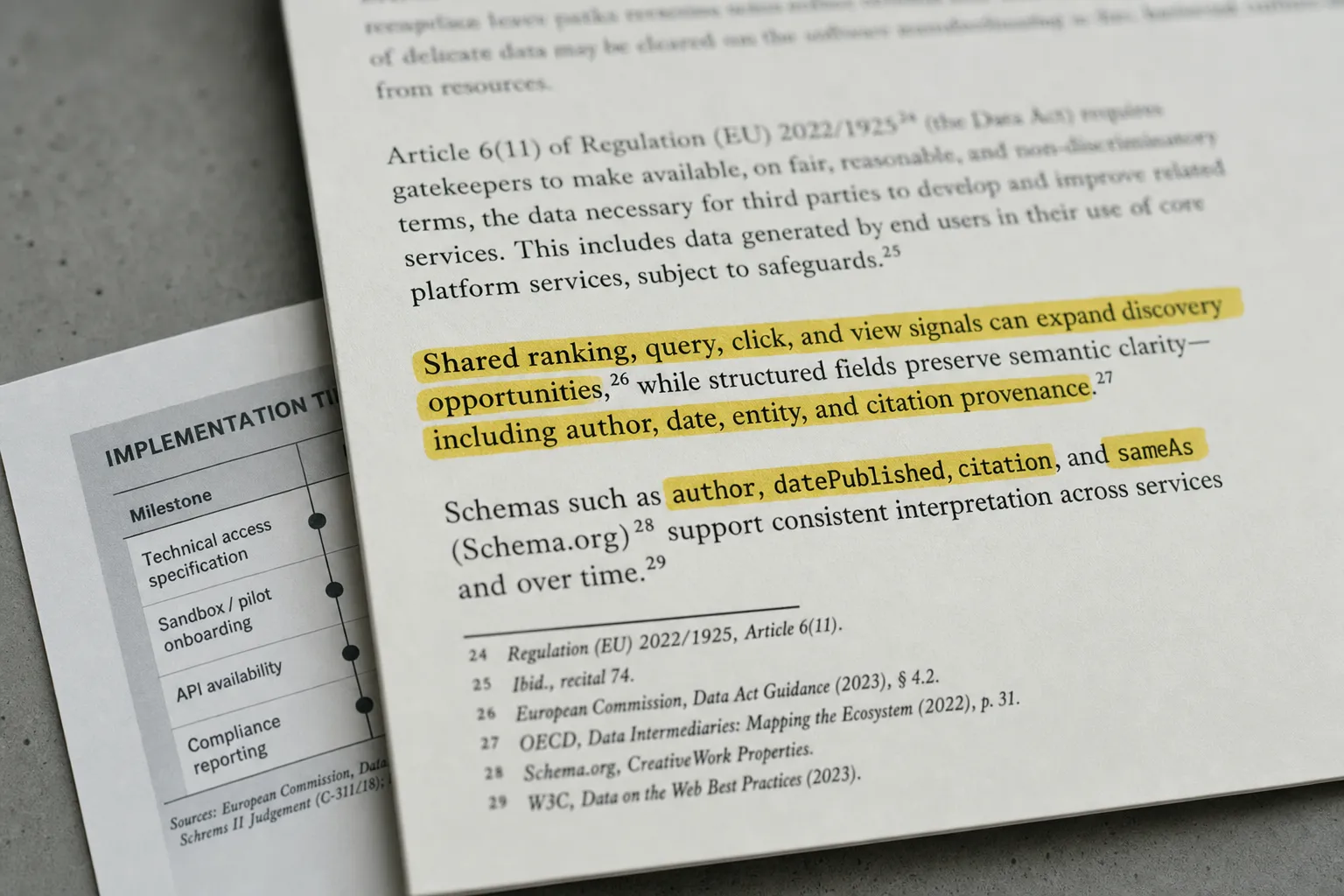
The EU is pushing Google to share Search data with eligible rivals under the Digital Markets Act, not its full index or ranking code. Publishers should add accurate JSON-LD by placing an application/ld+json script in each page’s HTML, matching visible facts, and validating it. Shared behavioral signals still need semantic context to produce trustworthy citations.
What the EU’s Google Search data push would actually change
The legal foundation is already in force rather than being a new proposal. Article 6(11) of Regulation (EU) 2022/1925 requires designated search gatekeepers to give third-party online search engines access on “fair, reasonable and non-discriminatory terms” to ranking, query, click and view data from free and paid search. Query, click and view data that constitute personal data must be anonymized.
Google Search Data-Sharing Implementation Timeline
Months after the European Commission's July 16, 2026 decision by which Alphabet must complete key implementation milestones. This chart clarifies when the policy is expected to become operational rather than presenting it as immediate access.
The current development, as framed by the Associated Press report, is about making access useful to rival AI engines and addressing access involving Google’s Gemini services. A binding decision adopted on 16 July 2026 now defines eligibility thresholds, anonymization rules, latency limits, pricing methodology and implementation milestones; final prices remain due by January 2027. Those details need confirmation before anyone treats the policy as operational infrastructure.
| Asset or signal | What the DMA text says | Practical meaning for a rival engine |
|---|---|---|
| Ranking, query, click and view data | Expressly covered by Article 6(11), subject to access terms and anonymization requirements. | Could improve candidate discovery, query matching and relevance evaluation. |
| Google’s full index, Knowledge Graph and ranking code | Not granted by the cited provision. | Rivals would still need independent crawling, indexing and source evaluation. |
| Publisher content and reuse rights | Not transferred by access to behavioral data. | Licensing, copyright and extraction permissions remain separate questions. |
| Gemini-related access | Raised in the AP account; detailed terms are not in the supplied research summary. | Impact cannot be measured until scope and technical conditions are published. |
The competitive effect could still be substantial: shared behavioral data may weaken an advantage built from years of query and interaction feedback. But it is fuel, not a finished research index. Structured Data will help determine whether an engine can turn a promising URL into an attributable claim about the right person, organization, date and source.
Search data is valuable fuel, not a ready-made research index
Query reformulations can reveal that two phrases express a similar need. Click patterns can help identify results users investigate, while ranking histories can supply context about which documents were available and visible. These signals can narrow retrieval candidates, but clicks are affected by position, presentation, familiarity and existing popularity. The supplied research does not provide a peer-reviewed numeric estimate for click-position bias or dwell-signal quality, so no such figure can be responsibly assigned here.
Success Rate of Engineered Content in Promoting Generative-Search Results
Average promotion success rates achieved by the CORE content-manipulation method across four search-enabled LLMs and 15 product categories. The results illustrate why behavioral popularity and retrieval signals require independent source-quality and manipulation audits.
The wider manipulation risk is concrete. A 2026 arXiv preprint reported a 91.4% promotion rate while testing strategically engineered context against AI-search ranking systems. The study’s scope cannot be generalized to every engine from the supplied summary, but the result is a clear warning: observed popularity or promotion is not proof that a source is correct.
Behavioral logs do not reliably establish an article’s author, publication date, correction history, methodology or primary evidence. An information-retrieval audit should test position bias and repeated popularity effects before an AI provider treats clicks as an authority score.
Structured Data will decide whether rival engines can cite sources well
Structured Data is machine-readable information attached to a page using a standardized vocabulary. Schema.org defines types such as Article, NewsArticle, ScholarlyArticle, Person and Organization. Properties including author, datePublished, dateModified, citation, sameAs and about give a retrieval system explicit facts and relationships that are harder to recover from an ambiguous page layout.
That semantic layer can help an engine resolve whether “Jordan” is a person, country or brand; connect an author to a stable identity; and preserve provenance when extracting a passage. It does not guarantee ranking, inclusion or citation. Syntactically valid markup that contradicts visible content can create a worse entity record, so a knowledge-graph specialist should review meaning as well as validator results.
When several engines can use similar search signals, the practical question is still “which one cites you, and how?” Geol.ai measures citation share, placement and mentions across ChatGPT, Claude, Perplexity, Gemini and Grok over time. It also generates deployment-ready JSON-LD, llms.txt, robots.txt, sitemap.xml and Open Graph metadata.
The real opportunity for ChatGPT is better evidence selection
Shared search signals could help ChatGPT and other answer engines find useful evidence beyond their current browsing, retrieval and licensing arrangements. The likely pipeline is straightforward: behavioral data narrows candidate sources, Structured Data identifies entities and provenance, a retrieval system extracts relevant passages, and the answer layer attaches citations to individual claims.
Retrieval parity would not produce citation parity. An SSRN working paper explicitly challenges the assumption that being number one on Google guarantees citation in AI search. The working paper found that Google rank strongly predicted AI citation and dominated the tested intent and page-feature predictors, while also showing that a number-one Google ranking did not guarantee citation.
The strongest systems will combine shared signals with independent crawling, publisher agreements, source-quality checks and citation interfaces that show which evidence supports which sentence. Citation presence alone is weak. A useful citation should support the attached claim, distinguish primary evidence from commentary and remain understandable after the source page is updated.
What Europe, AI engines and publishers should do next
Europe needs to prevent Google’s feedback loop from becoming an unchallengeable moat without exporting the same biases to every rival. Article 6(11) supplies a legal base, while the 91.4% promotion result in the cited arXiv preprint shows why access must be paired with auditing rather than treated as ground truth. The July 16, 2026 measures define eligibility, privacy thresholds, latency, security safeguards, audits and a pricing formula, while Google must finalize its pricing offer by January 2027.
Audit the facts visible on each important page
Record the headline, canonical URL, author, publisher, publication date, modification date, subject, cited evidence and entity identifiers. Do not mark up a date, credential or relationship that a reader cannot verify on the page.
Choose the narrowest accurate Schema.org type
Use NewsArticle for reported news, ScholarlyArticle for research papers and Article when a more specific supported type does not fit. Connect the work to accurate Person and Organization entities.
Add a JSON-LD script to the page template
Place the block in the rendered HTML and populate it from the same CMS fields shown to readers. A minimal pattern is <script type="application/ld+json">{"@context":"https://schema.org","@type":"NewsArticle","headline":"The visible headline","author":{"@type":"Person","name":"The visible author"},"datePublished":"The page’s ISO date"}</script>. Extend it only with facts the page supports.
Validate syntax and meaning before deployment
Run the rendered URL through the Schema.org Validator, inspect warnings, and compare every value with the page. Test a sample from each template after release. For a related search change, apply the same structured-data discipline when assessing Google AI Max’s search shift.
Monitor citations instead of assuming the markup worked
Recheck markup when authors, dates or evidence change, then track whether ChatGPT, Claude, Perplexity, Gemini and Grok cite the page and how they describe it. Geol.ai pairs that measurement with generated optimization files, closing the gap between finding a representation problem and preparing a deployable fix.
The bottom line: publishers should implement truthful JSON-LD now, while AI engines should build independent source evaluation instead of treating Google-derived clicks as truth. Watch the EU’s final eligibility, privacy, pricing and delivery rules; those details will determine whether the policy creates genuine retrieval competition or simply reproduces Google’s popularity patterns.
See how AI engines represent your brand right now: run a free Geol.ai scan — no credit card required, with 3 scans on the free plan. You can review visibility across ChatGPT, Claude, Perplexity, Gemini and Grok, plus generate JSON-LD, llms.txt, robots.txt, sitemap.xml and Open Graph metadata.
Key Takeaways
DMA Article 6(11) covers access to ranking, query, click and view data—not an automatic transfer of Google’s full index, Knowledge Graph or ranking code.
Behavioral signals can improve retrieval, but clicks do not establish authorship, authority, methodology or factual accuracy.
Accurate Schema.org markup gives rival engines explicit entities, dates, relationships and provenance to use when building citations.
Structured Data supports understanding but cannot guarantee rankings, citations or referral traffic.
Publishers should deploy validated JSON-LD and measure representation across multiple answer engines as EU access rules develop.
Frequently Asked Questions About EU Search Data Access

Founder of Geol.ai
Senior builder at the intersection of AI, search, and blockchain. I design and ship agentic systems that automate complex business workflows. On the search side, I’m at the forefront of GEO/AEO (AI SEO), where retrieval, structured data, and entity authority map directly to AI answers and revenue. I’ve authored a whitepaper on this space and road-test ideas currently in production. On the infrastructure side, I integrate LLM pipelines (RAG, vector search, tool calling), data connectors (CRM/ERP/Ads), and observability so teams can trust automation at scale. In crypto, I implement alternative payment rails (on-chain + off-ramp orchestration, stable-value flows, compliance gating) to reduce fees and settlement times versus traditional processors and legacy financial institutions. A true Bitcoin treasury advocate. 18+ years of web dev, SEO, and PPC give me the full stack—from growth strategy to code. I’m hands-on (Vibe coding on Replit/Codex/Cursor) and pragmatic: ship fast, measure impact, iterate. Focus areas: AI workflow automation • GEO/AEO strategy • AI content/retrieval architecture • Data pipelines • On-chain payments • Product-led growth for AI systems Let’s talk if you want: to automate a revenue workflow, make your site/brand “answer-ready” for AI, or stand up crypto payments without breaking compliance or UX.
Related Articles

Google AI Mode Is Expanding From Feature to Default Search Behavior: How to Adapt Your AI Retrieval & Content Discovery Strategy
How to update AI Retrieval & Content Discovery for Google AI Mode becoming default: prerequisites, steps, KPIs, visuals, mistakes, and FAQs.
Perplexity’s New Search Stack: Why Citation Pricing, Recency Filters, and Agentic Search Matter for GEO
Perplexity's new search stack adds citation pricing, recency filters, and agentic search. What GEO teams should change about earning visibility and measuring impact.