What a GEO Platform Actually Costs in 2026: The Pricing Guide Vendors Won't Write
Real published prices for the Generative Engine Optimization tool market in 2026: self-serve entry tiers, enterprise quote walls, metering math, and honest tool-versus-consultant economics.
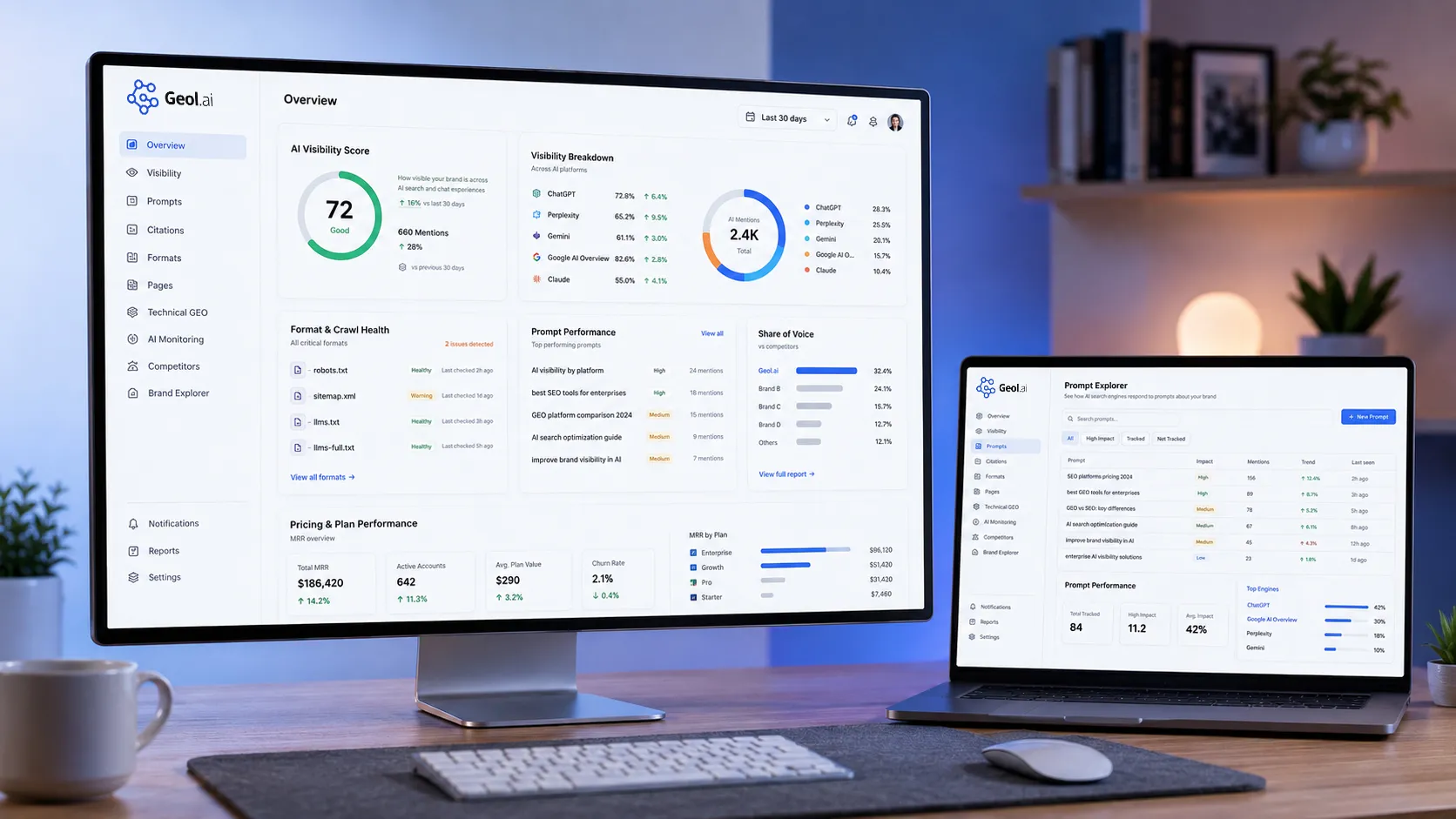
A workable GEO monitoring budget in 2026 starts near $20 a month, the mid-market runs $250 to $800, and consultants who publish their own rates start around $3,000 a month: that is a map of published price pages, not a benchmark of outcomes. Nobody has independently established which option earns more AI citations per dollar, and this guide will not pretend otherwise.
The numbers come from a pass over more than two dozen vendor pricing pages on August 14, 2026. Nine self-serve trackers publish entry tiers between $20 and $100 a month: eight third parties plus our own platform, which sits in the price map labeled as ours. Five mid-market platforms publish $250 to $800, and every true enterprise tier in the set is quote-only, with just three vendors publishing so much as a floor.
The pages that rank for these queries are written by the vendors themselves, and pricing is the one axis where a vendor gains nothing by being thorough. This piece covers the same tool landscape, organized around what things cost, what meters the bill, and when hiring a human beats buying software.
What you are actually buying
A GEO platform (also sold as AEO software or an AI visibility tool) monitors how AI answer engines such as ChatGPT, Perplexity, Gemini, and Google AI Overviews mention, cite, and describe a brand across a set of tracked prompts, then reports citation share against competitors.
Some platforms add fix-side output: structured data, content recommendations, crawler configuration. The wider discipline is mapped in the Generative Engine Optimization pillar guide; this article is only about the cost side.
Every "Best GEO Tools" Guide Is Written by Someone Selling One
Pull the five most-visible "best AEO tools" guides and the pattern is visible in one scroll: four are published by vendors that rank their own product first, and the fifth is an affiliate roundup that has not been updated since November 2025. The most cited of them, a 19-tool ranking Profound published on July 28, 2026, contains zero dollar figures.
The mechanics repeat across the set. Buying-criteria sections are written so the author's feature set scores perfectly, and rivals get a standard weaknesses heading while the author's own entry gets a softened one. One suite vendor ranks itself first of nine and recommends itself in three of its five FAQ answers; another vendor's product blog ranks its own tracker first of ten with no disclosure; a third ranks itself first of seventeen. None of this is illegal. It is just not buyer-side research, and it prices nothing.
Geol.ai, this briefing's publisher, measures how AI engines cite and represent brands versus their competitors, which makes this guide exactly as conflicted as the rest. The difference is format: every number below carries a source and a date, vendors that publish nothing are labeled as such, and our own product appears in the map below, labeled as ours everywhere it shows up.
The Self-Serve Price Map: $20 to $100 a Month Buys Real Tracking
Nine trackers publish self-serve entry tiers, and on August 14, 2026 they span $20 to $100 a month; eight are third parties, and our own platform appears among them below, labeled as ours. The capacity behind the sticker varies by an order of magnitude: 15 tracked prompts at the low end, a claimed 500 at another vendor, engine coverage from one answer engine to eight.
Self-serve GEO trackers: published entry tiers (August 14, 2026)
| Tool | Entry price (USD/mo) | Prompts at entry | Engines included | Refresh | Evidence status |
|---|---|---|---|---|---|
| Rankscale | $20 (Essentials) | credit-metered, allotment not published | All majors incl. Claude, Grok, DeepSeek | Configurable, hourly to monthly | Vendor pricing page, 2026-08-14 |
| Geol.ai (ours) | $29 (Growth; $24 annual) | 15 | 4 (ChatGPT, AI Mode, AI Overviews, Perplexity); 8 at Scale | Weekly | Ours; our published pricing page, 2026-08-14. Free plan (3 scans, no card) below the paid tiers. |
| Otterly | $29 (Lite) | 15 | 4 (ChatGPT, AI Overviews, Perplexity, Copilot) | Daily | Vendor pricing page, 2026-08-14 |
| Ayzeo | $31 (Starter, annual billing) | 20 | 2 (ChatGPT, AI Overviews) | Not published | Vendor pricing page, 2026-08-14 |
| Knowatoa | $59 (Starter) | Not published | 3 AI search services | Weekly digest | Vendor pricing page, 2026-08-14 |
| LLMrefs | $79 (All in One, "limited time") | 500 (keyword fan-out method) | All engines, no per-engine fees | Weekly | Vendor pricing page, 2026-08-14 |
| Peec AI | $80 (Starter, annual billing) | 50 | Choice of 3 models (11 at custom tier) | Daily | Vendor pricing page, 2026-08-14 |
| Profound | $99 (Starter, annual billing) | 50 (1,500 responses/mo) | ChatGPT only | Daily | Page obfuscates the digits; $99 cross-checked against three secondary sources, 2026-08-14 |
| Trakkr | $100 (Growth) | 50 per brand | All 8 models, no per-engine fees | Daily | Vendor pricing page, 2026-08-14 |
Cheapest advertised monthly price, dedicated GEO trackers (USD)
Our own platform is included and labeled as ours; every other bar is a third party. Billing bases differ: Ayzeo, Peec, Profound, and Trakkr show annual-contract per-month rates while Otterly, Knowatoa, and ours are month-to-month, and the $20 credit-metered tier does not publish its allotment. Sticker prices say nothing about capacity per dollar, and one figure had to be recovered from secondary sources because the vendor animates its own digits.
Since it sits in the table: Geol.ai is ours, so here is the case in one breath, limited to what is shipped. It measures how AI engines cite and represent a brand versus its competitors over time, it pairs that measurement with generated fixes (JSON-LD structured data, llms.txt, robots.txt, sitemap.xml, and Open Graph metadata), and the free plan includes 3 scans with no credit card, so the baseline costs nothing. That is the whole pitch this guide will make for it.
Climbing the tiers mostly buys prompts, engines, and workspaces: the mid tiers across the eight third-party tools run $124 to $489. Price says nothing about measurement quality, which is a separate axis; for that comparison see our GEO tools comparison review.
Mid-Market Tiers Start at $250, and the Enterprise Quote Wall Is Nearly Total
Of the nine mid-market and enterprise GEO platforms this guide checked on August 14, 2026, five publish an entry price and four publish nothing. The published entries run $250 to $800 a month, and all nine gate the real enterprise tier behind a custom quote.
| Platform | Published entry price | What it meters | Evidence status |
|---|---|---|---|
| Scrunch AI | $250/mo (Core) | 125 prompts, 5 site audits, 4 LLMs, 5 seats | Vendor pricing page, 2026-08-14 |
| AthenaHQ | $295/mo (Starter) | 3,600 credits/mo, 1 credit = 1 AI response, 9 models | Vendor pricing page, 2026-08-14 |
| Goodie | $399/mo (Explorer) | 100 prompts, 3,000 responses/mo, 3 models, daily | Vendor pricing page, 2026-08-14 |
| Gauge | $599/mo (Growth) | 600 prompts daily across 6 platforms (108,000 answers/mo) | Vendor pricing page, 2026-08-14 |
| Evertune | $800/mo (Pro) | 100,000 prompts across 11 models, cadence selectable | Vendor pricing page, 2026-08-14 |
| Daydream | None: waitlist form | Not disclosed | Pricing URL renders a lead-capture form, 2026-08-14 |
| Bluefish AI | None: no pricing page | Not disclosed | Pricing URL 404s; demo-only CTAs, 2026-08-14 |
| Brandlight | None: no pricing page | Not disclosed | Site map has no pricing route; enterprise-only positioning, 2026-08-14 |
| xfunnel | $0 one-time audit only | Recurring product is quote-only | Vendor pricing page, 2026-08-14 |
What the enterprise quote wall is selling is mostly governance. SOC 2 claims appear on three of the nine (AthenaHQ, Goodie at its enterprise tier, and Brandlight, which leads with SOC 2 Type 2). Single sign-on is gated to the custom tier at nearly every vendor, and multi-region tracking, BI connectors, and audit logs follow the same pattern. If your procurement checklist needs those rows, the quote wall is where you will live. Among the self-serve trackers, only three publish an enterprise floor: $1,000 to $6,000 a month.
The category is also consolidating under buyers' feet. Sitecore announced its acquisition of Scrunch AI on June 3, 2026, and xfunnel's site now carries a banner announcing a pending acquisition by HubSpot. A point tool you shortlist today can be a suite feature with different packaging by renewal. That argues for month-to-month terms this year, not for avoiding the category.
The Metering Math: Prompts Times Engines Times Cadence Is the Real Price
No two vendors meter the same way, so the only comparable number is the one none of them prints: cost per tracked answer, which is prompts times engines times refreshes. The sticker price is an opening bid; the metering math plus the add-on sheet is the contract.
Worked example, from published add-on rates: Ayzeo's $31 entry tier covers 20 prompts on two engines. Track 40 prompts across four engines and the bill becomes $31 plus two $15 prompt packs plus two extra engines at $29 each: $119 a month, 3.8 times the sticker. Per-engine charges are the exception (six of the eight bundle engines free), but the two vendors that charge them are also two of the three cheapest stickers on the chart above. That is a pricing strategy, not a coincidence.
Otterly runs the same play more gently: four engines are included at $29, while Claude, Gemini, and Google AI Mode are paid add-ons and extra prompts come in $99 packs of 100. Credit systems are the third metering model: Rankscale charges roughly a quarter credit per engine query, and AthenaHQ counts one credit per AI response. Credits are flexible and honest, but they make the sticker nearly meaningless without arithmetic.
Half the entry prices in this guide are annual-contract rates displayed as monthly numbers, and month-to-month billing typically runs 15 to 25 percent higher. Before comparing two tools, put both on the same billing basis; the ranking can flip.
When you normalize, cheap and expensive swap places. The $99 ChatGPT-only starter in the table above works out to roughly 6.6 cents per response at its published 1,500 responses a month. The $599 mid-market tier running 600 prompts daily across six platforms works out to about half a cent per answer, arithmetic its vendor prints because it wins. Expensive per month and cheap per answer are frequently the same product.
Divide the monthly price by prompts times engines times refreshes per month. It is the one number that makes a $29 tool and a $599 tool comparable, and vendors will not print it for you. If a sales call cannot say how many answers your money buys, that is your answer.
Your SEO Suite May Already Include the Tracking You Were About to Buy
The cheapest ongoing AI tracking in the market is not a GEO startup but the incumbent suites: $50 a month buys a standalone tracker from one of them, and the big SEO platforms bundle prompt tracking into base plans from $99 to $129. If your team already pays for one, check what is included before buying anything new.
| Product | Monthly cost | AI tracking included | Refresh |
|---|---|---|---|
| HubSpot AEO | $50, standalone, no suite required | 3 engines, competitor compare | Weekly |
| Surfer Standard | $99 (annual billing) | 25 prompts, ChatGPT (daily multi-engine from $182) | Weekly at this tier |
| Semrush AI Visibility Toolkit | $99, standalone | 25 tracked prompts, 1 domain | Daily |
| SE Ranking Core | $129 monthly ($103.20 annual) | 100 prompts/day across 5 LLMs | Daily |
| Ahrefs Lite | $129 | Brand Radar included, 5 tracked AI prompts | Not published |
Cheapest published route to AI visibility tracking via incumbent suites (USD/mo)
Not like-for-like: two of these are standalone AI-only products and three are full SEO suites that include AI tracking, prompt allowances range from 5 to 100 per day, refresh cadence splits weekly versus daily, and two figures are annual-billing monthly equivalents. Enterprise suites with quote-only AI add-ons are excluded because they publish no price at all.
Two caveats keep this from being a free lunch. The allowances are thin at the bottom: 5 tracked prompts is a smoke alarm, not a measurement program. And the enterprise wings of the incumbent world (Conductor, seoClarity's AI product, Similarweb's AI package) are exactly as quote-only as the dedicated platforms, with one published base floor starting at $2,500 a month. The sequencing for a suite customer: run the free one-time checks (one incumbent gives away a single-shot grader), turn on whatever prompt tracking your plan includes, and only then decide whether a dedicated tool earns its keep.
Consultants Publish Rate Cards; the Industry Publishes Guesses
Direct answer to the head-to-head question: self-serve software runs $20 to $800 a month at published rates; consultants and agencies that publish their own pricing start at roughly $3,000 a month and run past $25,000. Between those facts sits a vacuum: no independent survey of GEO service pricing exists as of August 2026.
GEO consulting: rates the providers publish themselves
| Provider | Published rate | What it covers | Evidence status |
|---|---|---|---|
| DerivateX | $3,500/mo, 90-day pilot | Entity mapping, off-site citations, weekly reporting | First-party rate card, updated Jul 6, 2026 |
| The Remarkable Agency | From $3,000/mo | Scoped retainers, citation baseline first | First-party page, as scraped 2026-08-14 |
| RevvGrowth | $3,000 to $25,000+/mo | Tiered GEO programs, content through enterprise | First-party rate card, as scraped 2026-08-14 |
| First Page Sage | $2,000 to $12,000/mo across 3 tiers | List placements, authority articles, PR, directories | First-party rate card, updated Nov 14, 2025 |
Treat everything beyond first-party rate cards with suspicion. The aggregator roundups claiming GEO retainers span $1,500 to $50,000 a month disclose no respondent sample and no methodology, and most are published by agencies pricing their own market. One agency puts it plainly in its own buying guide: "any ranking you find reflects who paid or who pitched." The nearest real survey data is Ahrefs' SEO pricing survey of 439 providers, which found an average agency retainer of $3,209 a month and a most-common band of $501 to $1,000. It was fielded in 2023, updated in August 2024, and it measures SEO, not GEO. GEO retainers price at a visible premium over that band, on assertion rather than audited demand.
The decision logic follows the budget. Below roughly $3,000 a month of total budget, a tool plus in-house execution is the only option with published economics; a thin retainer at that level buys reporting, not work. Above it, the question is not tool versus consultant but measurement versus execution: buy software when you cannot see what AI engines say about you, and buy people when you know what needs fixing and lack the hands.
The "Real Prompt Data" War Is a Pricing War
The loudest feature fight in the category is over whose tracked prompts are "real," and it is best read as a pricing argument. There is no independent evidence that either camp's data lineage produces better visibility outcomes, and the premium tiers are priced as if there were.
Camp one licenses opt-in consumer panels of actual AI conversations and statistically models them up to population scale; the loudest vendor in this camp has escalated its dataset claim across its own pages from 400 million to 1.5 billion to 1.9 billion prompts, the last figure appearing in the same July 28, 2026 guide that publishes no prices, with no auditable methodology anywhere in the chain. Camp two derives prompts from search behavior: Ahrefs builds its tracked prompts from People Also Ask questions and its keyword database, and argues search-grounded beats guessed. A third camp generates synthetic prompts from personas (Conductor's approach), and one suite vendor sidesteps the fight by telling customers to curate their own sample.
Both camps claim the word "real" and both have grown their headline numbers faster than their published methodology. The buyer-side reading: at $29 to $100 a month you are buying a sampling strategy either way, and prompt selection you control matters more than provenance you cannot audit. Our analysis of why LLMs cite pages that are not top-ranked in Google covers why the citation layer behaves independently of rankings in the first place.
Refresh Cadence: What Daily Tracking Buys, and What No Tracker Can Fix
Daily refresh is the most-marketed line item on every pricing page, and the volatility evidence supports a cheaper conclusion: weekly, aggregated across multiple runs, is enough for most small teams. The engines churn citations constantly, but most of that churn is sampling noise.
The churn is real. Sistrix measured 82,619 prompts over 17 weeks across six countries (published May 1, 2026): ChatGPT replaces about 74 percent of its cited sources week over week, Google AI Mode about 56 percent, and Google AI Overviews about 5 percent, though that average hides a split: 53 percent of AI Overviews prompts changed nothing in 17 weeks. The same study found news citations almost never persist while evergreen pages survive, which is itself a budgeting instruction.
Weekly citation source replacement by AI platform (%)
One vendor-published study (82,619 prompts, 17 weeks, 6 countries, May 2026); the publisher sells SEO tooling. The AI Overviews average masks a bimodal split in which 53% of prompts changed zero sources across the window. Source churn is not the same as brand-mention churn, and none of this measures whether daily observation changes outcomes.
The counterweight is a 90-day noise-versus-drift study published July 17, 2026 by MaxAEO, itself a monitoring vendor: running the same prompt twice in the same minute matched top-3 brand sets only about 46 percent of the time, so a single daily check mostly samples randomness. Noise-adjusted, about 22 percent of a top-5 list genuinely turns over per week, and the top recommendation truly changes roughly every 10 to 11 days. The cadence that follows: weekly aggregated tracking for most brands; daily for live-retrieval engines like Perplexity and AI Mode, active reputation incidents, and the weeks after model releases (July 2026 alone brought new flagship defaults from OpenAI and Anthropic). Vendors selling continuous monitoring read the same numbers as "daily or meaningless." Both camps sell tracking; the disagreement is the finding. Weekly is also the cadence our own pricing meters: every Geol.ai monitoring tier, from the $29 Growth plan up, runs on a weekly refresh.
Whenever an AI engine reshapes how it selects and cites sources, the practical question is "does it still cite you?" Geol.ai tracks citation share across ChatGPT, Claude, Perplexity, Gemini, and Grok over time, so a shift like this shows up as a number you can watch rather than a surprise. It also generates the JSON-LD, llms.txt, robots.txt, sitemap, and Open Graph metadata that make pages easier for those engines to quote.
The larger budgeting truth: a dashboard, at any refresh rate, changes nothing by itself. Citations move when content answers the tracked prompts, when structured data makes pages parseable, and when crawlers can reach you at all. That last one now has a deadline: Cloudflare's content-signals defaults, announced July 1, 2026, will block AI training and agent crawlers by default on ad-supported pages for new domains from September 15, 2026, which can silently remove a site from the answers a tracker is watching. Reserve budget for the fix side: structuring content so engines can quote it, schema, crawler access, and freshness. A tracker that reports zero citations forever is working correctly; it is your content that is not.
How to Buy: Match the Criteria to Your Budget, Not the Demo
The evaluation criteria worth paying for change with buyer size, so weight them before the demos. SMB under $100 a month: prompts per dollar, the two or three engines your buyers actually use, no per-engine surcharges; weekly cadence is fine. Mid-market at $250 to $800: multi-model coverage, personas and markets, API or BI export, sentiment beyond raw mentions. Agencies: per-client workspaces and white-label economics, where published add-ons start around $49 per brand. Enterprise: SOC 2, single sign-on, audit logs, multi-region tracking. That is what the quote is pricing.
Define your prompt set before you shop
Pull 25 to 50 questions from real sales calls, support tickets, and onboarding conversations, and write them down before any demo. This is the asset every tool meters you on, and it stops a vendor's suggested prompt list from defining your success criteria.
Baseline for free
Run the free one-time graders and free tiers before paying anything; Geol.ai's free plan includes 3 scans with no credit card. A snapshot is not a trend, but it tells you whether AI engines mention you at all, which determines whether you need measurement or remediation first.
Shortlist two tools inside your band and run them in parallel
Thirty days, same prompt set in both. Disagreement between two trackers on the same prompts is itself information about how much noise you would be paying to watch.
Normalize to cost per tracked answer
Prompts times engines times refreshes per month, divided into price. Rank the shortlist on that number, not the sticker.
Price the add-on sheet against real usage
Extra engines, prompt packs, seats, markets, month-to-month versus annual billing. Compute the exit cost too: what happens to history if you cancel.
Pick cadence by engine mix, not marketing
Weekly aggregated for most brands; daily only if live-retrieval engines dominate your buyers or you are managing an incident.
Rerun the tool-versus-consultant question at day 90
If the data shows what to fix and you have hands to fix it, keep the tool and spend the retainer money on content and technical work. Hire people when execution, not visibility, is the constraint.
See how AI engines represent your brand right now: run a free Geol.ai scan: no credit card, free plan included. You get your visibility across ChatGPT, Claude, Perplexity, Gemini, and Grok, plus the generated files (JSON-LD, llms.txt, robots.txt, sitemap, Open Graph metadata) to improve it.
Key takeaways
Published entry pricing in 2026: $20 to $100 a month for self-serve GEO trackers, $250 to $800 mid-market, and quote-only at nearly every enterprise tier (published floors: $1,000 to $6,000).
The real bill is prompts times engines times refresh cadence plus add-ons; a $31 sticker can become $119 at realistic usage, and a $599 tool can be the cheapest per answer.
Incumbent SEO suites include or sell AI tracking from $50 to $129 a month; check your current stack before buying a dedicated tool.
No independent survey of GEO consultant pricing exists; first-party rate cards run $3,000 to $25,000+ a month, and every broader range is vendor-asserted.
Volatility studies from May and July 2026 support weekly aggregated tracking for most brands; daily pays off for live-retrieval engines, incidents, and model-release weeks.
A dashboard changes nothing by itself: reserve budget for content, structured data, and crawler access, including the Cloudflare defaults taking effect September 15, 2026.
GEO platform pricing: frequently asked questions

Founder of Geol.ai
Senior builder at the intersection of AI, search, and blockchain. I design and ship agentic systems that automate complex business workflows. On the search side, I’m at the forefront of GEO/AEO (AI SEO), where retrieval, structured data, and entity authority map directly to AI answers and revenue. I’ve authored a whitepaper on this space and road-test ideas currently in production. On the infrastructure side, I integrate LLM pipelines (RAG, vector search, tool calling), data connectors (CRM/ERP/Ads), and observability so teams can trust automation at scale. In crypto, I implement alternative payment rails (on-chain + off-ramp orchestration, stable-value flows, compliance gating) to reduce fees and settlement times versus traditional processors and legacy financial institutions. A true Bitcoin treasury advocate. 18+ years of web dev, SEO, and PPC give me the full stack—from growth strategy to code. I’m hands-on (Vibe coding on Replit/Codex/Cursor) and pragmatic: ship fast, measure impact, iterate. Focus areas: AI workflow automation • GEO/AEO strategy • AI content/retrieval architecture • Data pipelines • On-chain payments • Product-led growth for AI systems Let’s talk if you want: to automate a revenue workflow, make your site/brand “answer-ready” for AI, or stand up crypto payments without breaking compliance or UX.
Related Articles
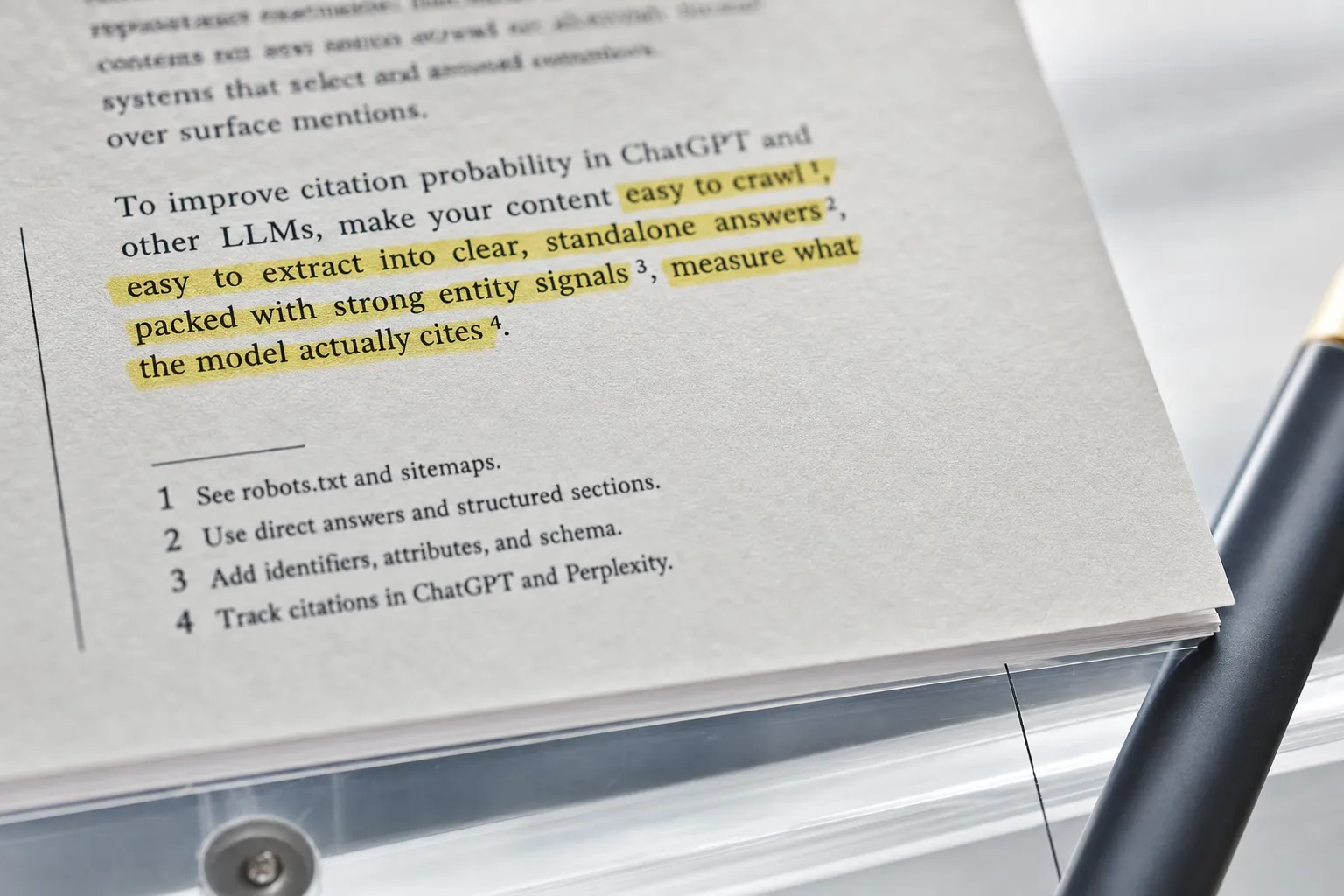
ChatGPT Optimization in 2026: A Working Checklist for Getting Your Brand Cited, Not Just Ranked
How ChatGPT retrieves and cites sources in July 2026, with a sourced Generative Engine Optimization checklist covering crawler access, extractable answers, entity signals, and measurement.
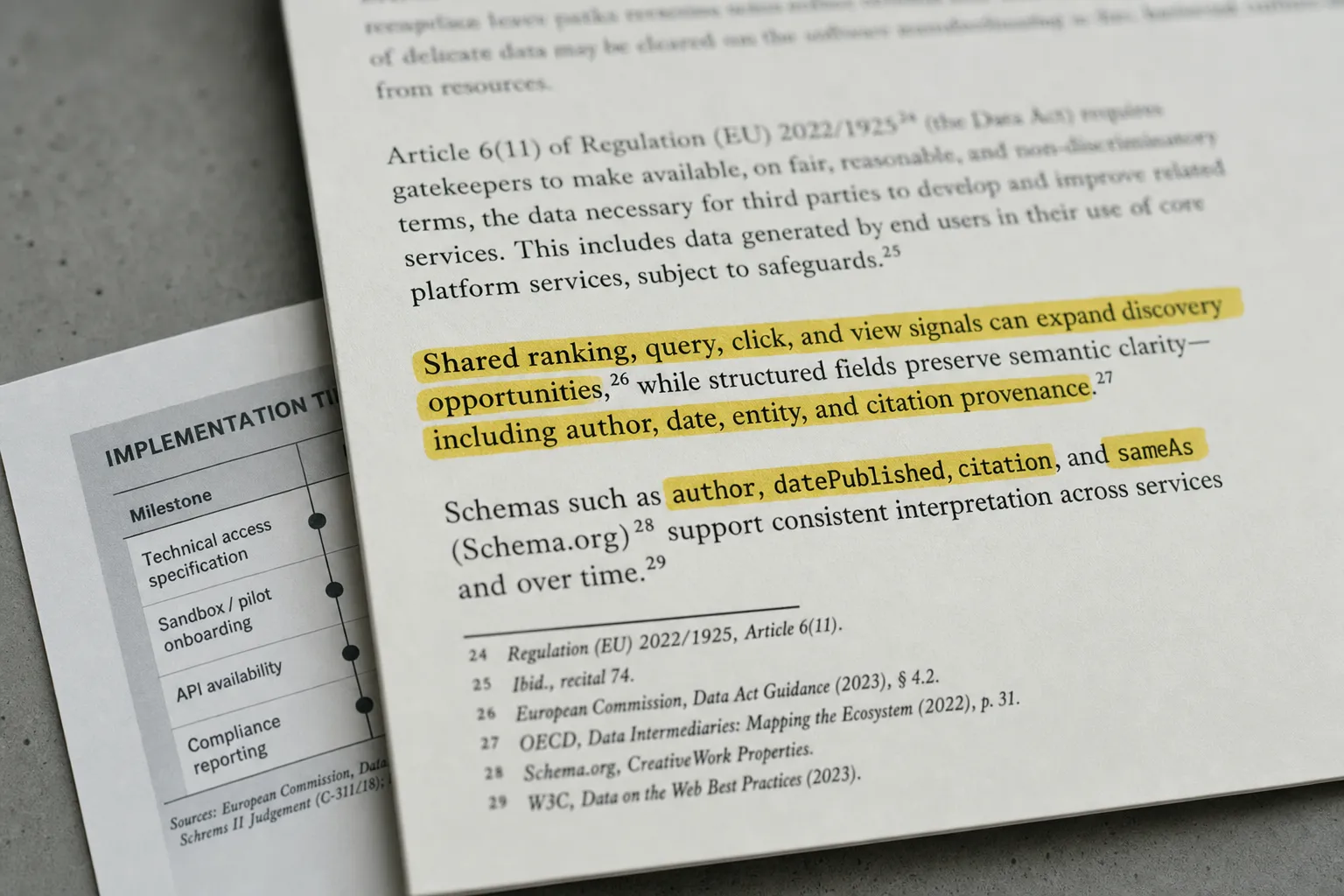
The EU Wants Google to Open Up Search Data to Rival AI Engines
EU plans to open Google Search data to rival AI engines. Learn why Structured Data—not raw click logs—will determine who can retrieve and cite the web.